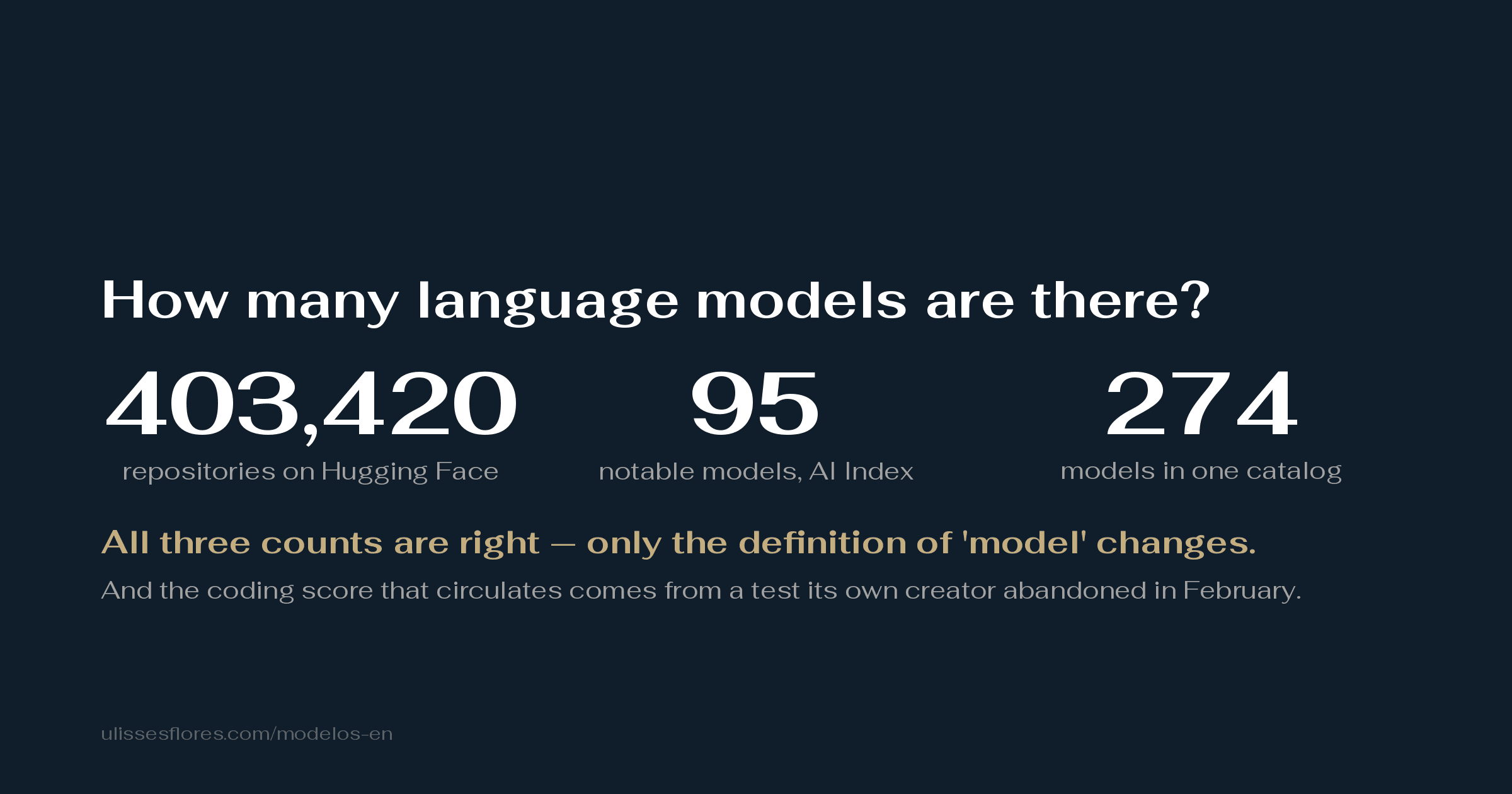
Three counts of "how many language models exist" — 274, 95, and 403,420 — are all correct, and the gap between them is nobody's mistake: it is the definition of "model." I went to check the LLM (large language model, the technology behind ChatGPT, Claude, and the others) statistics that circulate in 2026 roundups, and found a bigger problem than the count: the coding benchmark that serves as the ruler for "who leads" was declared contaminated by its own creator in February, which then stopped publishing the score — and six months later it is still the ruler.
The ruler that came out of the fact-check fits into two questions. "Model according to whom?" settles the count. "Score given by whom, for which version, on a test that still measures anything?" settles the scoreboard. No number in this article is false. Almost all of them change weight once the label comes with it.
Methodological note. Every number was checked against the original source — the model card (the technical page a lab publishes alongside a model), a PDF, a paper, an official pricing page, or a public API — on August 26, 2026. Three measurements are mine and reproducible: the repository count on Hugging Face (the command is at the end of the article), a full read of the Vals AI table (86 models, extracted from the page's HTML, not the summary), and a seven-provider pricing table read from official pages. Where a source exists only as an archived copy (OpenAI blocks automated reading), the text says "Wayback." A first automated extraction of xAI's prices came back fabricated and was discarded — that episode is in the pricing section, because it is the reason price only enters this article from an official page read by a human. There is no Reddit or X in this article: the community source is Hacker News, where every comment has an id.
The fact-check scoreboard
The verdict before the argument, because that is what circulates on its own. "What circulates" is what LLM-statistics roundups repeat in 2026 — the German page that prompted this piece is the most complete example I found, with 274 models catalogued and 235 links.
| What circulates | Verdict |
|---|---|
| "There are 274 LLMs, from 35 vendors" | ⚠️ It is one site's catalog. Hugging Face has 403,420 repositories with the tag; Stanford's AI Index counts 95 "notable" models in 2025. Three definitions, three numbers |
| "Claude Fable 5 leads in coding with 95.0% on SWE-bench Verified" | ⚠️ 95.0% checks out in Anthropic's System Card (average of 5 attempts). It does not lead: in the same table Mythos 5 scores 95.5%, and in the independent evaluation Opus 5 scores 97.0% |
| "DeepSeek-V4-Pro: 80.6%, about 8 points behind Opus 4.8" | ❌ 80.6% is the score of the April version. The current version (0813) measures 96.4% in the independent evaluator — 8 points ahead of Opus 4.8. And the new version's model card does not even publish this metric |
| "GPT-5.5: 82.6% on Vals-AI-Harness" | ✅ 82.6% checks out (Vals AI, 08/19/2026). But "Vals-AI-Harness" is not a benchmark: it is SWE-bench Verified run by Vals — and, in the same table, 82.6% sits 14.4 points behind the leader |
| "GPT-5.5 Pro is the most expensive: US$ 30 per million input tokens" | ❌ o1-pro, still for sale, costs US$ 150 — five times more. The "factor of 600" between the cheapest and the most expensive is, in the real catalog, a factor of 3,000 |
| "OpenAI maintains 35 models, Anthropic 19, Google 18" | ❌ The same page says 38, 20, and 27 five sections later |
| "AI Index: the US released ~60 notable models in 2025, China ~35; more than 90% come from industry" | ✅ Checks out: 59 and 35; 91.2% |
| "GPT-4 has 1.76 trillion parameters (estimate)" | ⚠️ It never came from OpenAI: the technical report says it does not disclose the size. The number comes from George Hotz and SemiAnalysis (2023). The page links to Wikipedia |
| "Llama 4 Scout and Qwen-Long: 10 million tokens of context" | ⚠️ Checks out with an asterisk: Qwen-Long only reaches 10 million through file upload (pasted text: 1 million); Scout was trained with 256 thousand |
| "Gemini 3.1 Pro: 94.3% on GPQA Diamond; Kimi K3: 93.5%" | ⚠️ 93.5% checks out in Kimi K3's repository (self-report, the lab grading its own model). I could not find 94.3% on any Google page. And in the independent evaluator both have already been surpassed |
| "6 of the top 10 on Chatbot Arena are closed" | ⚠️ In the 08/21/2026 table I found no open-weight model among the top ten (the first clearly open one is 13th; caveat: 10th place is kimi-k3-max, a variant of a model whose base weights are open). And the Arena measures conversational preference, not coding |
| "Kimi K3: 2.8 trillion parameters, 896 experts, open weights on 07/27, US$ 3 / US$ 15" | ✅ Everything checks out in the official model card — and it is missing the cache price (US$ 0.30), ten times lower |
Three check out clean, three are wrong, six exist with the wrong label. Notice that the serious errors are all comparison errors, not number errors: every individual score is in the source the page cites. What exists nowhere is the ruler that authorizes putting two scores side by side.
The ruler: "model according to whom?"
"How many models exist" is the simplest question in the subject and it has no answer — not because data is missing, but because there is too much definition. The figure summarizes the three that show up in the roundups; the rest of the section shows that all three are correct.
Notice the first box. Hugging Face is the public repository where labs and individuals
publish models, and each publication is a "repository." I asked the site's search page how
many repositories carry the text-generation tag (the tag for LLMs): 403,420 at 04:43
on August 26; 403,535 at 11:55 the same day. The number grows while you read, because
it counts everything — every compressed copy, every fine-tune a student ran, every test
version. The most downloaded repository in the batch (24.4 million downloads) is
Qwen3-0.6B, a model too small to appear in any capability ranking.
The second box is the opposite: a hand-built list. Stanford's AI Index uses Epoch AI's database, which flags a model as "notable" for technical advancement, historical importance, or citations — and the report warns, in its own words: "This is a manual curation, so the dataset is not a census of all AI models." By that criterion, 2025 had 93 notable industry models and 2 from academia — 95. In the next figure of the same chapter, which classifies releases by access type, the base count is 102. Same report, two counts, seven models apart — because the cutoffs differ.
The third box is the editorial catalog: someone decides what "counts as a model" for their audience. The German page lists 274, from 35 vendors — and contradicts itself within its own body: in section 2, OpenAI has 35 models, Anthropic 19, and Google 18; in section 7, 38, 20, and 27, and an Alibaba with 42 shows up that section 2 never mentioned. It is not dishonesty; it is what happens when a catalog uses different cutoffs ("active models" in one figure, "the whole history" in the other) and nobody writes the cutoff next to the number.
None of the three counts answers the reader's real question, which is "how many models matter to me" — and only the reader can count that one. What is possible is to show the same vendor under all three definitions, so the size of the gap becomes visible.
Notice OpenAI: 5 repositories, 20 notable models, 38 in the catalog — the same
company, the same year. On Hugging Face it barely exists (it only published the open
gpt-oss models), and Anthropic does not exist at all: zero repositories, because no
Claude model has published weights. In Epoch AI's curation the order flips: OpenAI
released the most notable models in 2025, followed by Google (14) and Alibaba (11). And in
the editorial catalog Alibaba leads, because the editor decided to list every Qwen
variant. The sentence "company X has more models" means nothing without the definition
next to it — and the three definitions flip the podium each time.
Score given by whom: the coding test its creator abandoned
Every 2026 roundup has a "who is the best coder" section, and the ruler is always the same: SWE-bench Verified, a benchmark (a standardized test that scores a model) with 500 real problems pulled from open-source code repositories — the model gets a bug description and has to fix it; an automated test suite says whether it got it right. The German page publishes four scores: Claude Fable 5 at 95.0%, Opus 4.8 at 88.6%, DeepSeek-V4-Pro at 80.6%, and Kimi K2.6 at 80.2%, and concludes that DeepSeek is "about 8 points behind." I went after all four. They are all in the cited source. And none of the comparisons holds up, for three stacked reasons.
The first reason is the most serious and the least cited. On February 23, 2026, OpenAI — which had created "Verified" in August 2024, reviewing 1,699 problems from the original SWE-bench with human engineers until 500 were left — published a piece titled "Why SWE-bench Verified no longer measures frontier coding capabilities." Two conclusions, quoted from the original:
"We audited a 27.6% subset of the dataset that models often failed to solve and found that at least 59.4% of the audited problems have flawed test cases that reject functionally correct submissions."
"In our analysis we found that all frontier models we tested were able to reproduce the original, human-written bug fix [...] indicating that all of them have seen at least some of the problems and solutions during training. [...] This is why we have stopped reporting SWE-bench Verified scores, and we recommend that other model developers do so too."
Translating the mechanism for non-programmers: the test uses public problems, with the public solutions sitting right next to them, pulled from the same repositories the labs use to train. The model may have "seen the exam with the answer key" before taking it. OpenAI measured what progress was left — "improving from 74.9% to 80.9% in the last 6 months" — and decided that whatever climbs beyond that measures exposure to the test, not capability. Six months later, the independent evaluator's table shows seven models at 95% or above. The discussion reached Hacker News in April (343 points, 181 comments); the top-voted line sums up the skepticism in one sentence: "Goodhart's Law in reverse, what can't be gamed gets rejected" (comment 47911060). Another reader: "This feels very much like 'we are now moving the goal posts.'" (47910902). Both readings are possible. What is not possible is using, in August, a ruler its own maker withdrew in February without telling the reader.
The practical consequence is already in the model cards: OpenAI no longer publishes the score, and the open labs are migrating away too. In Fable 5's System Card, the "GPT-5.5" column on the SWE-bench Verified row shows a dash. In Kimi K2.6's model card, the "GPT-5.4" column, same thing. Kimi K3, Qwen 3.8, and GLM-5.2 no longer report the classic metric — they swapped it for SWE-bench Pro, DeepSWE, FrontierSWE. The only place where everyone is still comparable is an outside evaluator that runs the old test with the same harness (the tool scaffold the model is given to work with) for every model. That is Vals AI, and it is where the second reason shows up.
Notice first what did not change between the gray block and the blue one. The score Anthropic publishes for Fable 5 (95.0%, average of five attempts, in the System Card) is the same one Vals measures from outside; Opus 4.8's too (88.6% in both). DeepSeek publishes 80.6% for the April V4-Pro, in its most expensive reasoning mode; Vals measures the same model at 77.4%. Kimi K2.6: 80.2% against 76.2%. Self-report (the score a lab gives itself) holds up under the check: where the same model was measured by both, the gap sits between zero and four points. That contradicts my starting hypothesis — I expected independent evaluation to knock down the official scores — and the result is published anyway.
What does not hold up is the gold block. The "80.6%" that circulates is from
DeepSeek-V4-Pro Preview, published on April 22; the model card was last updated on
June 22. On August 13 DeepSeek released the definitive version,
DeepSeek-V4-Pro-0813, in a separate repository — and the new model card publishes no
SWE-bench Verified score at all (it uses DeepSWE, Cybergym, and others). The one
measuring 0813 is Vals: 96.4%, second place among 86 models, behind only Opus 5
(97.0%) and ahead of GPT-5.6 Sol, Grok 4.6, and Fable 5 itself. The sentence "DeepSeek is 8
points behind Opus 4.8" compares one's April score with the other's May score; with the
August versions, DeepSeek is 8 points ahead. Neither number is false. The comparison
is.
The third reason is the most mundane: benchmark leadership has a shelf life of weeks. The
German page is dated August 23 and says Fable 5 "leads with 95.0%." In the very System Card
that carries the 95.0%, Mythos 5 scores 95.5%. On Vals, from August 19, Opus 5 scores
97.0%. And the "82.6% on Vals-AI-Harness" from the same page is the only score that comes
from an independent evaluator — with the wrong name ("Vals-AI-Harness" is not a benchmark,
it is Vals running SWE-bench Verified with the mini-swe-agent scaffold, using only the
bash command line) and no context: in the same table, 82.6% sits 14.4 points behind the
leader. I have already written here about how DeepSeek published the table where it
loses 9 to 0 and how Z.ai delayed GLM-5.3's weights and
published what the model thought about it: the labs have been more
honest in their model cards than the coverage that summarizes them.
This section's ruler, in one line: a benchmark score only compares when four fields match — same test, same scaffold, same version, same date. Coverage usually gets the first one right and ignores the other three.
What it costs: the same test, with the column nobody publishes
If the isolated score decides nothing, what does? Vals's table has a column no roundup copies: cost per task, in dollars, for the same test run on the same scaffold. It is the only price comparison that cuts across vendors without depending on how many tokens (the chunks of text a model reads and produces, the billing unit) each one spends to think — because it measures the real spend, at the end of the task.
Notice the two highest points: Opus 5 solves 97.0% of tasks at US$ 1.29 each; DeepSeek-V4-Pro-0813 solves 96.4% at US$ 0.10. Six-tenths of a point costs twelve and a half times the price. And notice the point furthest to the right: Fable 5, at US$ 2.05 per task, solves less than Opus 5 and costs more — the System Card explains that Fable's score "reflects its production safeguards," meaning Anthropic's most expensive model is not the one that scores best on this test. On the cheap side, GPT-5.6 Luna scores 93.0% at four cents, and DeepSeek V4 Flash, 88.8% at one cent — the same score as Opus 4.8, which costs US$ 1.92 per task. I already showed here, measuring 43 thousand calls, that price per token is not cost per task; this table is the same lesson with a different evaluator.
This explains why the "most expensive" and "cheapest" in the roundups almost never match
the real catalog. The German page says prices range from US$ 0.05 (GPT-5 nano) to US$ 30
(GPT-5.5 Pro) per million input tokens — "a factor of 600." In OpenAI's official table,
read on August 26, o1-pro is still for sale at US$ 150 for input and US$ 600 for
output; gpt-5.4-pro costs the same US$ 30 as 5.5 Pro. The real factor between the
cheapest and the most expensive in the catalog is 3,000. And the list price is not
even the price: DeepSeek charges US$ 1.32 per million input tokens for V4-Pro-0813 at peak
hours and US$ 0.66 off-peak, dropping to US$ 0.044 when the request repeats
already-processed text (cache hit, a match found in the cache). Kimi K3 costs US$ 3 at
list price and US$ 0.30 with cache. A single price number per model is an editorial
choice, never a fact.
A parenthesis about method, because it changes what you should trust. While gathering material for this article, a first automated extraction of xAI's pricing page returned a complete, plausible table, with models and values — and fabricated: the real page had one model (Grok 4.6, US$ 2 / US$ 6) and the tool filled in the rest. It was discarded and redone by hand. That is why price only enters this article from an official page read by a human, with a date; any roundup that does not say where it pulled its price from is one step away from the same mistake.
Parameters and context: the giant number always belongs to an open model
After "who leads" comes "who is bigger." Here the pattern flips: the largest published numbers all belong to labs that open their weights (the billions of numbers that make up a model, published for download), and the closed frontier models have no number at all.
Notice the bottom block: four empty bars. That is not missing data from my research; it is data that does not exist. The GPT-4 technical report says, in its own words: "this report contains no further details about the architecture (including model size)" — citing "competitive landscape" and "safety implications." The "1.76 trillion" every roundup repeats was born in June 2023, from a speculation by George Hotz (Comma.ai's founder) — eight models of 220 billion each — and a report from SemiAnalysis, a semiconductor analysis firm. OpenAI never confirmed it nor denied it. The German page marks the number as an estimate, which is correct; and links, as its source, to Wikipedia — which is where the rumor was compiled.
In the top block, the numbers are real and checked model card by model card, with a nuance the roundups omit: almost all of them are MoE (mixture of experts — the model has many blocks and uses only a few at a time). Kimi K3 has 2.8 trillion parameters total, but activates 16 of 896 experts per token: 104 billion working at any given moment, 3.7% of the total. DeepSeek-V4-Pro: 1.6 trillion total, 49 billion active. Comparing "2.8 trillion" with GPT-3 2020's 175 billion — which used all of them at once — is comparing the size of the building to the number of lit rooms.
The context window (how much text a model can read at once) has the same trap. The page says Llama 4 Scout and Qwen-Long "lead with 10 million tokens" — about thirty volumes of Harry Potter. Both numbers are in the official sources. Meta also says Scout was trained with 256 thousand tokens of context and reaches 10 million through length generalization (an extrapolation technique, not the training regime). Alibaba says Qwen-Long only reaches 10 million through file upload with reference by identifier; text pasted directly into the message caps at 1 million. And Kimi K3, with the largest parameter count, has a context of 1,048,576 tokens — one million, not ten. I already explained here what the context window costs in memory when a model runs on your own machine; the lesson is the same: the headline number is the theoretical ceiling, and the model card carries the conditions.
Parameters and context are the two statistics where the official number is always the largest possible one — and the footnote is always smaller.
Brazil: the only cost comparison in reais
No international LLM-statistics roundup has a single line about Brazil — the German page has zero. I went looking for what exists in official sources and found more than I expected, with one negative finding in the middle.
Notice that the figure is about cost, not score — and it is the only full-suite cost comparison in national currency that I found in an official source. Maritaca AI, from Campinas, publishes the Sabiá 4 family with prices in reais: R$ 5 per million input tokens and R$ 20 on output for Sabiá 4 (R$ 40 in the Thinking version, which reasons before answering), R$ 1 and R$ 4 for Sabiazinho 4, and 30% more on the "BR-SP" variants, whose "inference and processing run 100% within national territory." The same documentation publishes Sabiá 4's scores on Brazilian exams (97.4% on Brazilian law; 86.6% on the combined ENEM/USP/OAB benchmark — Brazil's national high-school exam, a major university's entrance exam, and the bar exam; a 7.49-out-of-10 score on a legal-brief writing task) and the cost of running the full suite on each competitor: R$ 206 on Sabiá 4 Thinking, R$ 281 on Gemini 3.1 Pro, R$ 449 on GPT-5.4, R$ 590 on Opus 4.8. It is self-report — the company measuring its competitors with its own exams — and it enters here with that label, by the same ruler as the previous section: the score stands as the lab's own claim until someone runs it independently.
The negative finding: there is no project called "BR-LLM," despite the term circulating. What exists, in official sources or in the press, are initiatives with their own names — Sabiá (Maritaca), Amazônia IA (WideLabs, with Oracle and NVIDIA, no published numeric benchmark), and the SoberanIA program (Brazil's Ministry of Science and Technology and the state government of Piauí, December 2025), whose official page served this machine nothing but a CAPTCHA and therefore stays here unverified. And "ChatPetrobras," sometimes cited as a national LLM, is an application for 110 thousand workers built on top of GPT via Azure — a product built on a third party's model, not a model of its own.
On the usage side, Cetic.br measures what the roundups only estimate: 17% of Brazilian businesses with more than 10 employees used AI in 2025 (13% in 2024; 50% among large ones), with "natural language generation" jumping from 20% to 30% — the fastest-growing category, and the one LLMs belong to; among internet users, 32% have already used generative AI, about 50 million people. I already showed here why "50 million Brazilians" is the one people-count that actually counts people; the same warning applies.
Brazil has pricing in reais, exams in Portuguese, and measured usage — what it does not have is a presence in any roundup that circulates.
What I would do with this
Two questions, ten seconds each, before repeating any LLM statistic.
- "Model according to whom?" If the number counts repositories, it measures activity; if it counts "notable" models, it is curation with a published criterion; if it is a catalog, it is an editorial decision. All three are useful. None substitutes for the others — and a "who has more models" ranking without the definition next to it flips the podium depending on the definition.
- "Score given by whom, for which version, on a test that still measures anything?" Lab self-report held up under this article's checking — but it only compares against self-report from the same date, on the same scaffold, of the same version. Two scores from different model cards side by side is the most common error and the most invisible one. And SWE-bench Verified, 2026's default ruler, was withdrawn by its own creator in February: whoever cites it in August should say so.
And one pricing rule: never a single number per model. Input, output, cache, time of day, and version; or, better yet, cost per task measured by someone outside the lab.
If you want to check the easiest measurement in this article, it takes ten seconds:
curl -s "https://huggingface.co/models?pipeline_tag=text-generation" -A "Mozilla/5.0" \
  | grep -o "numTotalItems[^,}]*"
It will give you more than 403,420 — it grew by 115 repositories between 04:43 and 11:55 on August 26. If it gives you less, or if you find a SWE-bench Verified score for DeepSeek-V4-Pro-0813 in any official model card, send it my way: I will update the article and credit the correction.
Sources
- Hugging Face — página de modelos com a etiqueta text-generation —
numTotalItemsmedido em 26/08/2026 (04:43 e 11:55); contagens por organização via?author= - Stanford HAI — AI Index Report 2026, capítulo 1 (Research and Development) — seção 1.1, Figuras 1.1.1, 1.1.4–1.1.6 e 1.1.8–1.1.9; capítulo Technical Performance (3,3% × 0,5%)
- OpenAI — "Introducing SWE-bench Verified", 13/08/2024 e OpenAI — "Why SWE-bench Verified no longer measures frontier coding capabilities", 23/02/2026 — ambos lidos em cópia do Wayback (o site recusa leitura automatizada); discussão no Hacker News, item 47910388
- Vals AI — SWE-bench Verified — tabela "Updated 8/19/2026", 86 modelos, campos
accuracyecost_per_testextraídos do HTML em 26/08/2026; harnessmini-swe-agent - Anthropic — Claude Fable 5 & Claude Mythos 5 System Card (PDF) — Tabela 8.1.A e seção 8.2
- DeepSeek — model card do DeepSeek-V4-Pro (Preview) e DeepSeek-V4-Pro-0813; preços oficiais; relatório técnico arXiv 2606.19348
- Moonshot AI — model card do Kimi K2.6, Kimi K3, repositório do Kimi K3 e preços
- Qwen — model card do Qwen3.8-2.4T-A95B; Alibaba Cloud — Qwen-Long, contexto longo
- Meta — "The Llama 4 herd"; Mistral — Mixtral 8x22B; OpenAI — gpt-oss-120b
- OpenAI — "Language Models are Few-Shot Learners" (GPT-3), arXiv 2005.14165; GPT-4 Technical Report, arXiv 2303.08774 — seção 2
- Preços oficiais lidos em 26/08/2026: OpenAI · Anthropic · Google Gemini · Mistral · xAI
- Arena (ex-LMArena) — leaderboard de texto — 21/08/2026, 7.906.317 votos, 394 modelos; Artificial Analysis — GPQA Diamond
- Maritaca AI — documentação (modelos e benchmarks) e preços; Amazônia IA; Petrobras — ChatPetrobras
- Cetic.br — TIC Empresas 2025 e TIC Domicílios 2025
- Página que motivou a pauta — gradually.ai, "LLM-Statistiken 2026" — inspiração de estrutura; nenhuma frase ou número reaproveitado sem conferência
Verification. Model cards, PDFs, papers, and pricing pages read in full and preserved on 08/26/2026; OpenAI posts via archived copy; the Vals AI table extracted from the HTML served (86 of 86 rows); Hugging Face counts measured by the author. Gemini 3.1 Pro's 94.3% on GPQA Diamond and the SoberanIA page were not checked against an official source and are flagged as such in the text. There is no Reddit or X in this article, due to source unavailability.