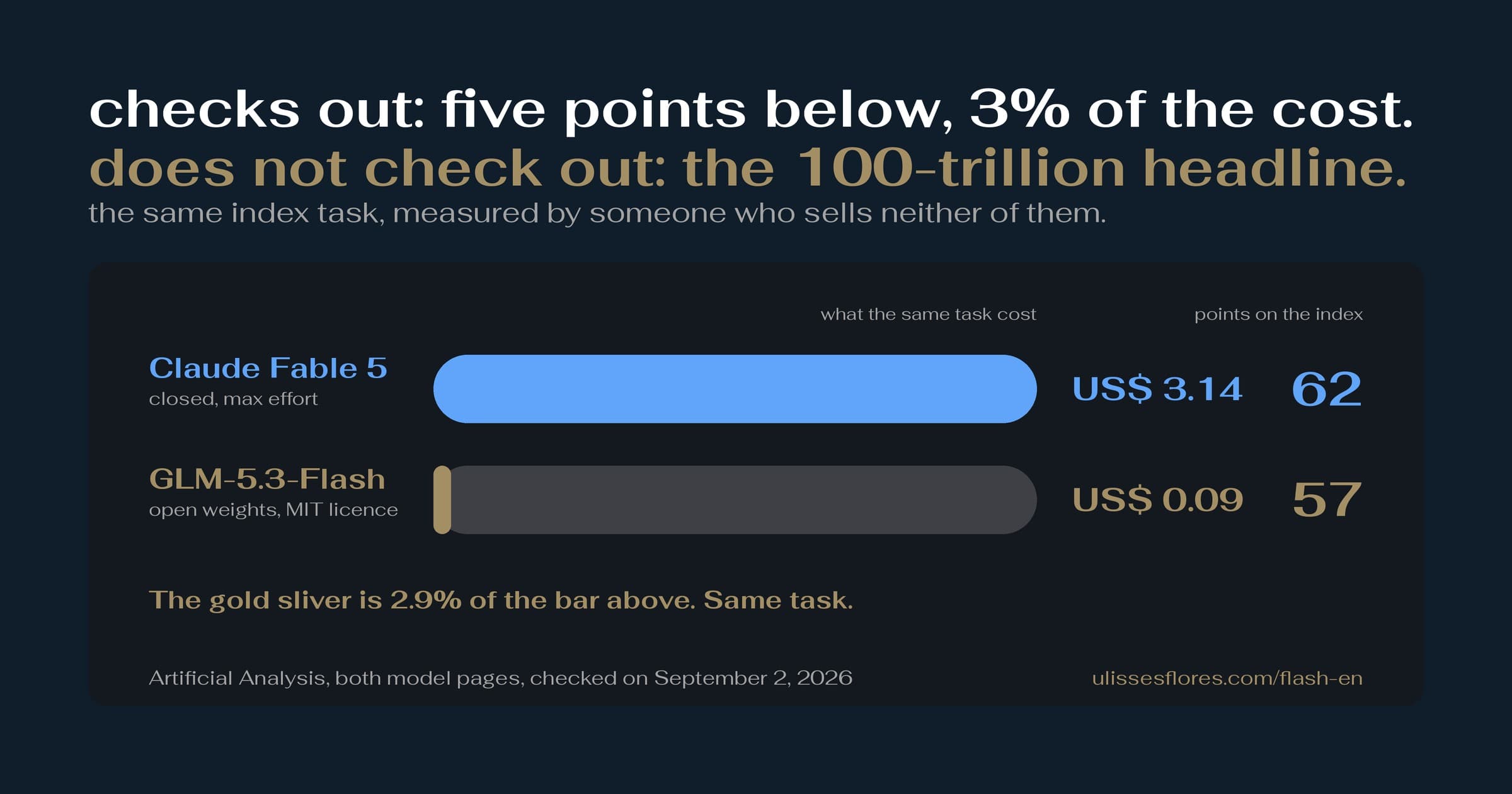
An open-weights model scored 57 on the Artificial Analysis intelligence index where Claude Fable 5 scored 62, and charged US$ 0.09 for the task Fable charged US$ 3.14 for. The four numbers come from an outside measurer, not from the vendor, and I rechecked them today, one by one, on each model's page.
That was not the headline that travelled. The headline was that Z.ai was serving one hundred trillion tokens a day on Chinese chips. I went looking for the original sentence: it exists, it belongs to another company, it is in the wrong tense, and it was about a promotion. The cost checks out; the headline does not. This article separates one from the other.
Methodological note — read this before quoting any number from here. The Artificial Analysis Intelligence Index is an average of several normalized tests. Three caveats that apply to the whole comparison: (1) the Claude Fable 5 page measures the "Adaptive Reasoning, Max Effort, Opus 4.8 Fallback" configuration and the GLM-5.3-Flash page measures the single reasoning variant it publishes — that is not the same effort ruler; (2) an index for a model days old is provisional, and the price feeding the cost per task is the list price, which was on promotion until September 9; (3) dividing 57 by 62 and announcing "92% of the intelligence" is exactly the kind of arithmetic this article exists not to do — the five missing points are the hardest tasks in the set, and a composite index does not license ratios. Here the two axes travel separately: difference in points on one side, ratio of cost on the other.
The scoreboard, before the body
| What circulated | Verdict |
|---|---|
| 320 billion total parameters, 18 billion active, MIT license | ✅ checks out — it is on the official card |
| Index 57 against Claude Fable 5's 62 | ✅ checks out — Artificial Analysis, September 2, 2026 |
| US$ 0.09 against US$ 3.14 per task | ✅ checks out — Artificial Analysis, September 2, 2026 |
| It burns nearly twice the output tokens (150 M against 83 M) | ✅ checks out — and it does not overturn the bill |
| Terminal-Bench 2.1 = 84.3 and Deep-SWE = 63.4 | ⚠️ vendor numbers, with no published harness |
| "Z.ai was serving 100 trillion tokens a day" | ❌ does not check out — the sentence belongs to another company, in another tense |
| "It runs on your machine" | ⚠️ depends on the machine — false on an ordinary laptop, true on a large workstation |
| "First place on GDPval by a wide margin" | ❌ I found no source at all |
| "Cancel your subscriptions" | ❌ it is the second slowest of the six I measured, and it is not the cheapest per task |
The body proves it line by line, in the order a person who has never heard of any of this can follow.
What a task costs, without a single technical word
Two cars are going to the same address. The first knows a shortcut and charges a lot per kilometer. The second takes a much longer way round and charges a pittance per kilometer. Both arrive. The question that matters is not who drove less: it is what the meter read when the door opened.
Notice the inversion in the figure: the longer bar is on the bottom row and the larger fare is on the top one. That is the whole thing. Calling this "cost per task" is merely naming the meter — what you pay for is not the route, it is the arrival. When someone compares two artificial intelligence models by the price of the token (the small chunks of text a model produces, and the unit it is billed in), they are comparing the price of the kilometer. It is the wrong comparison, and it was precisely because of it that I measured 43 thousand real calls to find out who pays for the re-read in an earlier article.
The same two cars, with their real names
Now the same figure, with the measured data. The expensive car is Claude Fable 5. The cheap car is GLM-5.3-Flash, released by the Chinese company Z.ai on August 26, 2026 under an MIT license — 320 billion parameters in total, 18 billion active per token.
Intelligence Index 57 against 62 (Artificial Analysis, September 2, 2026); US$ 0.09 against US$ 3.14 per task on the same set, on the same date. The two threads of this article start there, and anyone can reopen both pages and check. Note what the figure does not say: it does not say Flash has 92% of Fable's intelligence. It says it lands five points lower on a composite index, and that the task costs 2.9% of the price. Those are claims of different natures, and mixing them is the first step of every crooked headline.
It burns nearly twice the tokens — and that is why the bill falls
The obvious objection is that price per token deceives: a talkative model can be cheaper on the price list and dearer on the invoice. It is a good objection, and in this case it is already answered inside the number — because Flash is the talkative one of the two.
The nearly invisible sliver on the bottom row is the whole argument: US$ 0.50 against US$ 50.00 for the same million output tokens — a hundred times less. Flash burned 150 million tokens against Fable's 83 million, one point eight times more, and even so the closed bill for the evaluation was US$ 138.02 against US$ 5,455.22 — thirty-nine times smaller. The gluttony is real, it is measured, and it is swallowed by the difference in tariff before it reaches the invoice.
That answers the price-per-token objection, and only that. It does not answer whether the completed tasks are the same — and that is a question no aggregate index answers for you.
The 100-trillion sentence changed verb and owner in nine days
Now the part that made me write the article. The claim that travelled furthest in this launch was that the model was being served at one hundred trillion tokens a day on Chinese chips. I went looking for the first occurrence of the sentence. It exists, it has a link, and it is not Z.ai's.
It was written by OpenCode — not an AI lab, but the terminal program many people use to talk to these models. And the post was not announcing a feat of engineering: it was announcing a one-week promotion of a still-anonymous model, nicknamed "Ox Alpha", that nobody knew the owner of.
"Ox Alpha (stealth model) is free for the next week — 1M Context — Multi-modal — Zero Data Retention. Generous rate limits, near unlimited usage. We have capacity for 100T tokens per day, lets see what you can do" — @opencode on X, August 20, 2026
Hold on to two words: "have" and "capacity". It is OpenCode talking about its own infrastructure, and it is an offer, not a measurement. On August 22 Techmeme was already repeating the sentence with the qualifier intact — "a stealth model from an unknown AI lab ... and capacity for 100T tokens/day". Nobody yet knew who had built the model.
Over the following nine days, the sentence lost one qualifier at a time.
Read the figure from top to bottom and notice that two things change, not one. The verb changes — from "we have capacity for" (an offer) to "is served" (a measurement). And the subject changes — from OpenCode, a terminal application, to Z.ai, a lab that never said that number. The intermediate links are published and can be read: SemiAnalysis wrote "the 100T tokens per day is served on Chinese chip" in its own thread; Wccftech turned that into a headline with the verb in the gerund; and the-decoder had already written, on August 27, that it was Z.ai that "served 100 trillion tokens a day".
Z.ai's official announcement does not contain the number. What the company did claim, in its launch post, was something else — and that something else is remarkable in its own right: "Previously previewed as Ox Alpha, running entirely on Chinese AI chips". Running a frontier model with no American hardware is the true headline of this launch, and it did not need the inflated number.
What can be said about plausibility, with the premises on the table
I cannot prove the hundred trillion did not happen — nobody can prove such a negative from the outside. Two honest things can be done.
The first is to look at the only public measurement that exists, while declaring what it is. OpenRouter, which is one distribution channel among several, published that Ox Alpha was "the biggest model ever on OpenRouter, processing over 20 trillion tokens in 6 days" — about 3.3 trillion a day. That is not Z.ai's total, it is one channel's, and for that reason it does not support saying "measured X against claimed Y". It supports saying that the largest volume ever recorded by that channel, for a model that was the talk of the week and was free, came in an order of magnitude below the number that circulated.
The second is to size it. One hundred trillion tokens a day, from a single lab, is of the order of what all of Google processes (about 107 trillion a day, from the 3.2 quadrillion a month figure released in May 2026) and somewhere between 55% and 70% of what all of China consumes — the two public estimates of Chinese consumption are 180 and 140 trillion a day. It is not impossible — it is extraordinary, and an extraordinary claim asks for evidence of the same size. implicator.ai recorded the gap in so many words: "none of the serving results has been independently audited". And there is an ambiguity that on its own moves the arithmetic by ten to a hundred times: none of the sources says whether "tokens" are input or output — reading text is cheap and parallelizable, writing text is expensive and serial. Without that word, the number is not verifiable even in principle.
Cost per task is not the only axis, and Flash loses on the others
Here the figure from the analogy comes back, with the same geometry and more data: now it is the six models I was able to verify one by one on Artificial Analysis. The bar is still what you spend; the number is still what you get.
The shortest bar in the figure is not Flash's: it is GPT-5.6 Luna's, which charges five cents per task. Flash delivers five more index points for nearly twice the price per task — which is a defensible trade, but it is a trade, not a victory. And in the right-hand column it gets worse: Flash produces 42.5 tokens per second against Gemini 3.7 Flash's 279.4. More than six times slower for one point more of index.
This is not my observation: it is the criticism Hacker News made first, and it deserved to be in the coverage. One reader put it this way — "Gemini 3.7 flash 56 intel / 0.40 cost / 338 speed. GLM 5.3 flash 57 / 0.09 / 49. I have both ... and see no reason for choosing GLM 5.3 Flash". His numbers do not match exactly the ones I measured today — speed varies by provider and by day — but the direction does, and the direction is what matters.
The same six, now on the chart:
The full table, with the Kimi K3 that did not fit on the chart:
| Model | Index | Cost per task | Speed | Price per 1M (input / output) |
|---|---|---|---|---|
| Claude Fable 5 | 62 | US$ 3.14 | 64.6 tok/s | US$ 10.00 / US$ 50.00 |
| GLM-5.3 | 60 | US$ 0.68 | 69.6 tok/s | US$ 1.40 / US$ 4.40 |
| Kimi K3 | 60 | US$ 0.84 | 37.8 tok/s | US$ 3.00 / US$ 15.00 |
| GLM-5.3-Flash | 57 | US$ 0.09 | 42.5 tok/s | US$ 0.15 / US$ 0.50 |
| Gemini 3.7 Flash | 56 | US$ 0.40 | 279.4 tok/s | US$ 0.75 / US$ 3.75 |
| GPT-5.6 Luna | 52 | US$ 0.05 | 126.4 tok/s | US$ 0.20 / US$ 1.20 |
The GLM-5.3 row deserves a paragraph of its own, because it is the comparison almost nobody made: the big brother, which I covered on August 14, scores 60 points at US$ 0.68 a task. Flash scores 57 at US$ 0.09. Three index points cost seven and a half times more inside the same house. It is the most concrete routing decision this launch offers, and it does not depend on believing any headline.
Where Flash breaks, according to the second measurer
Artificial Analysis is not the only independent ruler. LiveBench has also listed the model, and its portrait is more specific — and more useful:
| Model | Global average | Coding | Instruction following | Cost per task |
|---|---|---|---|---|
| GLM-5.3 | 76.1 | 79.0 | 69.3 | US$ 0.450 |
| GLM-5.3-Flash | 71.6 | 79.0 | 52.8 | US$ 0.031 |
On coding Flash ties squarely with its big brother — 79.0 against 79.0 — and the whole hole is in following instructions: 52.8 against 69.3. If your use is writing code inside a scaffold that already says what to do, the cheap one delivers the same. If your use is a loose agent that has to obey a long contract, those 16.5 points of difference are the bill you will pay in rework. It is the same lesson that showed up here when I demonstrated that the safety score belongs to the pair, not to the model.
And there is a vendor number worth checking carefully: the official card announces 63.4 on Deep-SWE, a rumour of ~80% circulated, and the only complete, independent run of the 113 tasks I could find — by Henry Zhang — came in at 58.4%: "The Rumored ~80% pass rate is completely incorrect. Actual benchmark result is 58.4%". Three numbers for the same test, and the smallest is the only one with a declared procedure.
Open by license, closed in practice: 328 gigabytes
The license is MIT — the most permissive there is, with no sign-up and no gate. That is a real virtue and deserves saying. What "open" does not mean is "fits on your machine".
I downloaded the repository's file list through the Hugging Face API and added it up: 62 weight files, 328.3 gigabytes. That is not an eyeball estimate, it is the sum of the blobs. The community has already published compressed versions — the process is called quantization, and it is the equivalent of recording the same song at fewer bits: it takes up less space and loses a little fidelity.
The honest reading of this figure has two halves, and the coverage gave only one. It is false that it runs "on your computer" if your computer is an ordinary laptop: only the most aggressive compression, at 1 bit, fits into 128 GB. And it is true that it runs on a workstation of 128 to 256 GB — there are people reporting exactly that on Hacker News, one of them saying it is "the first local model that feels good enough to me to be a 'main' model". Saying only the first half would commit the very framing sin this article denounces.
And one installment is missing from every calculation above. The figures are weights only. When I showed how to tell whether a model runs on your card, the error that decided the whole table was exactly this one: the card budgeted the weights and forgot the context cache, which grows as you talk. For Flash, nobody has published that installment. So the correct ruler is: the numbers in the figure are the floor, and the floor already does not fit.
The price was a campaign, and it ended on September 9
Updated on September 11, 2026: the promotion ended on the announced date. This section and figure 8 were moved to the past tense, and Z.ai's pricing page was rechecked that day — the discount line is gone, and the table is back to US$ 0.15 and US$ 0.50 per million tokens.
The last step is the easiest to forget and the one that changes an adopter's decision most.
Z.ai's pricing page said, until September 9, in one line: "GLM-5.3-Flash is available at a 50% discount ... The promotion ends at 24:00 on September 9, 2026 (UTC+8, Singapore time)". Input at US$ 0.075 and output at US$ 0.25 during the promotion; US$ 0.15 and US$ 0.50 since September 10. I rechecked the page on September 11: the discount line is gone, and the table lists Flash at US$ 0.15 input and US$ 0.50 output.
Two caveats the coverage mixed up, and that I mixed up too before checking today:
- This article's cost per task does not depend on the promotion. The US$ 0.09 comes from the full list price, which is what Artificial Analysis used. The promotion ended, and the number did not move. It is whoever was paying half who saw the bill double.
- There is no "free tier" for GLM-5.3-Flash at Z.ai. What the pricing table marks as "Limited-time Free" is the cache storage column, not use of the model. The free use so many people saw was the "Ox Alpha" publicity week on OpenCode and OpenRouter, with the model still anonymous — the same promotion the hundred-trillion sentence came from.
What the check did not reach
This is the piece that usually disappears from launch write-ups, and it is the one worth most.
- I did not test the model in production. It is less than a week old; any claim of mine about "how it behaves in your codebase" would be invention.
- Z.ai's official launch post remains unreadable to me. The address responds, but returns only the shell of the site; the text reader I tried returned the contents of a completely different document. Nothing that depends exclusively on that post made it in here.
- I found no source for "first place on GDPval by a wide margin". I looked; it does not exist anywhere I could reach. It is recorded as an unverified claim.
- I could not cite r/LocalLLaMA. The replies came without attributable author or date, and a quotation without provenance does not get in.
- I did not verify how many chips Z.ai used. The "100 thousand domestic chips" figure that shows up in aggregators has no primary statement I could locate.
- The index is of right now. A model days old tends to move position when the measurer reprocesses. The numbers here carry a date because the date is part of the number.
- A seventh model appeared after the figures closed. On rechecking everything on September 2, 2026, GPT-5.6 Terra started responding on Artificial Analysis: the same index 57 as Flash, at US$ 0.53 a task — nearly six times dearer for the same number, and 2.4 times faster. I did not redo the figures, which are closed on the six I measured one by one; I record it here because the datum reinforces the argument rather than contradicting it, and omitting a finding for arriving late would be the sin this article spends its whole length denouncing. GPT-5.6 Soul, which the video cites, still has no page on the measurer.
What I would do with this
Route by task, not by subscription. The most actionable fact of the launch is not the face-off with Fable 5: it is the face-off with the brother down the hall. Three index points cost seven and a half times more between GLM-5.3 and Flash. If your work is what LiveBench calls coding, the two tie at 79.0 — and you are paying the difference for nothing.
Measure your own "instruction following" before switching. The hole of 52.8 against 69.3 is the most specific warning that exists about this model. Take twenty real tasks from your backlog with long instructions, run them on both, and count how many came back needing correction. That count, not the index, is what decides.
Count speed alongside price. More than six times slower than Gemini 3.7 Flash is people waiting. For an overnight batch it costs nothing; for someone typing and waiting, it costs everything.
September 9 has passed. If you built the budget on the promotional price, it doubled on September 10.
And distrust every sentence that gains a verb along the way. The rule left over from this article is not about Z.ai: it is that "we have capacity for" and "is serving" are different claims, and that the distance between them fits into nine days of reproduction. When an extraordinary number reaches you, go looking for its first occurrence. It is usually three clicks away, and it usually says something else.
Redo the math
Nothing here depends on believing me. The four numbers in the title come from two public pages — artificialanalysis.ai/models/glm-5-3-flash and artificialanalysis.ai/models/claude-fable-5 — and the size of the repository comes from one terminal line:
curl -s 'https://huggingface.co/api/models/zai-org/GLM-5.3-Flash?blobs=true' \
  | python3 -c "import json,sys; d=json.load(sys.stdin); \
    print(sum(f['size'] for f in d['siblings'] if f['rfilename'].endswith('.safetensors'))/1e9, 'GB')"
In plain words: the command asks Hugging Face for the repository's file list and adds up the size of every file holding weights. The result comes out in gigabytes.
If it comes out different from what is written here, send me the result with the date: I will correct the article and credit whoever pointed it out.
Sources
- Independent index: Artificial Analysis — pages for
glm-5-3-flash,claude-fable-5,glm-5-3,kimi-k3,gemini-3-7-flashandgpt-5-6-luna - Second independent ruler: LiveBench
- Weights and official card: huggingface.co/zai-org/GLM-5.3-Flash
- Pricing: docs.z.ai/guides/overview/pricing
- Z.ai's announcement: @Zai_org on X
- The original 100-trillion sentence: @opencode on X · Techmeme, 22/08/2026 · SemiAnalysis · the-decoder · implicator.ai
- One channel's measurement: @OpenRouter on X
- Independent Deep-SWE run: Henry Zhang on X
- Comparison between the two GLMs: Together AI
- Quantizations: Unsloth
- Reception: Hacker News thread
Every index, cost-per-task, speed and price number was checked by me on September 1, 2026 and rechecked on September 2, 2026, on the live pages of Artificial Analysis and Z.ai (Z.ai's pricing page again on September 11, 2026, after the promotion ended); the size of the repository was summed through the Hugging Face API on both dates, with an identical result. Between one check and the other only the speeds moved — they are the measurer's moving average —, and it is the September 2, 2026 reading that is published here. The community quotations were collected on August 30, 2026 and September 1, 2026 and transcribed from the original posts, with a link on each. The dates of the posts in the hundred-trillion chain were not read off the screen: each was derived from the identifier of the post itself, which carries the timestamp — and the five match what the harvest recorded. The date of the Wccftech article (August 26, 2026, 16:01 UTC) was read from the page's own header on September 2, 2026. The LiveBench numbers and the Unsloth quantizations were read from the public pages on September 1, 2026 and rechecked on September 2, 2026, with no change. Z.ai's official launch post was not reachable on any attempt, and nothing in this article depends on it.