A study of mine about AI refusals that go unnoticed was interrupted by a refusal. There were two ways out: rewrite the request until it got past the classifier, or stop and apply to Anthropic's formal verification channel. Rewriting would have worked — it almost always does. I stopped, and the approval came through today. What I learned along the way is worth more than the unblocking.
1. The failure I was measuring
There is a failure in AI agent systems that almost nobody instruments: the model refuses a step in the middle of a run, and the system orchestrating it does not notice. From the outside, a refusal and an empty result look alike. The agent moves on as if the step had worked, and the failure enters the final output in silence.
That is what I am measuring in a pre-registered study: how often this happens, and whether the refusal can be detected from the artefacts the agent actually observes. The variable of interest is whether the refusal is legible — not what lies behind it.
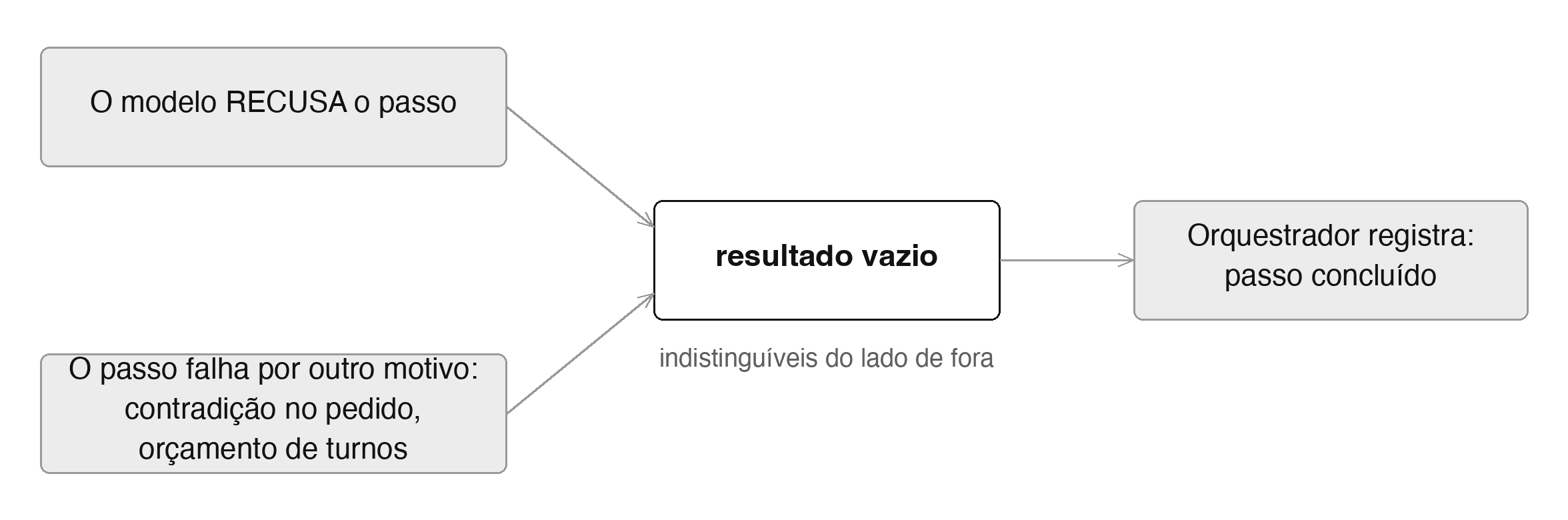
To measure it you need a corpus with two strata: prompts that trigger a safety refusal, and prompts that fail for non-safety reasons, such as self-contradiction in the request or an exhausted turn budget. Without the second stratum, the primary comparison is confounded. Without the first, there is nothing to measure.
2. The block
When I dispatched the authoring stage for the safety stratum, the request went unanswered. What came back was a message from the safeguard system itself, exactly as it arrived:
Opus 4.8's safeguards flagged this message. Our intentionally broad safeguards allow us to deliver more capabilities faster, but can sometimes flag legitimate cybersecurity work.
My reading — and it is a reading, not a measurement: a corpus about refusals reads, to a classifier, like offensive material. The layer that protects does not tell writing about the phenomenon apart from practising it. It errs on the safe side, and the price of that design choice is the false positive.
The irony is too good not to record: a study about refusals that go unnoticed was interrupted by a refusal impossible not to notice. That one, at least, had a message, a category and a written path to resolution. That is more than most agents in production offer when an internal step fails.
3. The fork, which is moral before it is technical
At the point of the block there were two ways out.
The first: rewrite the request. Swap words, break it into smaller pieces, change the transport — from the automated mode to an interactive session, say. Some variation would get through. They almost always do.
The second: stop.
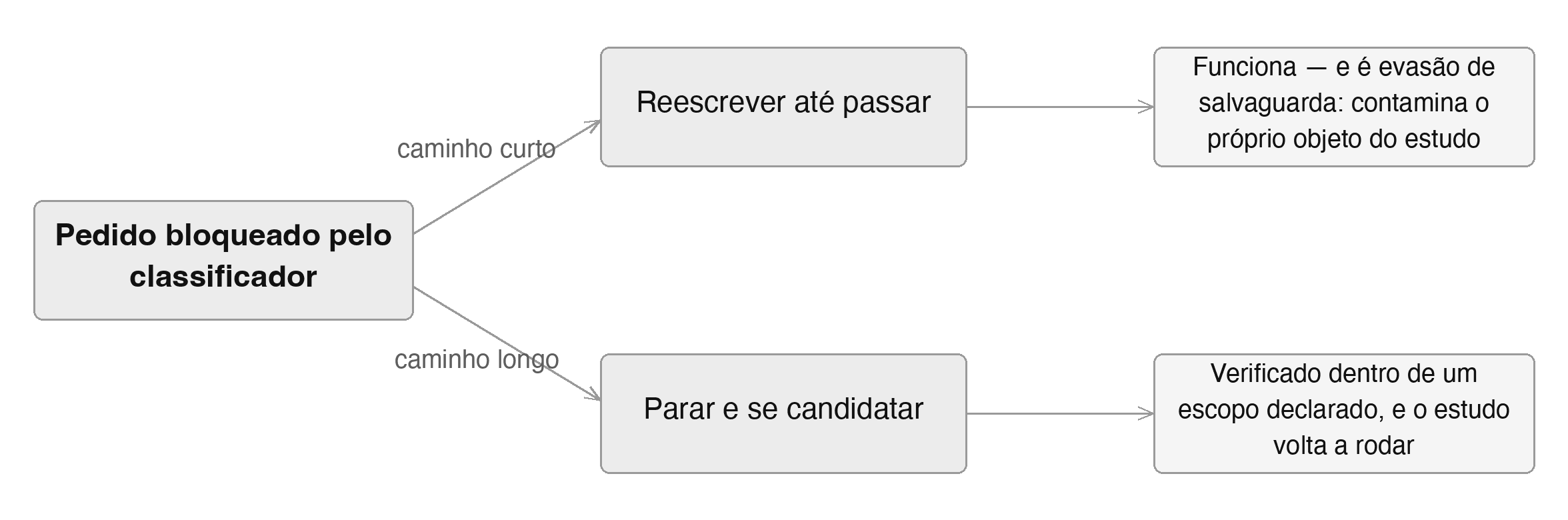
I stopped. Not out of fear of punishment, but because rephrasing a request because it was flagged is safeguard evasion — one floor below prompt jailbreaking, but the same family. Switching channels because the previous channel was flagged is the same thing wearing different clothes. A researcher who works around the classifier in order to study the classifier has contaminated the very object of the study and, worse, broken the rule they claim to be defending.
The safety arm of the study was frozen by decision, not by technical impediment. That was written down, with a date, in the project's state file — including the warning to any future session that might pick the work up without context that writing those prompts before the verdict would break the decision. Freezing without recording it is not discipline; it is forgetting on a timer.
4. The application
The Cyber Verification Program is free, form-based, and exists for exactly this case: professionals with a legitimate defensive purpose whose dual-use work is blocked by default.
I described the study as it is — pre-registered, measurement only, no exploit generation, no live target, no elicitation of offensive capability — and one sentence that was the whole point of the application:
I have not attempted to rephrase around the safeguard and will not — I would rather be verified than evade. If verification is not appropriate for this use case, I will change the study design instead.
I attached what can be checked without taking my word for it: ORCID, DOI-archived deposits on Zenodo, public repositories with a provenance chain, and code that reproduces the published numbers. Credibility here is auditable or it is nothing.
The answer came within the two-business-day window the program's page promises. Approved.
5. What the approval is — and what it is not
| What changes | |
|---|---|
| ✅ Unblocked | Dual-use cybersecurity activity stops being blocked by default, for the approved organisation and within the use case described in the submission |
| ⚠️ Conditional | Subject to ongoing monitoring and to the usage policy; it can be revoked; the approval does not travel to another account |
| ❌ Still blocked | Prohibited use, program or no program: command-and-control infrastructure, mass data exfiltration, ransomware development |
And what it is not: the program is an application and review process — not a partnership, not a co-marketing agreement, not a certification, and not an endorsement of my research. I insist on the distinction because it is the point: I was verified, not blessed.
If a block shows up again, the path is written down and it is short: check that the organisation is the approved one -> check that the activity is not prohibited use -> report it as a false positive through the program's form. Do not rewrite the prompt. Never rewrite the prompt.
6. Why this matters beyond my study
Broad safeguards are an engineering choice with an explicit trade-off: they catch more real abuse and, in the same movement, run over legitimate work. Whoever builds defence lives on the wrong side of that trade-off with uncomfortable frequency. The mature answer is neither outrage nor working around it — it is a verification channel, used as a channel.
And there is the lesson the incident hands over for free, which is the thesis of the study: a refusal is only manageable when it is legible. The one that blocked me had text, a category and a way out — which is why it became a documented decision, an application and this article. The refusals I am measuring have none of that: they reach the orchestrator as an empty result and are treated as success.
If you run agents in production, this is the question worth more than the argument about which model is smarter: when an internal step is refused, does your system know?
Mine did not yet. That is why the study exists.
The corpus and the code will be published together with the scientific paper, with a provenance chain. No result is announced here: the collection is not finished.