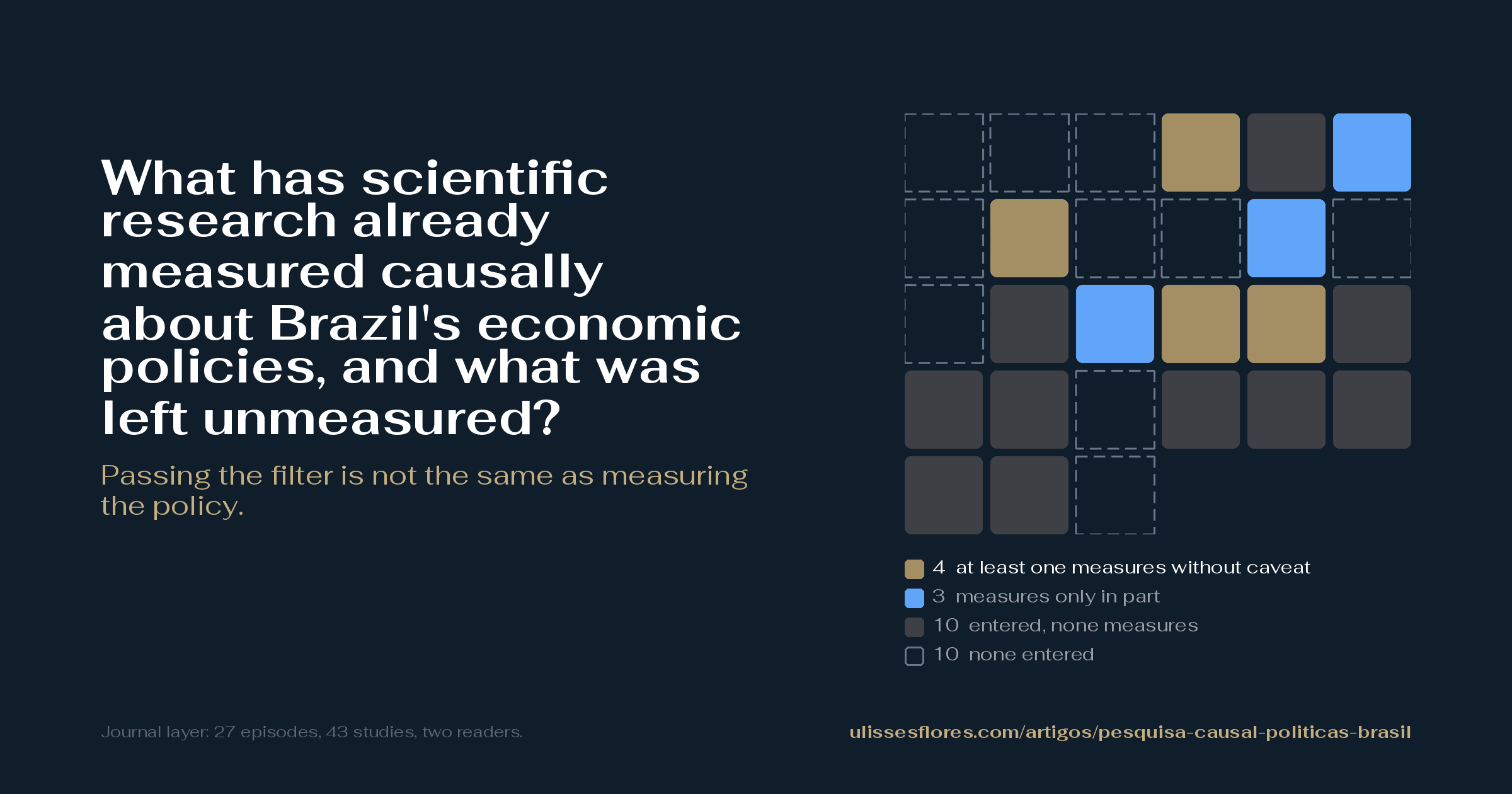
Of the 27 economic policy decisions I gathered since the Real Plan (the stabilization plan that created the real currency), the filter of scientific journals found no study at all for 10. For another 10 it found studies, but none measures the policy. Only 7 have one that does, and in just 4 it measures without caveat: Bolsa Família (cash transfers), Minha Casa Minha Vida (housing), Auxílio Emergencial (pandemic cash aid) and deforestation.
That filter catches journals in the top quartile (Q1) of the SJR (SCImago Journal Rank, a journal ranking). I went to check what lies outside it: working papers from institutions such as the Central Bank add little, and the exception without caveat is Lava Jato (Car Wash), with a study that measured a drop in employment at the investigated firms. Zero in this filter is not zero in the literature.
Federal government cards and travel, in the terms with data, come to between 0.0661% and 0.1474% of primary spending, which is everything the Union (Brazil's federal government) spends in a year, apart from interest: INSS (social security) benefits, payroll, health, education, transfers to states and municipalities, investment. Primary spending is not travel spending. None of this says who governed better. I took up that other question in which government was Brazil's best.
Without the second dish, what you see is the taste, not the effect of the salt
Two dishes of rice, the same pot, the same fire. One with salt. The other with none. Tasting only the first tells you the rice is salty. It does not tell you what the salt did. The second dish is what would have happened. The effect of the policy is the difference from the path not taken.
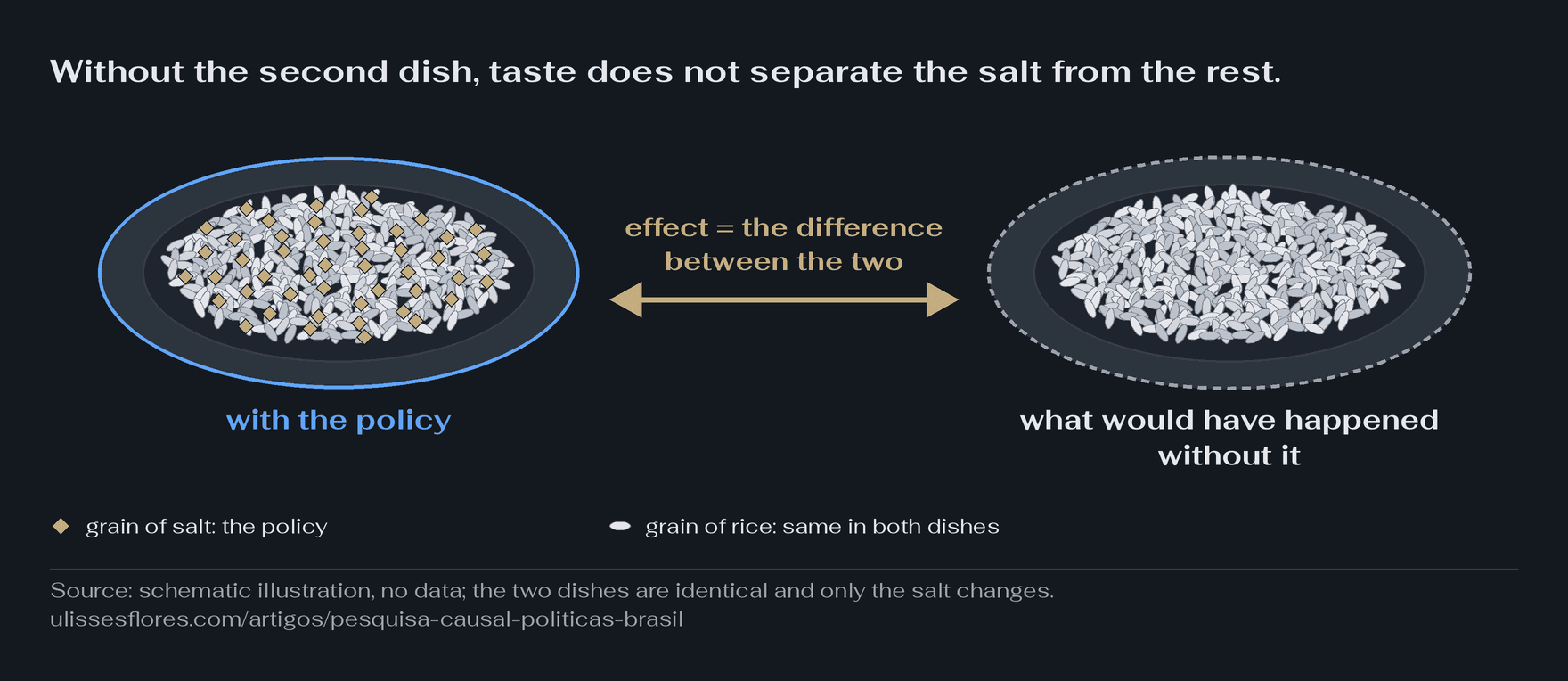
Look at the dish without salt: it is the comparison.
The four levels are not equivalent, and describing the dish is not measuring the salt
The scale was written before the reading. What counts is what the abstract describes, not the isolated word. Level 1, identification by design: the rule allocates who received the policy. Level 2, observation with adjustment: nobody drew lots; similar cases are compared. Level 3: a model simulates the dish nobody saw. Level 4: the dish served is described. I is indeterminate.
Level 1. Rural credit and deforestation, 2019, in part, improves. "Difference-in-differences estimations based on a panel of municipalities show that the policy change led to a substantial reduction in deforestation, mostly in municipalities where cattle ranching is the leading economic activity." Difference-in-differences compares the change among those who were hit with the change among those who were not. A panel is the same municipality over time.
Level 2. Conservation and prices, 2015, in part, improves. "After controlling for price effects, we find that conservation policies implemented beginning in 2004 and 2008 significantly contributed to the curbing of deforestation."
Level 3. Pensions, 2025, in part, improves. "Calibrated to Brazil, the model shows that unifying pension systems and raising the minimum retirement age reduce the pension deficit by nearly 40 percent, while increasing output, capital accumulation, and welfare, despite redistributive effects across age groups, sectors, and along the transition path." To calibrate is to fit the model to the country's numbers. The nearly 40 percent is the model's own sentence.
Level 4. Indigenous lands and mining, 2025, in part, improves. The readers left the study on the weakest rung. "The results indicate that ILs are effective in avoiding mining-induced deforestation, preventing the accumulated deforestation of approximately 25 million hectares between 2004 and 2019." IL is indigenous land.
Of the 43 journal studies: 12 at level 1, 9 at 2, 6 at 3 and 16 at 4. Of the 24 working papers: 2, 3, 7 and 12. In the exploratory search, 11 studies: 1, 2, none at 3, 7 at level 4 and 1 indeterminate. Studies that do not measure the episode's policy are in there. Level is not, by itself, that measure.
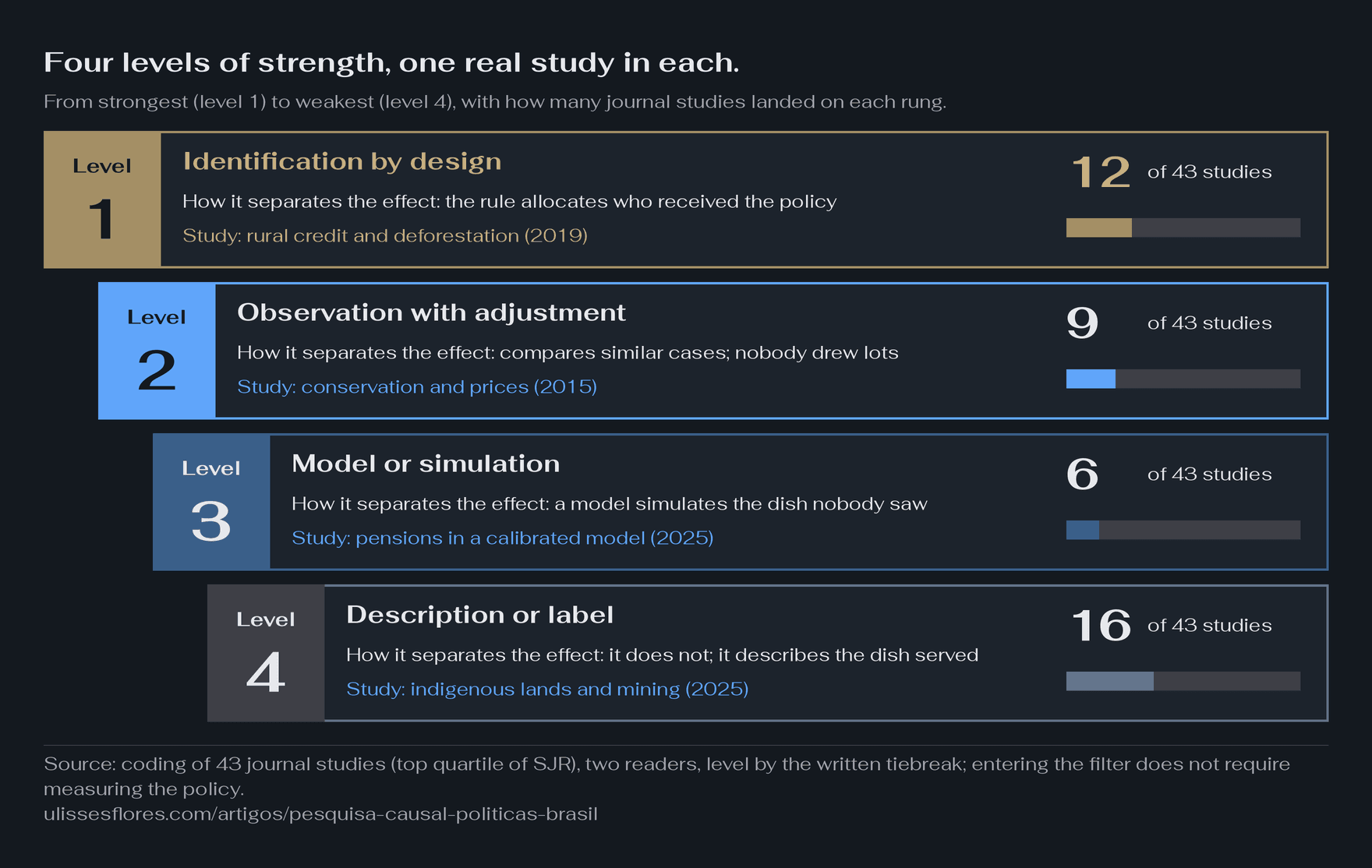
Note: a strong sentence does not move a study up a rung.
Methodological note. Three layers, never added together. Peer-reviewed journals: other researchers read the text before it is published. That is 43 studies from the top quartile of SJR 2024, with a DOI (permanent identifier), Brazil in the title or abstract and a method word in the abstract, across 27 episodes. Working papers: texts from the Central Bank of Brazil, the BIS (Bank for International Settlements), the IMF (International Monetary Fund) or Ipea (Institute for Applied Economic Research), in OpenAlex (an open catalog), without journal review, at most 5 per episode. That is 24. Exploratory search: the same kind of text, with no institution filter, done afterwards, only for Pix (the instant-payment system), Central Bank autonomy and operating costs. That is 11.
Two readers, Grok and Gemini, one study at a time, without seeing each other's output. Tiebreak written in advance: level goes to the larger number, the weaker one; "measures the episode", to the more conservative reading; a direction that does not match is marked discordant. Entering does not require measuring the policy. The titles were read before the rule closed, and that is stated in the amendment that records it.
Kappa measures the agreement between the two readers beyond chance. The most fragile reading is whether the study measures the policy of the episode, and for it the more conservative value stands.
On level, 43 is the number of studies. On "measures the episode", 47 counts each study-episode pair, because the same study can count for two. A 2008 profile of Alice Amsden entered under commodities and autonomy and measures neither. The word was counterfactual (what would have happened).
| Layer | Question | Readings | Agreement | Kappa |
|---|---|---|---|---|
| Journals | Level | 43 | 93.0% | 0.90 |
| Journals | Measures the episode | 47 | 70.2% | 0.50 |
| Journals | Direction | 43 | 79.1% | 0.65 |
| Working papers | Level | 20 | 90.0% | 0.80 |
| Working papers | Measures the episode | 29 | 69.0% | 0.29 |
| Working papers | Direction | 24 | 75.0% | 0.45 |
| Exploratory search | Level | 10 | 90.0% | 0.91 |
| Exploratory search | Measures the episode | 11 | 45.5% | 0.15 |
| Exploratory search | Direction | 11 | 90.9% | 0.87 |
| What is claimed | Verdict |
|---|---|
| In the journals, 7 of 27 episodes have some study that measures the policy | ✅ |
| In 4 of those 7, the study measures without caveat: Bolsa Família, Minha Casa Minha Vida, Auxílio Emergencial and deforestation | ✅ |
| Of the 27, 10 have no study that passed the filter | ✅ |
| In the working papers, Lava Jato has one study that measures without caveat | ✅ |
| Some journal study in the filter measures Pix or Central Bank autonomy | ❌ |
| The ratio of operating cost, in the terms with data, runs from 0.0661% to 0.1474% of primary spending | ✅ |
| This tally ranks a government or a head of government | ❌ |
In the journals, 7 of 27 episodes have a study that measures the policy; 4 without caveat; 10 with no study
The 7: Bolsa Família, commodities, Minha Casa Minha Vida, the 2014-16 recession, pensions, Auxílio Emergencial and deforestation. The 4 without caveat: Bolsa Família, Minha Casa Minha Vida, Auxílio Emergencial and deforestation. The 10 with zero: Real Plan, inflation targets, the Fiscal Responsibility Law, the 2008 crisis, subsidized BNDES (the national development bank) lending, tax breaks, Lava Jato, the spending cap, external debt and judicial independence. Another 10 got a study and none measures. Seven, ten and ten make 27. The 28th, cards and travel, has zero in the journals.
Zero in this filter is not zero in the literature. Left out are Ipea discussion papers, Brazilian journals and working papers.
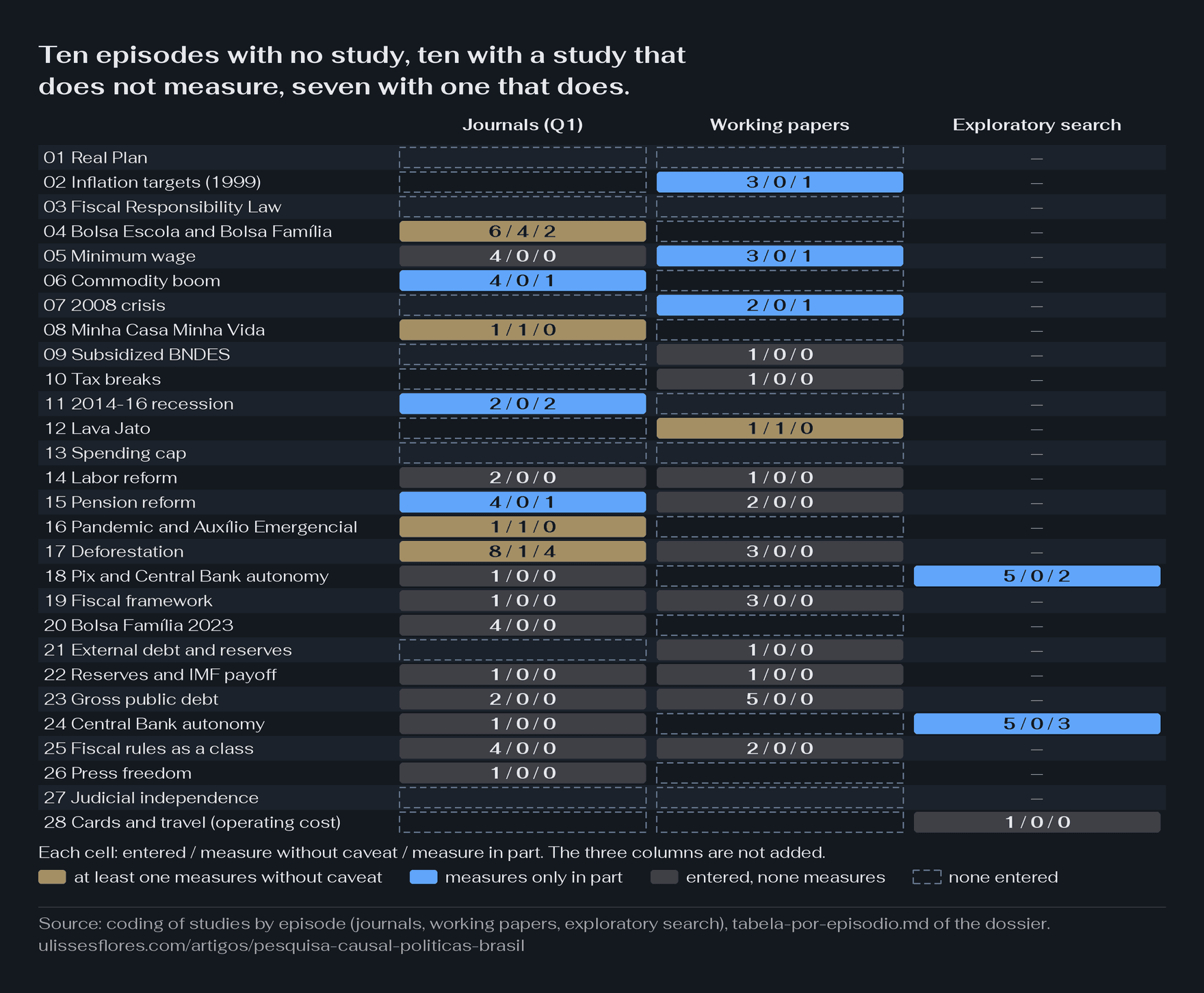
Note: the three columns are not added.
In the working papers, there is a measure in four episodes: inflation targets, minimum wage and the 2008 crisis, in part; Lava Jato, without caveat. The exploratory search looked at three. Pix: 5 entered, 2 measure in part, none without caveat. Autonomy: 5 entered, 3 in part, none without caveat. Operating cost: 1 entered and does not measure.
Measuring without caveat is not the same as finding improvement
Of the 43 journal studies, the final direction is 9 improves, 9 discordant, 3 mixed, 1 worsens and 21 not applicable. Not applicable: it entered and gives no signal about the policy. Of the 24 working papers: 15 not applicable, 6 discordant, 2 worsen and 1 improves. That improvement is a 2005 text on inflation expectations, level 4, with an empty abstract sentence. In the exploratory search, 11 studies: 5 not applicable, 2 improve, 1 worsens, 1 null, 1 mixed and 1 discordant. The lines do not add up.
Bolsa Família, journals: 6 entered, 4 measure without caveat, 2 in part. School, 2015, level 2, discordant. "Weak aggregate effects mask considerable heterogeneity." The same abstract records few significant impacts among boys. Of the 4 without caveat, the ones from 2020 and 2022 are protocols: they describe the calculation, and the direction is not applicable. Tuberculosis, 2018, level 2, improves. Food, 2016, in part, level 2, improves.
Deforestation: 8 entered, 1 without caveat, 4 in part. The one without caveat is from 2026, level 1, mixed. Rural credit and the 2004 and 2008 conservation policies are on rungs 1 and 2: in part, improves.
Minha Casa Minha Vida: 1 entered, without caveat, level 1, improves, municipalities from 2005 to 2019. "Results indicate that treated municipalities experienced significant economic gains, with per capita GDP increasing by approximately 7.7% and formal wages rising by 5.6%." GDP per capita is output divided by population.
Auxílio Emergencial: 1 entered, without caveat, level 1, mixed. "Using data from an online survey, our results suggest that eligibility to the emergency cash transfer led to a reduced likelihood of individuals contracting COVID-19, likely to have been driven by a reduction in working hours." The same abstract also records greater perceived severity and worsened misconceptions.
Lava Jato: no journal in this filter. Working paper from 2025, without caveat, level 1, worsens. "Using a difference-in-differences analysis of unique, matched firm-bank data, we find sizable declines in employment and wage bills for investigated firms, alongside reduced access to credit." The sentence is about the investigated firms. It is not this article's.
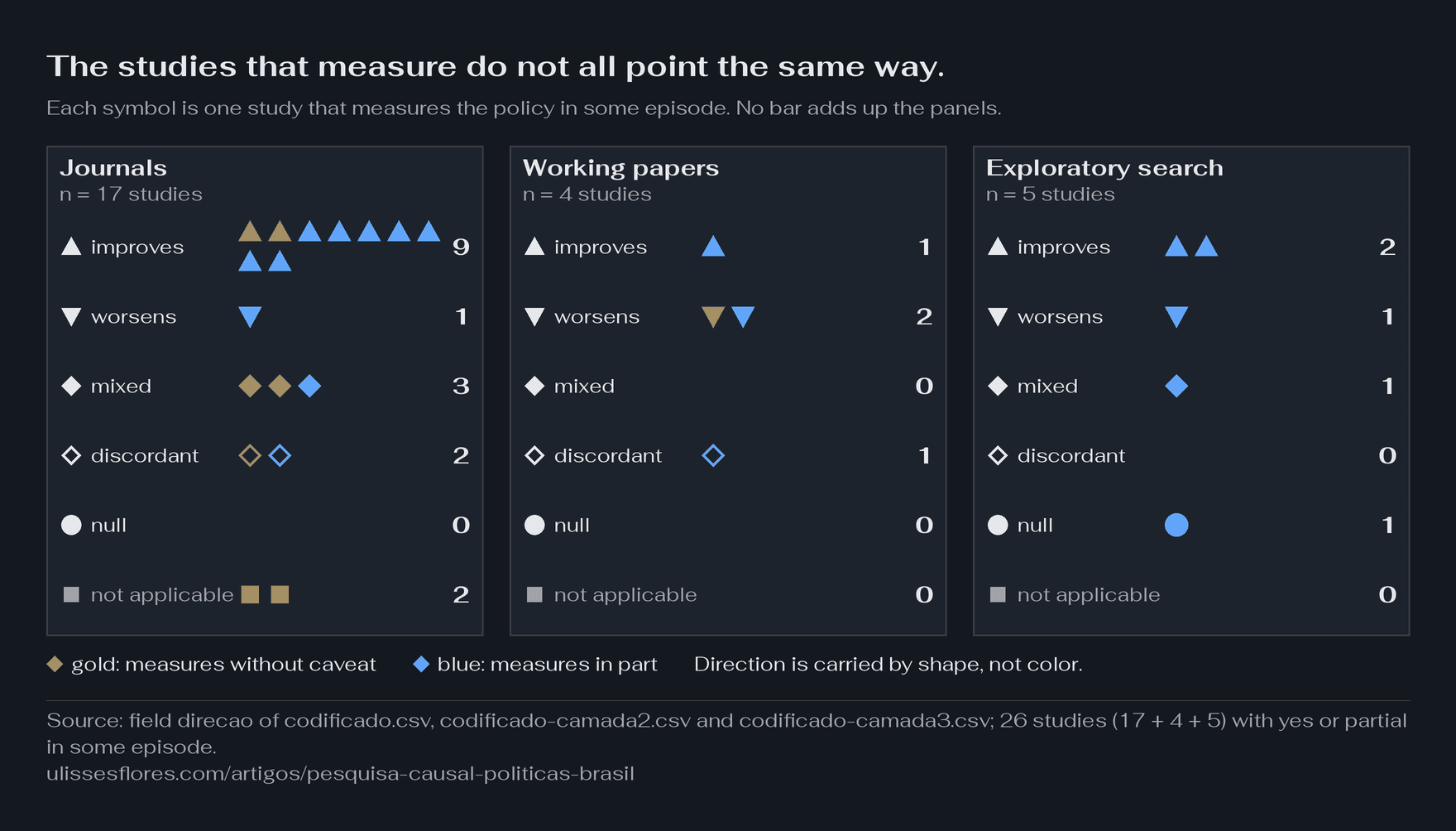
Note the mixed and the discordant: the sign changes by group, or the readers do not agree on the direction.
A method word in the abstract gets a study in, and does not make it measure the policy
Minimum wage, since 2005: 4 journal studies, none measures. They got in through calibrated or randomized: dental trauma in children with cerebral palsy (2015), malocclusion in schoolchildren (2012) and the Pelotas birth cohorts of 2004 and 2015, published in 2010 and 2017. A cohort is a group followed from birth. Dentistry and cohorts are not the minimum wage.
On Pix, the journal that got in and does not measure is from 2025, on climate and supply chains. The words were causal effects and difference-in-differences. It is about neither fraud nor payment. The cap of 5, by OpenAlex relevance, caught noise, including a betting page, and left out a more fitting study. The exploratory search, with no institution filter, came afterwards.
The spending cap goes in as a decision of Congress, even though the proposal came from the Executive
The decider is whoever held the power under the rule, not whoever had the idea. There are 124 rows, for the 28 episodes. Four of them were left without a verified basis: I did not find a primary rule to support the claim, and without a basis I do not assert it.
The 2016 cap is Congress alone, under Constitutional Amendment 95. The 2019 pension reform is also Congress alone. On inflation targets, the Central Bank row is without a verified basis; the Executive's has a basis, and Congress does not appear. On reserves and the IMF payoff, the Executive-and-Central-Bank row is without a verified basis. On the pandemic and press freedom, the Judiciary row too.
States and municipalities are in the rule of Bolsa Família, Lava Jato, the pandemic and deforestation. The world, as an outside shock, is in commodities, the 2008 crisis and the pandemic. This is power to decide, not effect.
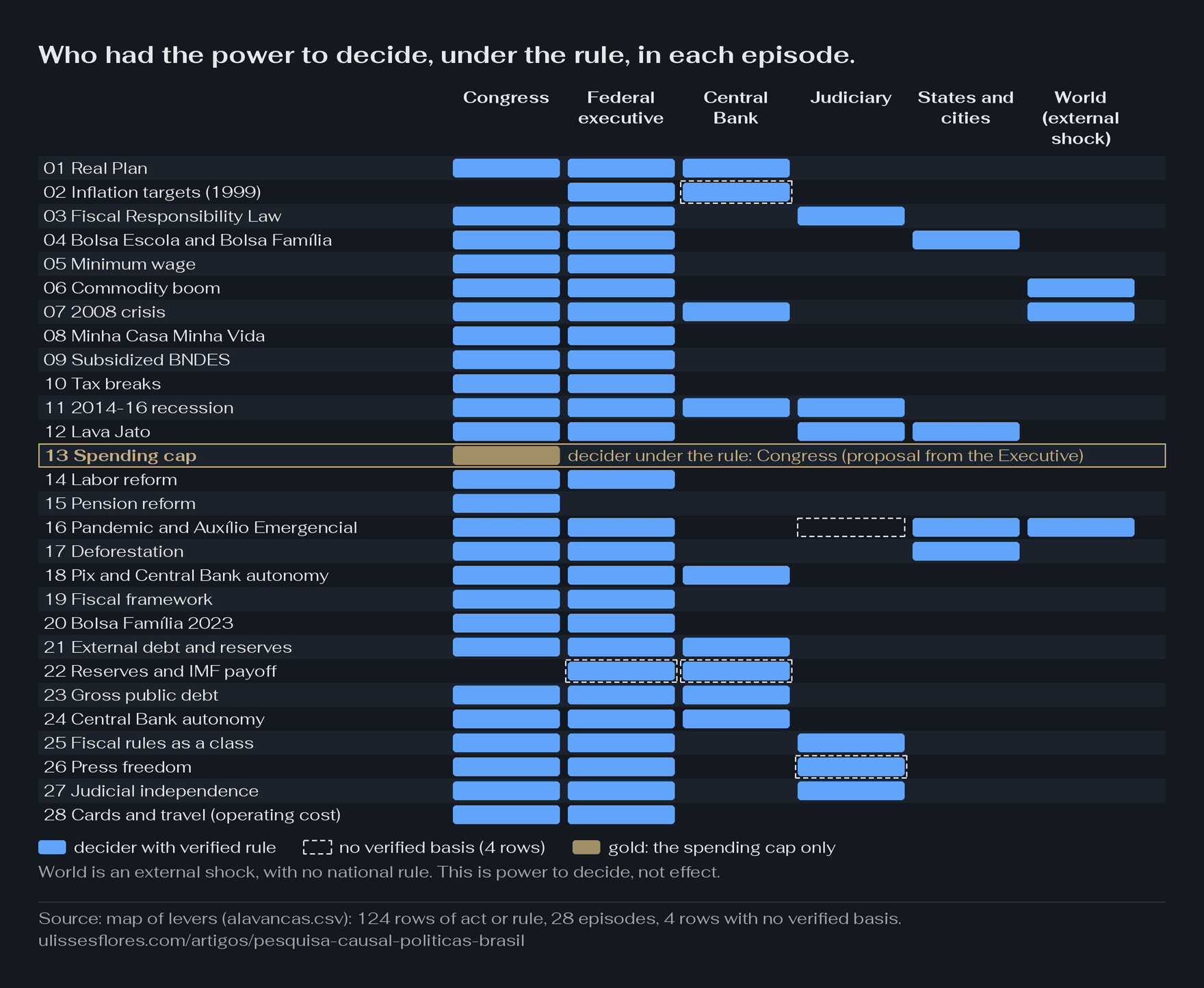
Note the cap: the proposal and the rule do not land in the same cell.
No journal study in the filter measures Pix or Central Bank autonomy
Before the search, the editor recorded: Pix and Central Bank autonomy are good policies. This article neither asserts nor tests the hypothesis.
In the journals, the two share one episode (2020-21), and autonomy has another: de facto since the 1999 targets and de jure through Complementary Law 179, of 2021. In both, there is a study that got in and none that measures. Working papers: zero.
What there is comes from the exploratory search, all in part. Pix, one text with no DOI in the record, level 1, improves: "We find evidence that Pix increases the usage of the four most common payment technologies in Brazil among individuals and firms." Another, from 2024, level 4, also improves.
Autonomy. Text from 2010, level 4, worsens, already in Portuguese: "Assim, as relações do BCB com o Estado e a sociedade civil constituem uma deficiência do processo democrático brasileiro." ("Thus, the BCB's relations with the State and civil society constitute a deficiency of the Brazilian democratic process.") Text from 2014, level 2, null direction. Text from 2006, level 4, mixed direction. None of these sentences was promoted to a conclusion here.
The ratio by term runs from 0.0661% to 0.1474% of primary spending
The ratio describes cards and travel. It is not a grade for a term. The hypothesis that discipline in this spending matters was recorded and was not tested.
The numerator is CPGF (Federal Government Payment Card) card spending plus travel. Centralized purchasing and the Civil Defense card are excluded. In reais of September 2026, adjusted by the IPCA (the official inflation index). The ratio uses nominal values on both sides; the September 2026 reais serve to compare absolute values across years.
Dilma 2 and Temer are one term, 2015-2018, by the editor's decision. Dilma 1 has data only for 2014, 12 of 48 months. Lula 3 ends on December 31, 2026; the data run to July, 43 of 48 months, with no projection.
| Term | Months with card and travel data | Cards | Travel | Operating cost | Average per month | Ratio |
|---|---|---|---|---|---|---|
| Dilma 1, only 2014 | 12 of 48 | R$ 0.13 billion | R$ 2.88 billion | R$ 3.00 billion | R$ 250 million | 0.1474% |
| Dilma 2/Temer, 2015-2018 | 48 of 48 | R$ 0.34 billion | R$ 8.24 billion | R$ 8.59 billion | R$ 179 million | 0.1045% |
| Bolsonaro, 2019-2022 | 48 of 48 | R$ 0.34 billion | R$ 5.71 billion | R$ 6.05 billion | R$ 126 million | 0.0661% |
| Lula 3, through July 2026 | 43 of 48 | R$ 0.42 billion | R$ 9.23 billion | R$ 9.65 billion | R$ 224 million | 0.1067% |
Each column is rounded separately, and a sum may differ by a hundredth. The smallest ratio is 0.0661%. The largest, 0.1474%, is not a whole term. The order is the calendar's. A smaller row is not a better government.
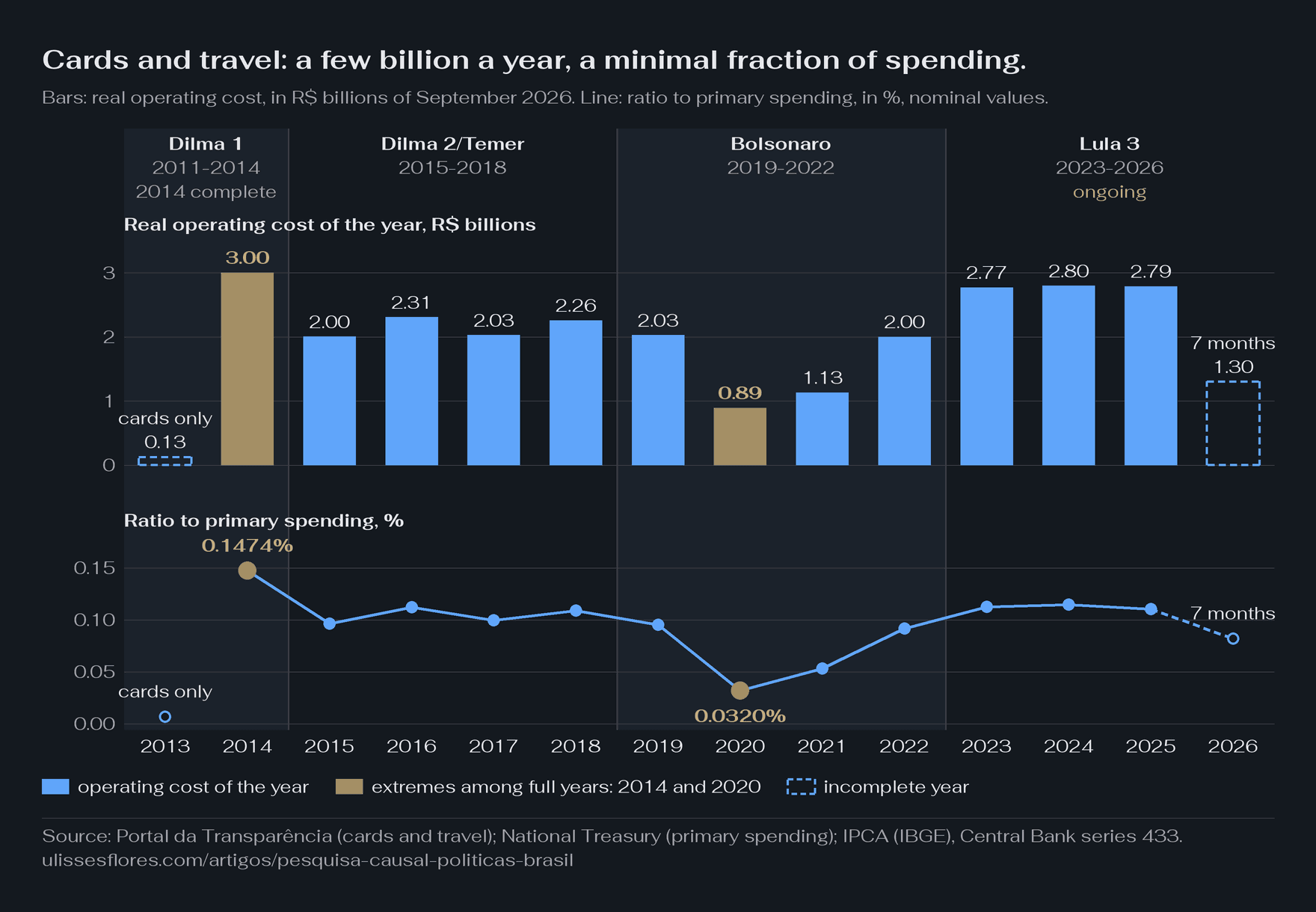
Note 2020: R$ 0.890 billion, the lowest operating cost in the series with cards and travel, with the ratio at 0.0320%. Note also 2013 and 2026: a year without travel coverage and a half year are not a closed term, which is why 2013 is not in the Dilma 1 row.
Primary spending, only as scale. Everything the Union spends in the year, without the interest on the debt. It tells whether the operating cost is a grain or a sack. It is neither airfare nor per diem, and it does not enter the table above.
| Term | Months in the series | Primary spending | Average per year |
|---|---|---|---|
| FHC 1, the series starts in 1997 | 24 | R$ 1,509 billion | R$ 755 billion |
| FHC 2, 1999-2002 | 48 | R$ 3,488 billion | R$ 872 billion |
| Lula 1, 2003-2006 | 48 | R$ 4,233 billion | R$ 1,058 billion |
| Lula 2, 2007-2010 | 48 | R$ 5,968 billion | R$ 1,492 billion |
| Dilma 1, whole term, 2011-2014 | 48 | R$ 7,439 billion | R$ 1,860 billion |
| Dilma 2/Temer, 2015-2018 | 48 | R$ 8,225 billion | R$ 2,056 billion |
| Bolsonaro, 2019-2022 | 48 | R$ 9,228 billion | R$ 2,307 billion |
| Lula 3, through July 2026 | 43 | R$ 9,007 billion | R$ 2,514 billion |
The R$ 755 billion a year of FHC's first term is the average of the whole primary spending of the federal government, not travel spending. Dilma 1's ratio of 0.1474% uses only 2014, when primary spending was R$ 2,036 billion in reais of September 2026; the whole term, 2011-2014, adds up to R$ 7,439 billion. These are different windows.
For FHC and for Lula 1 and Lula 2, cards and travel: not measured. On the Portal da Transparência (Transparency Portal), bulk card data begin in January 2013, travel with useful coverage in 2014, and the official card chart in 2013. The Treasury series, from 1997, covers primary spending.
No level of this ladder says who governed better
This measures what the literature has measured about policies. It does not measure competence and does not rank any government or head of government. States and municipalities are left for the next piece of work.
Back to the first dish: in the journals, 7 of the 27 episodes have some second dish, 4 of them without caveat, and 10 are left with no study in the filter.
Look at the dish without salt, the one in the first figure. No study is not no effect. A method word is not a cause. A cause, when there is one, is the study's sentence.
Sources
Studies cited (title, journal and year; DOI where one exists):
- The Effect of Rural Credit on Deforestation: Evidence from the Brazilian Amazon, The Economic Journal, 2019. 10.1093/ej/uez060
- Deforestation slowdown in the Brazilian Amazon: prices or policies?, Environment and Development Economics, 2015. 10.1017/s1355770x15000078
- Social Security Reforms, Retirement and Sectoral Decisions, International Economic Review, 2025. 10.1111/iere.70083
- Indigenous Lands inhibit mining-induced deforestation in the Brazilian Amazon, Global Ecology and Conservation, 2025. 10.1016/j.gecco.2025.e03540
- The Impact of Bolsa Família on Schooling, World Development, 2015. 10.1016/j.worlddev.2015.02.001
- Impact of the Bolsa Família program on food availability of low-income Brazilian families: a quasi experimental study, BMC Public Health, 2016. 10.1186/s12889-016-3486-y
- Resilience of Deforestation Reduction Policies Across Land Tenure Regimes, Land, 2026. 10.3390/land15050819
- Economic, environmental, and spatial impacts of Brazil's Minha Casa Minha Vida program, Land Use Policy, 2026. 10.1016/j.landusepol.2026.108081
- The effects of emergency government cash transfers on beliefs and behaviours during the COVID pandemic, Journal of Economic Behavior and Organization, 2023. 10.1016/j.jebo.2023.01.006
- The Real Costs of Washing Away Corruption: Evidence from Brazil's Lava Jato Investigation, working paper (NBER), 2025, not peer-reviewed. 10.3386/w33991
- Brazil's Central Bank will expand Pix payments system, Emerald Expert Briefings, 2024, not peer-reviewed. 10.1108/oxan-db286047
No DOI in the record used: the text on Pix at level 1 (Payment Technology Complementarities and their Consequences in the Banking Sector) and the 2006 one on Central Bank autonomy. The dentistry studies and the Pelotas cohorts, mentioned above, appear only as examples of improper entry into the filter.
Public data: cards, Portal da Transparência, page checked on October 30, 2026; primary spending, Resultado do Tesouro Nacional (National Treasury Result), table 1.1 ("Resultado Primário do Governo Central", Central Government Primary Result); inflation, IPCA (IBGE), through the Central Bank's series 433. Catalog of studies: OpenAlex. Journal ranking: SJR.
Data and code: the coding of the 43 studies, the lever map, the spending calculation and the texts of amendments 14 and 15 are in the public repository brazil-governments-factcheck, version 1.1.0, citable by the concept DOI 10.5281/zenodo.23604103. The command python3 run_all.py rebuilds this article's tables and calculations from the readings and series already saved in the repository (the literature search, the models' reading and the Portal da Transparência download are not repeated) and ends in provenance verified; every number the code computes is a test assertion, and the numbers inside quotations come from the studies' abstracts.
Checked on October 30, 2026 against the two readers' coding, the table by episode, the cards-and-travel calculation and the official cards page; two models from other labs (GPT and Gemini) checked the text against the facts. The quoted sentences come from the abstracts, and I did not reopen each study in full. I did not project the term that ends on December 31, 2026. FHC and Lula 1 and 2: no card-and-travel data. I did not measure states, municipalities or competence. The editor's hypotheses about Pix, Central Bank autonomy and discipline in operating cost were neither asserted nor tested. Nothing here ranks a government or head of government.