
In 2009, Usain Bolt ran 100 m in 9.58 s and nobody came close for 17 years. On Saturday, 22 August, in Beijing, a robot covered the distance in 9.39 s — in an official heat, with a scoreboard, against two other robots. That same weekend, another one jumped 2.88 m high from a standing start (the human record, with a run-up, is 2.45 m and has stood since 1993); a third played tennis against a former world top-15, served at over 100 km/h, fell flat on its back and got up on its own; a fourth rallied with an Olympic table tennis champion without a single camera on its body. There were 2,056 robots, 666 teams, 16 countries, five days — and 97% of all the humanoids shipped in the world this year came out of Chinese factories. A year ago, the 100 m winner ran 21.50 s. Four days later, on Wednesday night, Tiangong Ultra closed the Games by winning the 100 m final in 8.64 s — 9.39 in the heat, 8.86 in the semifinal, 8.64 in the final — and ended the race by crashing into the padded barrier. Almost every runner was carried off on a stretcher.
The question in the headline is the one the viral posts asked, with 2.75 million views and a repost from Elon Musk: is the human era over?
I wanted to know. I read the 14 most shared posts of the week, downloaded the 11 videos, pulled them apart frame by frame, read the Chinese press, the fact-checkers and the rulebook — and the answer has two halves. The first half is yes: what happened in Beijing is real, it is bigger than 2025 by an order of magnitude, and it is more impressive than the captions say. The second half is what the captions hide: the number Musk reposted is not the number on the scoreboard; the two most frightening clips on the timeline are fake; and the right question for each video is not "what time did it run" — it is "who was in control". The robots first. Then the ruler.
What actually happened
The 2026 edition ran from 22 to 26 August at the National Speed Skating Oval (the "Ice Ribbon" of the 2022 Winter Olympics). The organiser's numbers, repeated by Xinhua, AP and Global Times, are consistent with one another:
| 2025 (1st edition) | 2026 (2nd edition) | Change | |
|---|---|---|---|
| Teams | 280 | 666 | +138% |
| Robots | 500+ | 2,056 | ~4× |
| Countries | 16 | 16 | — |
| Events | 26 | 51 (30 competitive + 21 scenario) | ~2× |
| Matches | 487 | 1,301 | +167% |
| 100 m — best official time | 21.50 s | 8.64 s (final, 26 Aug; 9.39 s on the scoreboard in the viral video) | −12.86 s |
The results that made the headlines, with the source for each:
- 100 m: Tiangong Ultra (X-Humanoid / Beijing Innovation Center of Humanoid Robotics) 9.39 s in heat 9 of the large group, on the night of 22 August. Honor Lightning 9.47 s in the same heat; Unitree's robot came third and fell after the line (Ifeng, ZOL). In a later preliminary round, that same Tiangong Ultra clocked 9.32 s — a mark claimed by the manufacturer and repeated by the state press (X-Humanoid, 北京日报). Human record: 9.58 s (Bolt, Berlin, 2009). After this piece was published the event carried on: in the large-group semifinal (复赛) on 25 August, Tiangong Ultra ran 8.86 s — and hit a blue wall past the line, throwing sparks (CCTV via 京报网, Global Times); Honor announced 8.94 s for Lightning in the same round (IT之家, citing the brand's official account). In the final on 26 August, the last event of the Games, Tiangong Ultra won in 8.64 s — a Games record, with gold and silver going to robots of the same model, from Team 天骄 (Tianjiao) (Reuters, Xinhua). In the small group, the final came in at 11.98 s, for Team 天骁 (Tianxiao) (Xinhua via Ifeng).
- 400 m: Tiangong Ultra 38.15 s; its sibling Tiangong Omni won its heat in 45.66 s running with its hands up by its face — a posture that, according to engineer Han Gang, emerged from reinforcement learning (swinging the arms overheated the shoulders and burned too much energy to finish 400 m), and was not programmed (Global Times). Lightning ran 40.6 s on 23 August; the human record is 43.03 s (Van Niekerk, 2016) — who, according to the Chinese press, sent his congratulations (163.com).
- High jump (from a standing start): an X-Humanoid robot, 2.88 m, against Javier Sotomayor's 2.45 m (1993) (AP).
- Tennis: a Galbot humanoid played singles against former world top-15 Zheng Jie, served at over 100 km/h, fell flat on its back chasing a lob and got up on its own (Global Times, SCMP). It is the 43-second 4K video that Kyle Chan called "the most impressive to me, more than the 100m world record" — 860,000 views, and rightly so: it is real-time planning against a target that is trying to break your prediction.
- Table tennis: AgiBot's Expedition A3 rallied with Olympic champion Ding Ning at the opening (97-second video, 223,000 views). The detail the caption leaves out: the robot has no cameras on board — its entire view of the game comes from 10 motion-capture cameras in the arena, 8 overhead and 2 at the net (Global Times).
Now the ruler: four numbers, three measurements
The post that carried the news out of China was this one, from Trung Phan, 2.75 million views, reposted by Elon Musk: "Chinese humanoid robot by smartphone maker Honor ('Lightning') ran 100m in 9.32 seconds."
I downloaded the video and pulled the frames. At 18 seconds, the stadium scoreboard reads "大型组100米预赛9组 — 9.39": large group, 100 m, heat 9, nine point three nine. The robot that won that heat is not Honor's Lightning — it is the one from team Tianzhuo (天卓队), from Beijing's humanoid innovation centre, which the Chinese press identifies as the Tiangong Ultra. According to that same press, Lightning led off the gun, was passed near the line and ran 9.47 s. The "9.32" in the caption does exist, but it came from a preparatory test event, outside competition, reported by Chinese state TV (IT之家). And there is a second 9.32, this one official: the Tiangong Ultra clocked the same mark in a later preliminary round of the 100 m — claimed by the manufacturer and repeated by the state press (北京日报, 中新网). Four numbers, three rulers, one caption — and two of the numbers are the same 9.32.
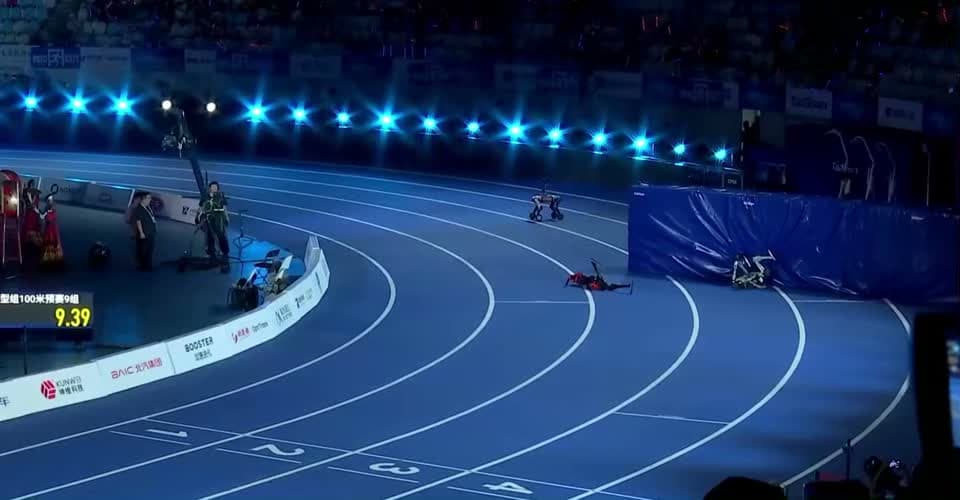
That does not cancel the feat — 9.39 s in an official heat is 12 seconds faster than the 2025 winner. It cancels the caption. The 9.32 s that made the headlines is not the same kind of number as Bolt's 9.58 s — nor the same kind as the 9.39 s of the heat, nor the same 9.32 s that the Tiangong Ultra went on to run in official competition. The numerical coincidence invites confusion (the Yomiuri appears to have fused the two marks into a single sentence). Worth separating them:
| Time | Robot | Where | Ruler | Source |
|---|---|---|---|---|
| 8.64 s | Tiangong Ultra | final of the large group, 26 Aug | official competition — Games record; gold and silver to the same model | Reuters, Global Times, Xinhua |
| 8.86 s | Tiangong Ultra | large-group semifinal (复赛), 25 Aug | official competition | CCTV via 京报网, Global Times |
| 8.94 s | Honor Lightning | same semifinal | official competition — time released by the manufacturer | IT之家 |
| 9.32 s | Honor Lightning | preparatory test event, before the opening | outside competition; peak of 14.5 m/s; reported by CCTV | Reuters, Guardian |
| 9.32 s | Tiangong Ultra | later preliminary round of the 100 m, reported on 23 Aug | official competition — claimed by the manufacturer, repeated by the state press; the wire agencies, however, count the record progression as 9.39 -> 8.86 -> 8.64, with no 9.32 in between | X-Humanoid, 北京日报 |
| 9.39 s | Tiangong Ultra | heat 9, large group, 22 Aug | official competition — heat, not final | Global Times, scoreboard in the video |
| 9.47 s | Honor Lightning | same heat | official competition | ZOL |
| 9.58 s | Usain Bolt | Berlin, 2009 | World Athletics: starting blocks, measured reaction, wind, anti-doping | World Athletics |
| 21.50 s | 2025 winner | 1st edition | official competition | Wikipedia |
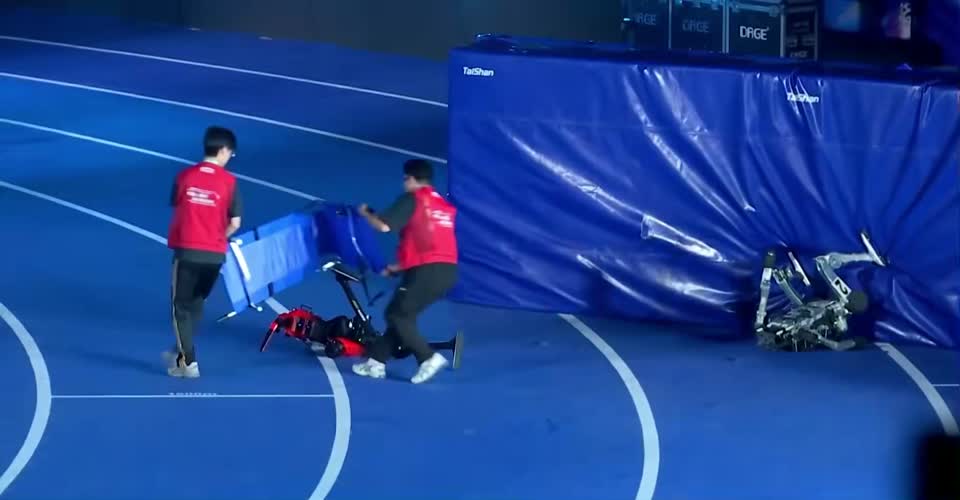
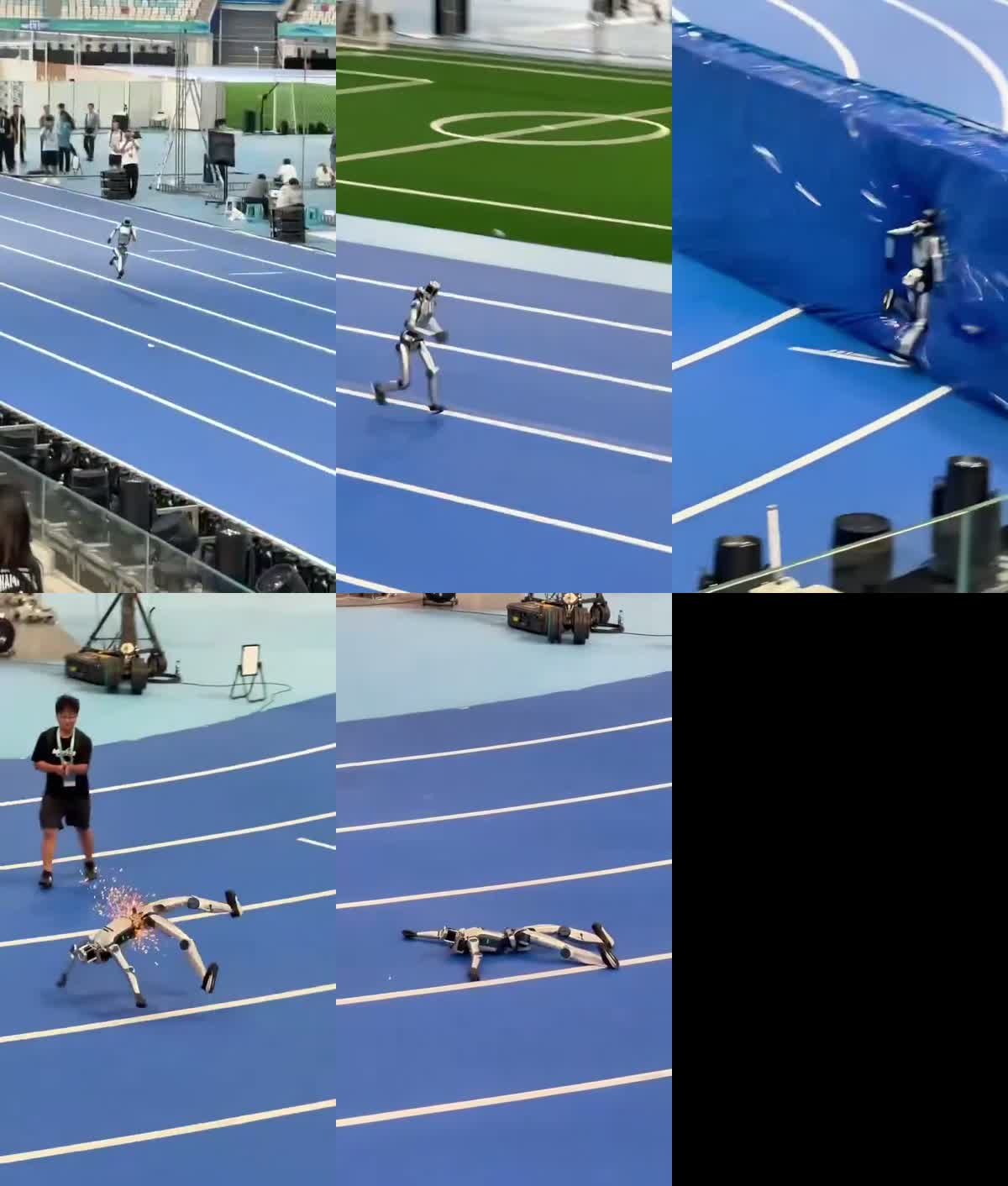
The official ruler did not stop at Saturday's heat. In Tuesday's semifinal Tiangong Ultra ran 8.86 s; in Wednesday's final, 8.64 s. Same ruler as the 9.39 s heat — and three quarters of a second less in four days. Which is why separating the rulers matters more after the final, not less: the number that actually beat Bolt's record in official competition is neither of the two 9.32s that went viral; it is Wednesday's 8.64 s, which almost nobody reposted. What Reuters and the AP recorded right afterwards says the rest: the champion crossed the line and hit the padded barrier, sparks came off some of the runners, staff ran over with fire extinguishers, and almost every robot was carried away on a stretcher (AP, Xinhua). Running 100 m under 8.7 s is real. Stopping after running still is not.
Two details the English-language coverage skipped over:
Lightning grew between one event and the next. At April's half marathon, the robot was 169 cm tall with 95 cm legs; for the Games, Honor lengthened the legs by 10 cm (Guardian). It is not cheating — it is engineering, and it is exactly why "record" is the wrong word: the athlete was redesigned for the event. A running blog summed it up well: Lightning "appears to have stumbled into the Enhanced Games category" (the5krunner).
Neither of them managed to stop. After the line, Tiangong Ultra staggered to the edge of the track and the crowd got out of the way; Lightning hit the crash mat, went down and left on a stretcher (ZOL). The stretcher is in the last 15 seconds of Trung Phan's own video, with four technicians carrying a robot — which of the two, the video does not let you tell.
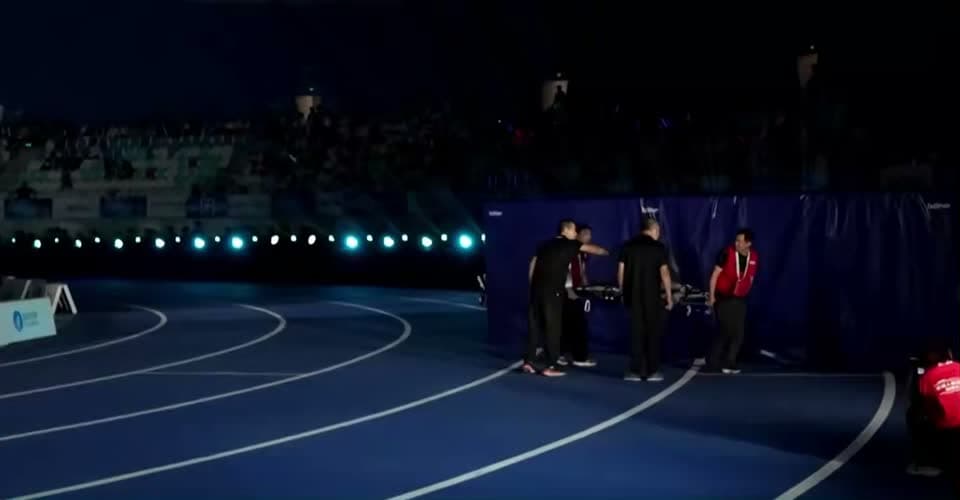
There was fire — and the robot has no name. An agency photo caption distributed on 23 August (Reuters, in the Irish Times) records that "A humanoid robot fell and caught fire after crossing the finish line in the 100 metre preliminaries", and the Japanese paper Yomiuri reported fire just after the finish in the same event — two independent sources, update of 24 August. Neither of them names the robot with any confidence: the Yomiuri says Tiangong; the two German blogs (all-ai.de, smarthomeassistent.de) say Lightning without citing a source for the identification; and the body of the Reuters piece gives Lightning only the fall and the stretcher. This piece does not name it. In the frames I pulled there is no visible flame.
The autonomy ruler — the number that matters and nobody puts in the caption
The right question for every clip is not "what time did it run", it is "who was in control". The Games have an official answer, and it differs from event to event:
- In the flat 100 m there is no remote control. This edition's rulebook requires every track event to be completed by the robot fully autonomously (全自主), with an exception only for the 100 m and the 400 m obstacle races (CCTV, via Tencent, 13 Aug; 新京报, 13 Aug; Beijing municipal government, 15 Aug). The heat in which Tiangong Ultra ran 9.39 s, therefore, ran with no operator: the robots navigate by their own perception, with nobody at the controls — an inference from the rule, not a claim by any source about that particular heat. Xinhua's list (12 Jun, 22 Aug) — the 400 m, the 1,500 m and the 4×100 m relay "upgraded to fully autonomous" in this edition — does not mention the 100 m because they were already autonomous and needed no upgrade.
- In the scenario events (factory, hotel, home, rescue), the organiser penalises teleoperation through the score: autonomous mode is worth 100% of the points, teleoperated mode is worth at most 50% per task (Sohu).
- At April's half marathon, the ruler was a multiplier: teleoperated robots had their time multiplied by 1.2. The autonomous Lightning ran 50:26 (human record: 57:20, Kiplimo); a teleoperated version of the same model ran 48:19 raw and finished behind once adjusted (iRunFar). In that same race, only 38% of the robots ran autonomously (TNW).
Table tennis is the most honest case: the organiser says the A3 played "free of remote controls, pre-written scripts or live human input" — and says, in the same piece, that its eyes are 10 cameras fixed to the ceiling. It is decision autonomy with external perception. Impressive, and not transferable to a factory without an instrumented ceiling.
That is the ruler that separates a demo from a product. And it is what the event itself is measuring: the 21 new scenario events — weighing powder, picking up beans with tweezers, opening a bottle, shutting off a valve, working a fire extinguisher — exist because running in a straight line on a blue track is the easy problem. Beijing's economy director, Jiang Guangzhi, said at the opening: "every extra centimetre in the jump, every extra kilogram in the lift, is the result of engineers optimising joint motors and reducers" — the event is an actuator test bench, not an Olympics.
The work shift: the thesis the viral posts argue, and what holds it up
The two long pieces that travelled with the clips — "The Human Era Is Ending: Robots Are Taking the Shift" (199,000 views) and "They stopped arguing about whether robots would show up. The robots already did" (1.37 million views, from an account with 359 followers) — argue the same thesis: the demo era is over, humanoids are already working shifts. Neither of them cites a primary source. But the thesis has evidence of its own, and it is better than the essays:
- Volume. In the first half of 2026, around 19,100 humanoids were shipped worldwide, 3× the same period in 2025. 97% came from Chinese makers: AgiBot ~8,400 (44%), Unitree ~5,900 (31%) — the two together are three quarters of the market (Smart Analytics Global, via Bloomberg and Forbes). Tesla had shipped ~150 Optimus by January (24/7 Wall St).
- Policy. In July, the US FCC banned imports of new foreign-made humanoids citing national security — the target is China (Guardian). Three days before the Games, Musk wrote that China is "also by far the strongest competitor in AI"; back in January, on Tesla's earnings call, he had already said that "by far the biggest competition in humanoid robots will come from China".
- What the robots do when they are not running. The scenario events are the portrait: 20+ teams on the rescue circuit (identify hazardous material, close a valve, work a fire extinguisher, in 30 min); a team from Shanghai completed the circuit using a hook so it would not have to hold the extinguisher (Sohu). That — the grasping workaround — is what shows where the frontier is.
And there are people who disagree with the whole framing, with credentials. Rodney Brooks (MIT, founder of iRobot) called the earlier race a "publicity stunt… it shows no safety at all"; Yanran Ding (Michigan) points out that people have "a cognitive bias to think that running a half marathon faster than a human is more difficult than folding laundry"; Alan Fern (Oregon State) puts the leap down to "engineering and investment rather than a breakthrough" (TNW). All three are right and none of them contradicts the 19,100 shipments. Running fast and working a shift are two different curves, and the Games measure the first one.
What the community saw
On Hacker News, the thread about the Guardian piece (49399642, 62 points, 99 comments) split the predictable way:
- "They ran so fast that most of them crashed into pieces in the end." — feverzsj
- "How many times/long can it do that before being recharged? Can it do other walking and mobility tasks? … anyone can build a purpose-built robot to beat specific human limitations." — AngryData
- "What's often overlooked when seeing these (mostly) propaganda events is the fact that the actual autonomy of these machines is still lacking." — qayxc
- "It's funny how absurdly dismissive and condescending tech people can be about difficult problems in other people's fields that they know absolutely nothing about." — DrewADesign
- "Watching robot after robot being taken away on a stretcher was pretty funny." — kasperni, on the live stream
On X, Lightning News replied to the tennis video by pointing at the back of the frame: "This army of robots in the background is the actual flex". Zhouhao posted the formation marching at the ceremony and wrote: "if a robot phalanx turns up at the next military parade, it will not surprise anyone". ZaxtR made the montage "🇺🇸 2024 · 🇨🇳 2024 · 🇨🇳 2026" — Optimus walking on one side, Chinese humanoids running on the other — with the caption "Imagine after 5 years". It is a meme, but it is the right meme: the comparison that matters is not with Bolt, it is with the video from two years ago.
What I would do with this
- If you write about robotics: before reposting a time, look for the scoreboard in the video. The one from 22 August was full-screen for two seconds. Heat ≠ final ≠ test; and "autonomous" only counts if the event's rulebook says so.
- If you invest or buy: the number of the week is not 9.32 — it is 97% of shipments. If your supply chain depends on a humanoid and your supplier is not Chinese, you are buying from 3% of the market, under an FCC rule that changes the rest.
- If you build agents (my own case): the A3 with no camera on board is the lesson. The robot's "autonomy" was real and the perception belonged to the arena. When a vendor says "fully autonomous", ask where the sensors are — and who installed them.
- If you just want to watch the videos: the Galbot tennis one is the one worth 43 seconds of your life. The 100 m one is worth it for the last 15.
What is fake in this timeline — and what is actually happening
Of the 14 posts I analysed, two are fabrications and one has the wrong caption. What each one claims, what it is, and how it checks out:
1. "Shooting test of the Unitree robots — in the future, wars will not need humans" (@Eng_china5, 18 February 2026, 2.09 million views). AI-generated. The video was made by user oukanghong on Bilibili on 17 February with the Seedance 2.0 model, with a red-text warning that the shooting scenes were fictional — the warning vanished on the reposts. Tells: shells do not eject, an empty magazine goes in at 0:23, the logo on the chest disappears and comes back, a robot walks through sandbags like a ghost. Checked by BOOM (19 February), DW, via Newswire and a Community Note on the post itself. What is real: Unitree's G1 robots exist, they danced at the Chinese New Year Gala — and that is where the creator took his inspiration from.
2. "A humanoid rallied a shuttlecock against a human in Beijing. No script." (@OxVelnox, 23 August 2026, 708,000 views). Manipulated video, and an old one. The original is a Vietnamese badminton TikTok, posted on 12 December 2023, with three human players; someone replaced one of them with a robot — the court, the shadows, the sound and the movements are identical to the original. Taken apart by D-Intent Data on 30 December 2023 and by Snopes ("Fake"). The Community Note is on the post; the text ("Track. Predict. Reposition. Swing.") is a good paragraph about a video that does not exist. What is real: Galbot's tennis against Zheng Jie, the same weekend, does exactly what the post describes — and it has a source.
3. "Lightning ran 100 m in 9.32 s" (@TrungTPhan, 2.75 million views, reposted by Musk). Real video, wrong caption. The scoreboard in the video reads 9.39, from heat 9; the 9.32 in the caption is the one from Honor's test, outside competition (the Tiangong Ultra clocked an official 9.32 in a later preliminary round — another number with the same digits); Lightning ran 9.47 in that race. It is not disinformation — it is three numbers fused into one, which is how most records are going to travel from now on.
I could not verify: the 12-second clip in Evan Kirstel's reply shows a robot down on the ground throwing sparks with a technician beside it — it is the scene Trung refers to ("it crashed into a safety wall without having its waist implode with sparks flying off"). The track is the same; the robot and the heat, I could not identify.
The 14 posts, one by one
Verdict on each post analysed (views as of 24 August 2026; "real" = authentic video of the event described):
| # | Post | Date | Views | What it shows | Verdict |
|---|---|---|---|---|---|
| 1 | @will_i__amm | 19 Aug | 199K | X Article "The Human Era Is Ending" | opinion essay, no primary source |
| 2 | @kyleichan | 22 Aug | 860K | Galbot vs Zheng Jie, 4K, 43 s | real |
| 3 | @LightningNewsX | 23 Aug | 6K | reply: "army of robots in the background" | real (tennis setting) |
| 4 | @Chuchu30488371 | 23 Aug | 1.3K | reply: mixed doubles tennis | real |
| 5 | @Zhouhao8009 | 23 Aug | 3K | formation marching at the ceremony | real |
| 6 | @Pujiang168 | 22 Aug | 223K | AgiBot A3 vs Ding Ning, 97 s | real |
| 7 | @Eng_china5 | 18 Feb | 2.09M | Unitree "shooting test" | FAKE — AI-generated (Seedance 2.0) |
| 8 | @TrungTPhan | 22 Aug | 2.75M | 100 m "in 9.32 s" | real, wrong caption (scoreboard: 9.39, heat 9) |
| 9 | @bearlyai | 22 Aug | 123K | high jump, 10 s | real (X-Humanoid, 2.88 m) |
| 10 | @EvanKirstel | 22 Aug | 8K | reply: robot down throwing sparks, 12 s | track consistent; robot and heat not identified |
| 11 | @AmX_ZaxTr | 22 Aug | 2.5K | "imagine after 5 years", 15 s | editorial montage (meme), not a fake |
| 12 | @askoaskole | 22 Aug | 7K | "robots just took Bolt's record" + 2 images | real, hype (no video) |
| 13 | @OxVelnox | 23 Aug | 708K | badminton "no script", 15 s | FAKE — manipulated video from Dec 2023 |
| 14 | @OxVelnox | 11 Aug | 1.37M | X Article "They stopped arguing…" | opinion essay, no primary source |
Tally: 2 fabrications (7 and 13), 1 wrong caption (8), 1 unidentified (10), 10 authentic or opinion.
Open questions
Three points the first version of this piece left open. Two of them closed on 24 August, with targeted research in Chinese, English, German and Japanese; the third closed on 26 August, when the final was run:
-
The 100 m autonomy rule — closed on 24 August. This edition's rulebook requires every track event to be fully autonomous (全自主); the exception is only for the 100 m and 400 m obstacle races (CCTV, 新京报, Beijing municipal government). The 9.39 s heat ran with no operator (detail in the section "The autonomy ruler"). Reconfirmed on 25 August by the Chinese business press, with the same rulebook text and the same scoring weights — 1.0 for full autonomy, 0.5 for teleoperation (21经济网, 新浪新闻).
-
"Caught fire" — closed on 24 August, with a caveat. Two independent sources (a Reuters photo caption in the Irish Times; the Yomiuri) confirm that a robot fell and caught fire after the finish of the 100 m preliminaries. Which robot, no source names with any confidence — this piece does not name it (detail and frame in the section "Now the ruler").
-
The 100 m final — closed on 26 August. The organisers' schedule (澎湃新闻) had the semifinal (复赛) on the night of 25 August and the final on the night of 26 August, in Beijing; that is what happened. In the large-group final — the last event of the Games — Tiangong Ultra won in 8.64 s, a Games record, with gold and silver going to robots of the same model (Team 天骄/Tianjiao); in the small group, the final came in at 11.98 s (Team 天骁/Tianxiao). The official progression of the week, as the wire agencies count it, was 9.39 s (heat, 22 Aug) -> 8.86 s (semifinal, 25 Aug) -> 8.64 s (final, 26 Aug) (Reuters, Global Times, Xinhua, Xinhua via Ifeng). The final decided on 24 August had been the 100 m obstacle race (team Zhiyuan of Shenzhen, 1:28.32).
A translation fix, in passing: the 25 August round is 复赛 — the semifinal, the second knockout round — not the repechage. The actual repechage, 复活赛, with 10 teams, was on 23 August. The first version of this piece used "repechage" for both.
Methodological note
- The 14 posts were read through X's public API (metadata, views, Community Notes) on 24 August 2026; the 11 videos were downloaded and the frames extracted with ffmpeg. The scoreboard frame (9.39) is the central evidence of this piece and it is in the dossier. What the frame proves: the time and the heat. What it does not prove: which of the three robots on the start line is which — the attribution Tiangong Ultra 9.39 / Lightning 9.47 / Unitree 3rd comes from the Chinese press (Ifeng, ZOL, Sina), not from my own reading.

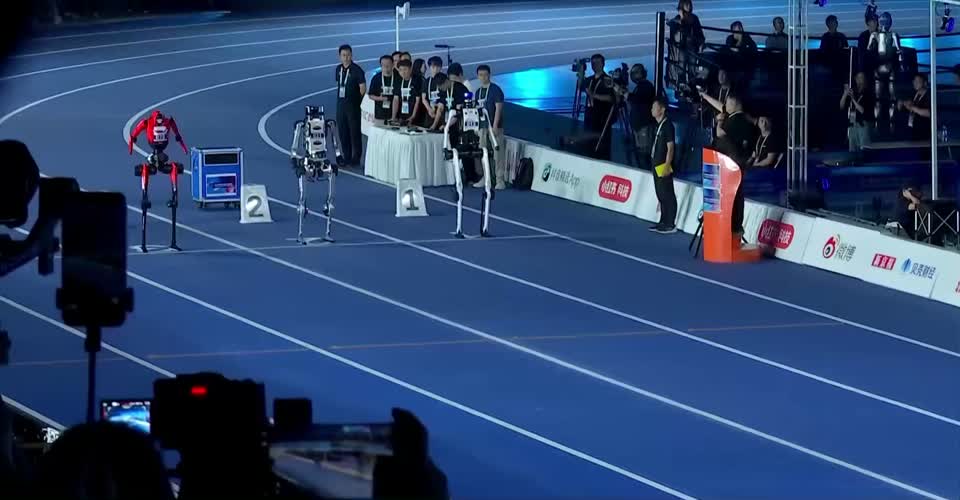
- Names: "Tianzhuo" (天卓队) is the team; "Tiangong Ultra" (天工Ultra) is the robot, both from the Beijing Innovation Center of Humanoid Robotics (X-Humanoid). The English-language coverage uses now one, now the other, as if they were two different runners.
- Unresolved conflict: first-half shipments — 19,100 (Smart Analytics Global) against the "40,000+" cited by Xinhua from a Chinese industry report. I used the smaller figure, the one with an identified source; the two agree on the 97%.
- No comparison with Bolt's record in this piece is an athletic comparison: the rulers are different by construction (starting blocks, reaction time, wind, anti-doping on one side; lengthened legs and a stretcher on the other).
Sources
- Xinhua, 加速跑 世界人形机器人运动会启幕 — 22 Aug 2026 (official numbers, autonomous events); 400 m, 1,500 m and 4×100 m upgraded to "全自主" — 12 Jun 2026
- Global Times, 100 m 9.39 s; Tiangong Omni, hands by the face; Galbot vs Zheng Jie; AgiBot vs Ding Ning — 22-23 Aug 2026
- Ifeng, 天卓队 9.39 s, heat 9; ZOL, Lightning 9.47 s and the stretcher; 163.com, Lightning 400 m 40.6 s — 22-23 Aug 2026
- AP via ABC News, 2.88 m jump — 22 Aug 2026
- Reuters, 9.32 s at the test event, via CCTV — 22 Aug 2026
- Guardian, 9.32 s in the test; legs +10 cm; FCC — 22 Aug 2026
- the5krunner, "Enhanced Games category" — 22 Aug 2026
- all-ai.de, World Robot Games 2026; smarthomeassistent.de, sprint "endet mit brennendem Roboter" — "caught fire" claim, accessed 24 Aug 2026
- CCTV News via Tencent, rulebook: every track event fully autonomous, except the 100 m and 400 m obstacle races — 13 Aug 2026; 新京报, same rule — 13 Aug 2026; Beijing municipal government (EN), same rule, official translation — 15 Aug 2026
- IT之家, Lightning 9.32 s in a preparation test — 22 Aug 2026; purely visual navigation in the 100 m; 9.32 s in a test — 24 Aug 2026
- Reuters via The Irish Times, photo caption: a robot fell and caught fire after the finish of the 100 m preliminaries; Lightning on a stretcher — 23 Aug 2026; Yomiuri Shimbun via Yahoo! Japan, fire after the finish of the 100 m — 23 Aug 2026
- X-Humanoid (manufacturer), Tiangong Ultra 9.32 s in the Games arena — 23 Aug 2026; 北京日报, 9.32 s in the 100 m preliminaries — 23 Aug 2026; 中新网, 10 teams in the repechage; 9.32 s — 23 Aug 2026; 新华报业, Tiangong Ultra 9.32 s — 23 Aug 2026
- 澎湃新闻, schedule: semifinal (复赛) 25 Aug and final 26 Aug at night — 22 Aug 2026; 北京日报客户端, 100 m obstacle race final: Zhiyuan of Shenzhen, 1:28.32 — 24 Aug 2026
- Semifinal (复赛), 25 Aug: CCTV via 京报网, Tiangong 8.86 s, first group — 25 Aug 2026; Global Times, 8.86 s, blue wall and sparks; map-based navigation instead of lane-following — 25 Aug 2026; CGTN, 8.86 s "in the 100-meter semifinals" — 26 Aug 2026; Reuters via Al Jazeera, "semifinal"; fire in the torso; a robot that disassembled in the other semifinal — 25 Aug 2026; IT之家, Honor Lightning 8.94 s, via the brand's official account — 25 Aug 2026
- Final, 26 Aug: Reuters via The Star, 8.64 s; 9.39 and 8.86 before the final; 2,000+ robots, 666 teams, 51 disciplines — 26 Aug 2026 (also in Asharq Al-Awsat); Global Times, 8.64 s, Games record; last event of the edition — 26 Aug 2026; Xinhua (EN), gold and silver for Tiangong Ultra of Team 天骄; robots collapsing and carried off on stretchers — 26 Aug 2026; AP via KSAT, the champion hits the barrier, sparks, extinguishers, stretchers; close of the five days; correction note: 8.64 s, not 8.84 s — 26 Aug 2026; Xinhua via Ifeng, official caption: 8.64 s large group (Team 天骄), 11.98 s small group (Team 天骁) — 26 Aug 2026
- Autonomy rule, reconfirmed on 25 Aug: 21经济网, 400 m 38.15 s; rulebook "完全自主" outside the 100/400 m obstacle races — 25 Aug 2026; 新浪新闻, teleoperation removed; weights 1.0 and 0.5 — 25 Aug 2026
- SCMP, tennis and records — 23 Aug 2026
- The Next Web, sceptical roboticists — 23 Aug 2026
- iRunFar, half marathon, 19 April — Apr 2026
- Sohu, rescue scenario; 50% for teleoperation — 23 Aug 2026
- 24/7 Wall St, Musk: China the strongest competitor; ~150 Optimus — 24 Aug 2026
- Bloomberg, 97% of shipments — 10 Aug 2026; Forbes, +300% — 20 Aug 2026
- Snopes, badminton "Fake"; BOOM, Unitree/Seedance — 19 Feb 2026; DW via Newswire, robot soldiers are AI — 23 Feb 2026
- Hacker News, thread 49399642 — 22 Aug 2026
- Wikipedia, World Humanoid Robot Games — accessed 24 Aug 2026