The United States has a monthly statistic for layoffs attributed to artificial intelligence; Brazil — the third-largest ChatGPT market and one of the first countries in the world by Claude usage — has none. I went to check the numbers circulating about AI and jobs at the source, and what I found was worse than the gap: a good share of the numbers reaching the Brazilian reader are out of date, swapped out of context, or simply unsourced.
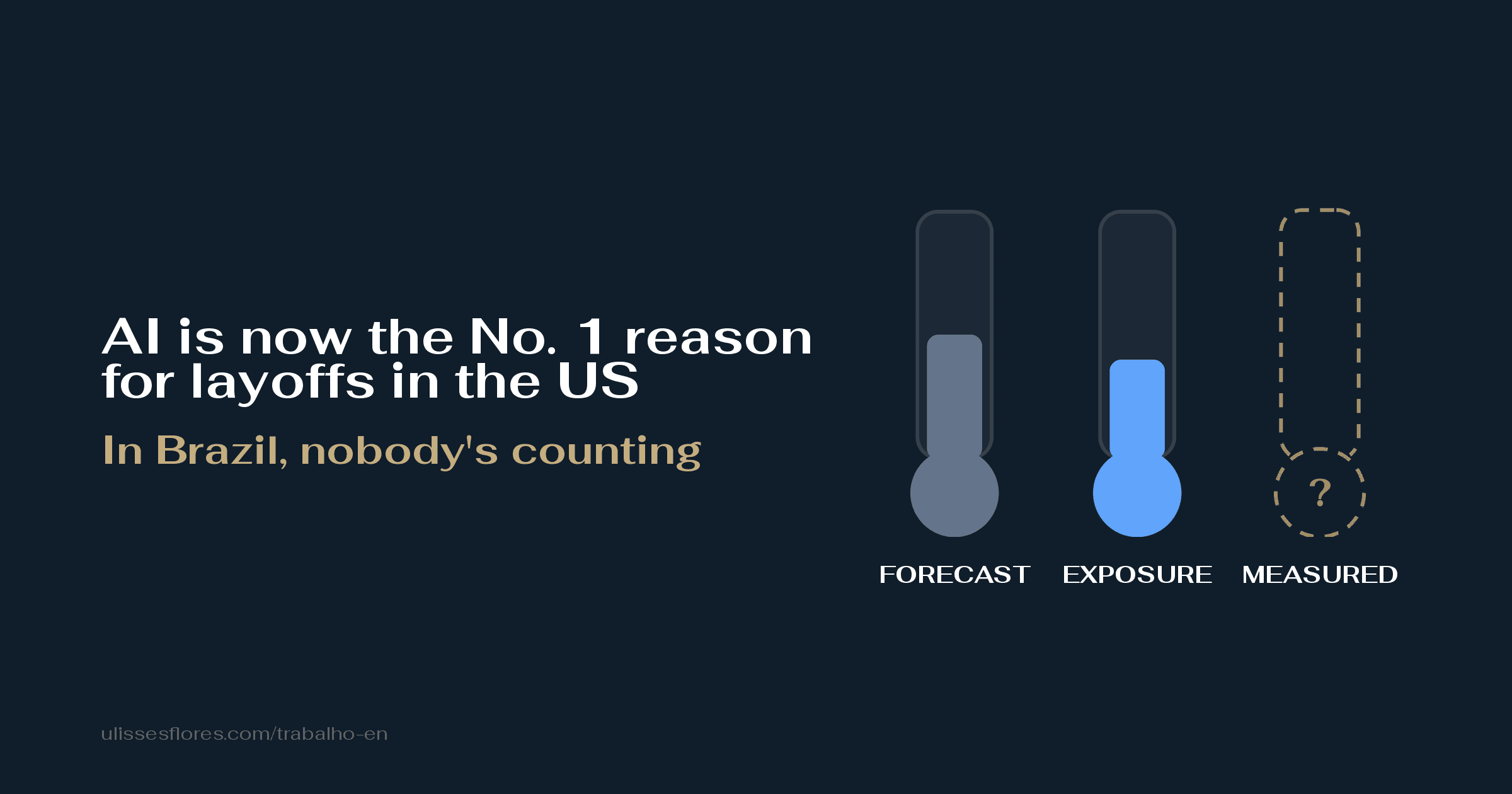
The thesis of this article fits in one sentence: coverage of "AI and jobs" mixes three different thermometers — what is forecast, what is exposed and what has already happened — and almost every misleading number is born of that mixture. I separated the three, checked each number against the primary source and assembled the picture for Brazil, where the third thermometer is empty.
Methodological note. Every number in this article was checked by me at the primary source between August 28 and September 4, 2026: the seven 2026 monthly reports from Challenger, Gray & Christmas (page by page; the August one checked on September 4, right after publication), Klarna's prospectus at the SEC, the PDFs of the ILO/World Bank study (WP121), of PwC's 2026 AI Jobs Barometer and of the Anthropic Economic Index — with the figures read off the image, not off somebody else's summary — plus IBGE, CAGED, Cetic.br, Brasscom and Microsoft's and OpenAI's own pages about Brazil. Challenger's January figure is derived from the year-to-date total (the January monthly report is not on the blog) and is flagged in the figure. Whatever I could not verify is said so in the text, with the reason.
The scoreboard of the check, before the detail:
| What circulates | Verdict | What the source says |
|---|---|---|
| "Youth employment fell 13% because of AI" (Stanford) | ❌ out of date | The authors have already revised it: 13% -> 16% -> 19% (Aug 2026 version) |
| "Klarna laid off 40% of its staff because of AI" | ⚠️ swapped | Prospectus at the SEC: AI-driven efficiency + natural attrition; nobody was laid off en masse |
| "AI has caused ~174,000 job cuts in the US since 2023" | ✅ and it has already grown | Through July: 184,538. In August AI fell to the month's no. 4 reason — but it is still no. 1 in the 2026 running total |
| "62% wage premium for people with AI skills" (PwC) | ✅ with a caveat | Confirmed — but the historical series changes value between editions of the report itself |
| "77% of companies will prioritize reskilling" (WEF) | ⚠️ cropped | 77% is the figure for high-income economies; the global one is 85% |
| "Anthropic measured it: only 10% fear losing their own job" | ✅ | The Cadences report exists (Jun 2026, ~9,700 respondents) — and more than 1 in 3 fear for the junior colleague |
| "Prompt engineer openings fell 40%" | ❌ no source | Circular citation: everybody cites everybody, nobody cites a primary |
| "Banco do Brasil cut foreign-exchange processing time by 90% with AI" | ❌ no source | It circulates on social media; no statement from the bank confirms it |
Weather forecast, risk map and rain gauge
Picture three different instruments for talking about rain. The weather forecast says what can happen tomorrow. The risk-area map says who is exposed if the rain comes — living on the hillside does not mean the house came down. And the rain gauge measures what actually fell, millimeter by millimeter.
Note that none of the three instruments "is wrong" — they answer different questions. The error is reading one as if it were the other: treating a forecast as an accomplished fact, or a risk area as a house already down. Almost every misleading headline about AI and jobs commits exactly that swap.
For the labor market, the three instruments have a first and a last name:
| Thermometer | Question it answers | Who measures |
|---|---|---|
| Forecast | How many jobs will AI create/eliminate? | WEF (World Economic Forum) |
| Exposure | What share of employment could AI affect? | IMF, ILO, World Bank |
| Measurement | How many cuts have already been attributed to AI? | Challenger, Gray & Christmas |
What each thermometer reads today
Forecast. The World Economic Forum's Future of Jobs Report 2025, with more than 1,000 employers covering 14 million workers, projects 170 million jobs created and 92 million eliminated by 2030 — a positive balance of 78 million. It is a forecast: worth what forecasts are worth, and the report itself changes with every edition.
Exposure. The IMF estimates that 40% of global employment is exposed to AI — 60% in advanced economies, 26% in low-income ones. Exposed, not extinguished: the same study splits that exposure between tasks AI can replace and tasks in which it complements the person working.
Measurement. The consultancy Challenger, Gray & Christmas, which monitors layoff announcements in the United States, has tracked AI as a stated reason for cuts since 2023. In 2026 alone, through August: 116,175 cuts attributed to AI — around 22% of everything announced in the year, the no. 1 reason year to date (since 2023, the total closed July at 184,538). From March to July, AI led the reasons for five months running — in July, with 33% of all the cuts that month. In August the run broke: 3,462 cuts, 4th place for the month, the lowest number since December 2025 — and even so the year's lead did not change hands.
Look at the shape of the series before you store any number from it: it climbs, collapses, climbs again. May carries a peak (38,579) pulled by financial technology companies; July falls to 10,970 and is still the month in which AI most dominated the reasons (33%), because total layoffs fell along with it; August collapses to 3,462 and hands the monthly lead back to good old restructuring. Real measurement is jagged — be suspicious of a smooth curve.
One caveat the series itself demands: the reason is stated by the company, and Challenger does not publish its classification criteria. Saying "AI" in the announcement came cheap — it may inflate the number (it sounds modern to the shareholder) or hide it (it sounds cruel to the public). It is the best rain gauge there is, and it is still self-reporting.
Where the circulating number breaks
Checking the primary source changes the number in four of the most cited cases. The pattern repeats: the number travels, the revision stays behind.
1. Stanford's "-13%" is already 19%. The study Canaries in the Coal Mine?, from the Stanford Digital Economy Lab, is the best evidence of damage to youth employment: it compares workers aged 22 to 25 in occupations highly exposed to AI with peers in occupations barely exposed. The first version (Aug 2025, data through July 2025) measured a 13% relative decline; the November 2025 revision (data through September 2025) measured 16%; the current version (Aug 2026, data through June 2026) reports 19% — and it changed the ruler along the way, from a model with statistical controls to a plain descriptive comparison: how far the exposed young worker's employment fell behind the barely exposed peer's (by the new ruler, the July 2025 data vintage measured 15%). Anyone citing "-13%" today is two revisions behind — and even PwC, in its 2026 report, cites the intermediate 16% version.
2. Klarna did not lay off 40%. The Swedish fintech became the symbol case of "AI replaced people" — headcount fell from 5,527 to 3,098 people (-44%) between 2022 and June 2025. But the document the company filed with the SEC to go public attributes the drop to "AI-driven efficiency gains and normal course employee attrition": the company froze hiring and stopped replacing those who left. Nobody was laid off en masse — and the famous "rehiring of humans" dates from May 2025, not a recent reversal.
3. The Challenger running total in circulation is always one report behind. Pieces published in August still cited "~174,000 since 2023" (the June figure), when July already read 184,538 — nearly 11,000 more. This article nearly repeated the sin: it closed with July's data and had to be reopened when the August report came out, knocking down AI's five-month run at the top of the monthly ranking into the bargain. It is not a grave error; it is a symptom of how the citation chain works: people translate the aggregator, not the source — and the source does not stop publishing.
4. The WEF's "77% will reskill" is a crop. The number circulates as "77% of companies worldwide are prioritizing reskilling"; in the report's figure, 77% is the figure for high-income economies — the global one is 85%. Small? Yes. But it is the kind of silent swap that only shows up when somebody opens the PDF.
The junior is who feels it first — and three independent sources say the same
AI is not laying off the senior; it is closing the junior's front door. That is the reading that survives when the three best sources are placed side by side:
- Stanford (Canaries, Aug 2026): employment among 22–25-year-olds in highly exposed occupations is 19% below what was expected — and the effect concentrates in occupations where AI replaces tasks, not in those where it complements them.
- SignalFire (2026): hiring of new graduates fell ~65% at the large technology companies and ~76% at startups since 2019; and the 2025 computer science graduate has a 45% lower chance of a job at a big tech firm than the class of 2022.
- PwC (2026): the entry-level openings most exposed to AI are seven times more likely to require traditionally senior skills — "EQ, judgment, and leadership" — than the least exposed ones. And 49% of CEOs expect to hire fewer juniors over the next three years (for seniors, only 12%). The entry-level job did not disappear: it was "seniorized" — entry-level openings that came to require more than 10 new senior skills grew 35%, while the rest shrank 10%.
The reading that circulates among those who follow the subject closely sums up the mechanism better than many a headline — in a post I checked on X: "The mass layoffs never came. The entry level jobs just stopped being created."
And how do people feel it? Anthropic's Cadences report (Jun 2026, ~9,700 workers) measured a revealing contrast: only 10% think it likely they will lose their own job to AI within 12 months — but more than 1 in 3 fear for the colleague starting out. The fear already has an address, and it is not one's own desk.
Note what the figure does not show: generalized panic. Most people do not fear for themselves — and for now the data give them reason: the measurable damage is concentrated in one age band and one type of occupation. What cannot be known yet is whether today's junior is the canary — the first warning — or the exception.
The other side of the scale: the premium for whoever learned
The same PwC that documents the seniorization measures the side that is growing, across more than 1 billion job ads in 27 countries:
- A 62% wage premium for people with AI skills, compared within the same sector — reaching 118% in sectors such as consumer goods. (Series caveat: the 2026 report says the 2025 premium was 57%; the 2025 report had published 56%. The trend is solid; the exact series changes its rear-view mirror between editions.)
- Openings that require AI grow 69% a year — almost eight times faster than the market as a whole (9%).
- Companies highly exposed to AI grew their headcount 52% since 2018, against 36% at the least exposed ones — exposure is not proving to be a synonym for shrinking.
- LinkedIn estimates 1.3 million jobs created in AI-related roles over two years.
The market is not paying less because of AI; it is paying more to whoever masters it — and demanding of the junior, at the door, skills that used to belong to seniors.
Brazil: record usage, high exposure — and the third thermometer empty
Now the same three thermometers, pointed at Brazil.
Usage (what is already happening). Brazil is one of the countries that uses AI the most in the world — that is not rhetoric, those are the platforms' own metrics. OpenAI reports 215 million messages a day to ChatGPT in Brazil (its 3rd-largest market by active users), with 35% tied to work, against a global average of 30%. Anthropic measures that "the Balkans and Brazil have the highest relative share of work use" among all countries — in the earlier geography survey, Brazil appeared right behind the United States and India in the global share of Claude usage, practically tied with Japan and South Korea. Microsoft measures that 72% of Brazilian AI users say they produce work they could not have produced a year ago (global: 58%) and that 79% fear falling behind (global: 65%). On the company side: AI adoption went from 13% to 17% in one year (Cetic.br, the Brazilian internet statistics center), and in industry with 100+ employees it jumped from 16.9% to 41.9% between 2022 and 2024 (IBGE/PINTEC, the national statistics office's innovation survey) — the fastest-growing technology of all. I have already shown how many people use AI in Brazil and in the world — the pattern repeats: Brazilians adopt fast and use it to work.
That same Cetic.br measurement holds the most uncomfortable figure: 32% of Brazilian internet users have already used generative AI — 69% in the top income bracket (class A), 16% in the bottom ones (classes D and E). The tool that pays a 62% wage premium is distributed the way everything else always has been.
Exposure (what could happen). Two studies using Brazilian microdata converge on a band: 37% of employment (ILO/World Bank, ~37 million jobs) to 41% (IMF, over the PNAD household survey). But the decomposition matters more than the total:
Look at the size of each slice: out of the 37% total, only 2% of Brazilian employment has full automation potential — the slice the study calls replaceable. 13% is "augmentation" (AI complements the person working) and 22% is what the authors christened the big unknown: it may turn into replacement or into complement, depending on how the technology is applied. The study itself warns, in so many words, against reading "37%" as "AI can automate 37% of employment". Exposure is the hillside map, not the house already down.
Measurement (what has already happened). Here the Brazilian picture ends — literally. No Brazilian public statistic records a layoff attributed to AI. CAGED, the monthly register of formal hires and separations, records admissions and dismissals by sector and occupation, but does not ask the reason; the PNAD household survey measures unemployment (5.3% in the quarter ending in July), but not the cause of the separation. There is no Brazilian Challenger: no private consultancy, no public agency, no union publishes a monthly series of cuts caused by AI.
What is left, in the absence of the thermometer, are indirect signals — and each one demands the right quotation marks:
- The Brazilian IT junior lives a measurable squeeze, but with a disputed cause. Brasscom (the association of technology companies) records 200,700 technology graduates in two years, of whom 55.6% went into informal work or sole-proprietor status; in April 2026, the ICT sector generated 82 net formal jobs — a drop of 98.9% against April 2025. Brasscom itself attributes the freeze to interest rates and the exchange rate, not to AI. The signal exists; the attribution does not. In the perception of those looking for an opening, the squeeze has an anecdotal number: in a thread on the largest Brazilian programming forum, a developer describes the "easy" junior opening receiving "3k–10k+ applications" (translated from Portuguese) — post checked for its text, its author and its date; stated perception, not statistics.
- The cases with a name are retrospective attribution by an executive. The most concrete one: the technology arm of Casas Bahia, the retail chain, went from ~3,000 to ~800 people, and the CEO says that without AI "we would have three times as many people" — a statement in an interview, not a dated announcement with an auditable number.
- What circulates on social media did not survive the check. "Banco do Brasil cut foreign-exchange processing time by 90% with AI" — no statement from the bank; "mass AI layoffs at Nubank" — no primary source. Network perception is data about the conversation, not about employment.
The country with one of the heaviest AI usage on the planet debates its impact on employment using somebody else's forecast, estimated exposure and anecdote. That is the finding that bothers me more than any number in this article.
What I would do with this
If you decide public policy or research: Brazil has the microdata (CAGED, PNAD, RAIS) and the researchers to build the rain gauge — a "stated reason" field in collective dismissals, or an independent series in the Challenger mold cross-referencing company announcements. The cost is small; the alternative is to go on importing the American debate two vintages late.
If you hire: the international evidence says the silent cut — freezing the junior opening — is the most common move, and the most expensive over the long run: PwC shows the "seniorized" entry-level openings growing 35%. Training a junior with AI in hand has become the asymmetric bet: if the constraint in your system is senior people, the AI-augmented junior is the cheapest way to elevate the constraint.
If you are entering the market: the two sides of the same coin measured in this article — 19% fewer openings at the exposed front door, a 62% premium for whoever masters the tool — point in the same direction: AI is ceasing to be a résumé differentiator and becoming literacy.
And the usual invitation: replicate the check. Challenger's reports are public — August's sits on a page anybody can open:
curl -sL "https://www.challengergray.com/blog/challenger-report-august-job-cuts-up-58-consumer-products-food-lead/" \
  | grep -o "AI has been cited in [0-9,]* job cut announcements"
CAGED publishes its monthly balances at gov.br/trabalho-e-emprego — look for the "reason for dismissal: AI" field. It does not exist. If you find a Brazilian public series that measures this, send it to me: I will update the article and credit you.
What was verified, against what, on what date. I checked between August 28 and September 4, 2026: the seven 2026 monthly Challenger reports (numbers read page by page; January derived from the year-to-date total, as declared; the August one checked on September 4, right after publication); Klarna's 424B4 prospectus at the SEC; the three versions of Canaries (Stanford); the full PDF of the PwC AI Jobs Barometer 2026 (pp. 11–13 read off the image); Fig. 7 of WP121 (ILO/World Bank) at 300dpi; Fig. 3.1 and the text of the Anthropic Economic Index (Jan 2026) and Cadences (Jun 2026); the IBGE releases (PNAD and PINTEC), the CAGED statement for July 2026, Cetic.br's ICT Enterprises/Households surveys, the two Brasscom reports and the official OpenAI and Microsoft pages about Brazil. What I did NOT verify: the Goldman Sachs note about "-11,000 jobs/month" is private client material (press citation only — it was left out); of the Reddit and X posts cited in the Brazilian public conversation, ten were confirmed to exist (permalink, author, date and verbatim text checked) — but the facts they allege still have no primary source and do not become an assertion here; Challenger's August report (published on September 2) was incorporated into this version of the article on September 4 — it is the source of the 116,175 year-to-date total and of AI's fall to the month's no. 4 reason.
Sources
- Challenger, Gray & Christmas — Challenger Report, August 2026 · July 2026 (and the earlier monthly reports, on the same blog)
- Stanford Digital Economy Lab — Canaries in the Coal Mine? (Aug 2026 version)
- Klarna Group — 424B4 Prospectus (SEC)
- PwC — 2026 Global AI Jobs Barometer (full report)
- WEF — Future of Jobs Report 2025
- IMF — Gen-AI: Artificial Intelligence and the Future of Work (SDN/2024/001)
- ILO/World Bank — Working Paper 121: Buffer or Bottleneck? (Fig. 7)
- Anthropic — Economic Index Report (Jan 2026) · Cadences (Jun 2026) · Geography of usage (Sep 2025)
- SignalFire — State of Talent Report 2026
- LinkedIn — Jobs on the Rise 2026
- OpenAI — Expanding our presence in Brazil (Aug 2026)
- Microsoft — Work Trend Index 2026, Brazil data (May 2026)
- IBGE — PNAD Contínua, quarter through July 2026 · PINTEC Semestral (AI: 16.9% -> 41.9%)
- Ministry of Labor — Novo CAGED, July 2026
- Cetic.br — ICT Enterprises 2025 · ICT Households 2025
- Brasscom — ICT Labor Market Outlook · Jobs and Wages Monitor
- NeoFeed — interview with the CEO of Casas Bahia (Aug 2026)