The most-repeated number about OpenAI in 2026 — "92% of Fortune 500 companies use our products" — is 31 months old and came from a post about a lawsuit. The line appears in a piece from January 8, 2024, the company's response to the New York Times lawsuit; statistics roundups hang it on the "1 million business customers" announcement from November 2025, which does not contain the number. I read both. OpenAI never updated the percentage.
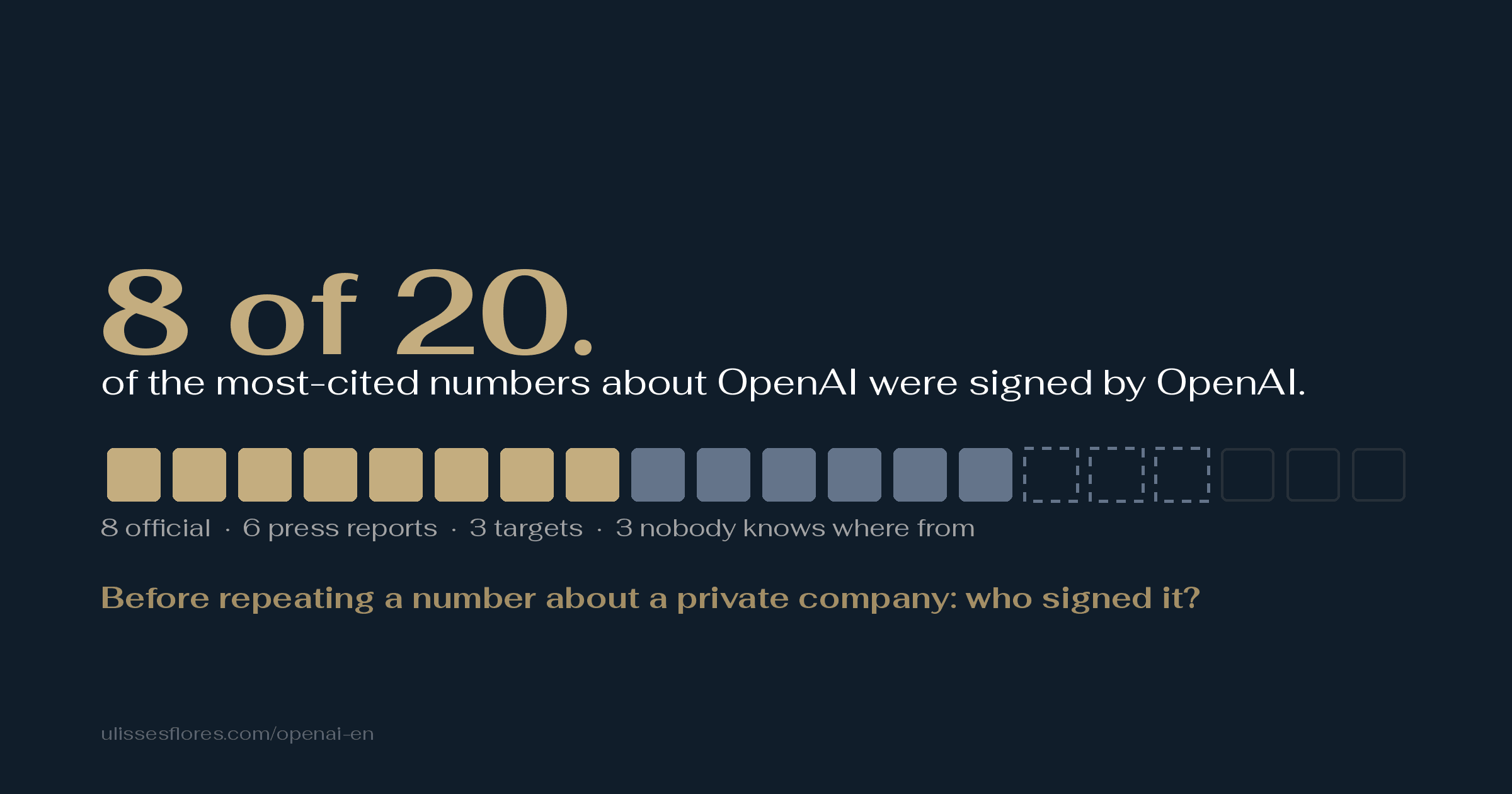
I went after the provenance of every statistic circulating about the most-cited and least-documented company in the industry. I classified the 20 core numbers into four natures — official, reporting, target, and orphan — and the ruler reorganizes the whole subject: only 8 come from OpenAI or public record; 6 are press reporting; 3 are intent; and 3 have no traceable origin. The only audited document that exists about the company is a tax filing from the original foundation, and it tells a story no one cites.
Methodological note. Every number was checked against the original source on August 26, 2026 — an official post, a funding-round announcement, a Form 990 filed with the IRS (via ProPublica), the SEC's EDGAR database, a pricing page — or, when the source is press reporting, against the reporting that originated it. OpenAI's website blocks automated reading (a 403 error on every page); anything from there was read in an archived copy on the Wayback Machine or in the browser, and the text says which. Three measurements are my own and reproducible: the two Form 990 filings from "OpenAI Inc" (FY2023 and FY2024), the search for the company's records at the SEC, and the pricing page's history on the Wayback Machine. ChatGPT users are out of scope — I already covered them here. There is no Reddit or X; the Hacker News discussion of these numbers is thin, and I say where.
The scoreboard: 20 numbers, four natures
The verdict before the argument, because that's what circulates on its own. "What circulates" is the list of numbers that OpenAI statistics roundups repeat in 2026 — the German page that prompted this piece is the most complete example, with 76 numerical claims. I picked the 20 core ones. The middle column is the ruler.
| The number that circulates | Nature | Where the evidence is |
|---|---|---|
| Annualized revenue above US$ 20bn in 2025 | ✅ Official | CFO Sarah Friar, OpenAI blog, Jan 19-20, 2026 |
| US$ 2bn per month (≈ 24bn/year), March 2026 | ✅ Official | OpenAI post from March 31, 2026, read on the Wayback Machine |
| US$ 122bn raised at a US$ 852bn valuation | ✅ Official | Same post |
| Altman's compensation: US$ 76,001 | ✅ Official | Form 990 FY2023 — it's the sum of two columns, and the following year comes to 113,674 |
| More than 1 million business customers | ✅ Official | Post from November 5, 2025 |
| Stargate: US$ 500bn | ✅ Official | Joint announcement from January 21, 2025 (the page says 2026) |
| Confidential IPO filing | ✅ Official | OpenAI post, June 8, 2026 |
| Altman holds 0% of the equity | ✅ Official | OpenAI statement during the restructuring, reported by Reuters on October 28, 2025 ("OpenAI says CEO Altman will not get a stake") |
| Headcount: ~4,500 -> 8,000 by the end of 2026 | 📰 Reporting | Financial Times, March 21, 2026 |
| Stock compensation: US$ 1.5 million per employee; 46.2% of revenue | 📰 Reporting | Wall Street Journal, February 18, 2026 (the page attributes it to another source) |
| 600 thousand ChatGPT Enterprise customers | 📰 Estimate | Venture-capital fund newsletter; OpenAI publishes "7 million seats" |
| US$ 50bn in compute in 2026 | 📰 Reporting | Greg Brockman, under oath in the Musk v. OpenAI lawsuit, May 5, 2026 |
| Altman's net worth: US$ 3.3bn | 📰 Estimate | Forbes — makeup: Stripe, Reddit, Helion (not Worldcoin) |
| SoftBank invested "more than US$ 71bn" | 📰 Wrong | SoftBank's own release: US$ 64.6bn, ~13% |
| 2026 revenue target: US$ 29.4bn | 🎯 Target | Internal documents via The Information: US$ 30bn; the decimal figure doesn't exist in any source |
| 2027 target: US$ 100bn | 🎯 Target | Altman, on a podcast: "How about '27?" |
| 2030 target: US$ 280bn | 🎯 Target | Internal documents via Bloomberg, February 20, 2026 |
| 2.2 billion API calls per day | ❓ Orphan | The cited source doesn't contain the number; no other source has it either |
| 3,400 education apps built on the API | ❓ Orphan | Same |
| 48% share of customer-service bots | ❓ Orphan | Same |
Eight official, six reported, three targets, three orphans. Notice the pattern: the numbers from OpenAI itself check out — and they're the least interesting ones. What makes headlines (the target, the leak, the "92%") is exactly what the company never signed off on.
The ruler: four questions before repeating a number
Before believing any statistic about a closely held company, one question separates what the number proves from what it only suggests: who signed it? The figure is the whole ruler; the rest of the article is the demonstration, number by number.
Notice that the ruler doesn't say "official is true, the rest is a lie." It says every box carries a weight: the official can be checked at the source, with a date — and it can be stale; the reporting is only as good as the digging behind it, and it changes when that changes; the target is intent with a deadline, not fact; and the orphan carries no weight at all, because there's nothing to check. The roundups' mistake isn't inventing numbers. It's putting all four boxes in the same sentence, with the same verb.
The German page is a good case precisely because it's better than average: it names its sources. The problem is what's left when you pull on each link.
Notice the ratio in the first block: 76 claims, 14 links. Bloomberg, Reuters, The Information, Financial Times, Sacra, and the IRS itself appear cited by name, with no link — 7 attributions the reader has no way to pull. And notice the last bar in the second block: of the 14 links, the 4 that open without blocking (three from TechCrunch, one from Anthropic) support exactly the number they're cited for; the blocked ones are Bloomberg, CNBC, and OpenAI itself, which refuse automated reading. The one link that opens, is an official source, and still doesn't contain the number it's hung on is the "1 million customers" post — the source for the "92%," the "2.2 billion calls," and the three orphans. It's not a dead link or a weak source: it's a citation that's technically present and still fails the most basic test, open it and read it.
The "92%": a 2024 number about a lawsuit, recycled with no date
The official post from November 5, 2025, "1 million business customers: the fastest-growing business platform in history," says what it says — and only that:
"Today, we're announcing that more than 1 million business customers around the world are directly using OpenAI [...]. We now have more than 7 million total ChatGPT for Work seats (up 40% in just 2 months). ChatGPT Enterprise seats specifically have grown 9x year-over-year."
I read the entire text, not a word search. There's no "92%," no "Fortune 500," no "460 companies," no chart comparing OpenAI with Google, Microsoft, and Anthropic, no "600,000" organizations, "2.2 billion" calls, "3,400" apps, or "48%" share — the six numbers the German page lists under the single label "Source: OpenAI, 1 Million Businesses," next to a chart it draws itself.
The "92%" is real. It's in a post from January 8, 2024, titled "OpenAI and journalism," the company's response to the New York Times' copyright lawsuit:
"Millions of developers and more than 92% of Fortune 500 are building on our products today."
"Today" was January 2024 — thirteen months after ChatGPT launched, in a paragraph of legal defense. OpenAI never republished the updated percentage; the November 2025 announcement, which would be the natural place for it, doesn't mention it. Every piece that says "92% of the Fortune 500" citing OpenAI in 2026 is using a number from 31 months ago, about a different subject, with no date attached. It's the "official" nature past its expiration date — and that's why it stays out of the table's 20: it's not an orphan, it's a fossil.
The three orphans are a different case. I searched for "2.2 billion API calls per day" in five targeted searches and found no OpenAI publication, consultancy, or report with that number. What officially exists is a different metric in a different unit — "Our APIs now process more than 15 billion tokens per minute" (tokens being the chunks of text the model reads and produces), in the March 2026 post. "3,400 education apps" and "48% of real-time customer-service bots" don't appear anywhere outside roundups that cite each other. A number whose cited source doesn't contain it isn't imprecise: it's nonexistent until proven otherwise.
Notice that the blue bar is the largest and is still a minority. And notice what it contains: the eight official numbers are revenue (three), funding (one), the Form 990, the million customers, Stargate, and the IPO filing. No headline is born there. The headlines are born from the other twelve.
Revenue: what OpenAI said, what leaked, what's a target
Revenue is the subject where the four natures blur together most in a single sentence: "OpenAI makes US$ 20 billion, will close 2026 at 30, and is aiming for 100 in 2027." Separated, the three parts carry different weights.
Notice the blue block: it's what the company signed off on, and it's consistent. CFO Sarah Friar wrote on the official blog, in January 2026, "$2B ARR in 2023, $6B in 2024, and $20B+ in 2025." On March 31, the post announcing the US$ 122bn round said, in text — I read it in the archived HTML of the page itself:
"Within a year of launching ChatGPT, we reached $1B in revenue. By the end of 2024 we were generating $1B per quarter. We are now generating $2B in revenue per month."
Two billion a month is US$ 24bn a year — an official, dated number, and the only one in the block that describes the present. From there, everything is external. The gray block is Sacra, a consultancy that keeps a live dashboard on the company: on August 26 it read "OpenAI hit $40B in annualized revenue in July 2026." The German page cites Sacra at "25bn in February" — a number the dashboard no longer shows, because the consultancy updates the estimate and erases the previous one. A live-dashboard estimate has to be cited with the date it was read, not the date of the number.
The amber block is intent. "2026 target: 29.4bn" doesn't exist in any source with that decimal figure; what The Information published, based on internal documents, is US$ 30bn — the "29.4" only shows up in roundups that cite each other. "100bn in 2027" is Altman's answer to investor Brad Gerstner, on the BG2 podcast, in October 2025: Gerstner suggested 2028 or 2029 and Altman shot back "How about '27?" The German page writes "hinted by Altman," which is correct — and it's exactly the weight a line from a podcast carries. "280bn in 2030" comes from internal documents Bloomberg saw in February. I already wrote here about how the "900 million weekly users" came from the same funding-round post, with no methodological note: the official revenue is the only line in that post that comes with a unit and a period.
Twenty-four is official, forty is an estimate, two hundred eighty is a target — and the sentence that lumps the three together with the same verb is wrong even if every number is right.
Fundraising: the rounds, and the difference between investing and pledging compute
OpenAI is the company that has raised the most private money in history, and roundups usually get the round right and the cumulative total wrong — because they add up things of different natures.
Notice the first point: the "US$ 1bn" from 2015 was a pledge from the founders, and CNBC found that only US$ 130 million had actually come in by 2019. The last point, by contrast, is official and unambiguous: "$122 billion in committed capital at a post money valuation of $852 billion," in the post from March 31, 2026 — the round announced in February as US$ 110bn to US$ 730bn "pre-money" (the valuation before the new capital comes in) closed bigger. Three months later, in May, Anthropic announced its own round at US$ 965bn and pulled ahead; the German page records that correctly.
The mistake is in the cumulative total per investor.
Notice the first bar. The German page says SoftBank invested "more than US$ 71bn." SoftBank's own release, from February 27, 2026, says:
"Upon completion of the Follow-on Investment, SBG's cumulative investment in OpenAI is expected to total USD 64.6 billion, representing an ownership interest of approximately 13%."
That's US$ 34.6bn already invested since September 2024 plus US$ 30bn in three equal installments through 2026 (April, July, October). I didn't find "71" in any source, primary or secondary; Forbes, in June, put it at "US$ 65bn for 13%." And note that SoftBank's bar already includes money that, as of this article's date, hasn't come in yet — the October installment.
Now the second block, which is where the inflated cumulative totals come from. Amazon invested US$ 50bn (US$ 35bn conditional on an IPO or a technical milestone; released in July) — and, separately, expanded a compute contract with AWS by US$ 100bn over eight years. Nvidia invested US$ 30bn — and signed, in September 2025, a letter of intent for up to US$ 100bn "progressively, as each gigawatt gets installed," which Nvidia's own CFO, Colette Kress, described in November as "still haven't completed a definitive agreement." And Stargate, the US$ 500bn in data centers with SoftBank and Oracle, was announced on January 21, 2025 — the page says 2026 — and is an infrastructure commitment, not capital in the company. Adding 50 to 100, or 30 to "up to 100," produces a number nobody invested. The historical cumulative "of ~US$ 190bn" that circulates is an aggregator's sum: sources that try to add it up land between US$ 180bn and US$ 190.6bn, depending on whether secondary sales and credit lines are counted, and none of them is OpenAI.
One last check, which is my own measurement: I searched the SEC's public database, EDGAR, for the company's records. A search for "openai" returns 24 entities — OpenAI's own investment fund for startups, third-party vehicles that package its shares for resale, and an Illinois aviation company called Openairplane. None of the filings is operating OpenAI: 46 Form D filings mention the name, zero list "OpenAI Global, LLC" as the issuer. That doesn't prove wrongdoing — there are legal structures that waive direct-name registration, and June's IPO filing is confidential by law until it goes public. It proves something else: for the most valuable company in the industry, the only audited document available to anyone is the tax filing of the nonprofit foundation that controls it. That's the next section.
The one audited document: the Form 990, and the story no one cites
Every nonprofit in the United States files a Form 990 with the tax authority, and it's public.
"OpenAI Inc" — the original 2015 entity, which by the 2024 filings already identifies itself as
openai.com/foundation — files its own, and that's where the one audited number that
circulates about the company comes from: "Altman's salary: US$ 76,001." I downloaded the two
most recent filings from ProPublica's Nonprofit Explorer.
Notice that the number matches to the cent — and it's the sum of two columns. In Part VII of the 2023 filing, Altman's line carries three figures: column D, "compensation from the organization itself," 0; column E, "compensation from related organizations," 64,957; column F, "other estimated compensation," 11,044. The foundation pays him nothing; the sum that circulates as "salary" comes from related entities — the for-profit arm — and estimated benefits. The 2024 filing, submitted in November 2025 and cited by no roundup, shows 0 + 65,638 + 48,036 = US$ 113,674, 49% more in a single year, almost all of it in the "other compensation" column. And that year's Schedule J adds, in text, that three listed people took part in "an equity-based compensation arrangement consisting of profits interest issued by a related organization" (profits interest meaning a right to future profits), with zero grant-date settlement value — meaning there's compensation the number doesn't capture.
What no one cites is in the second block: in the 2024 filing, the CEO is tenth of twelve names on the list. I extracted all of Part VII. Above him: Greg Brockman, listed as "Dir/Pres (Former)," US$ 264,189; Chris Clark, treasurer and secretary, US$ 216,021; Lawrence Summers, US$ 143,702; board members Adam D'Angelo, Susan Desmond-Hellmann, and Bret Taylor, US$ 140,000 each; Nicole Seligman and Fidji Simo, US$ 127,500; and Ilya Sutskever, already listed as "Director (Former)," US$ 119,538 — he left in 2024 to found SSI and still shows up receiving pay from a related organization. Below Altman, only Paul Nakasone (US$ 99,030) and Zico Kolter (US$ 53,494). The 2023 filing has another oddity: a line reading "Emmett Shear — CEO — 40.00 [hours] — 3,720" — the interim CEO of the few days in November 2023, with US$ 3,720, is the most concrete public record that episode has.
And the foundation's own revenue: US$ 5.36 million in 2023, US$ 691 thousand in 2024. That's not the company's revenue — it's the nonprofit entity's, which brings in directly less and less while the billions run through the subsidiary. Comparing that number with the "US$ 20bn" is the inverse mistake of the "92%": the nature is official and audited, and the object is a different one.
The Form 990 is the one number about OpenAI that comes with an auditor's signature — and every roundup cites it wrong on the label, the year, and what it measures.
Pricing: the "US$ 100 Pro" that never existed and the plan the page missed
Price is the easiest statistic to check and the one that changes the most. The German page lists ChatGPT's plans as "Free; Plus US$ 20; Pro US$ 100 or 200" — and the "or" already gives away the confusion. I went to the history.
In the archived copies of the official pricing page, from January 2024 to August 2025, Pro always cost US$ 200 a month (the plan didn't even exist in January 2024; Plus cost US$ 20, same as today). There was never a "US$ 100 Pro" in that stretch. On the live page, read in the browser on August 26, 2026, there are four individual plans — Free, Go at US$ 8, Plus at US$ 20, and Pro "From $100" — and Go, the mid-tier plan launched in 2025, doesn't appear on the German page. The likely origin of "100 or 200" is the business tab, where the "Premium" seat costs US$ 100 a month on the annual plan and US$ 125 monthly. The price changed between the last archived copy and today, and the Wayback Machine has no readable capture of OpenAI's pricing page since June 11, 2026: 39 attempts by the Internet Archive's crawler, all blocked. The most-cited company in the industry has a two-and-a-half-month hole in its public pricing history, opened by the company itself.
In the API, the same pattern: the flagship model, GPT-5.6 Sol, shows a promotional price (US$ 4 per million input tokens, "was $5"; US$ 20 output, "was $30") valid "at least through November 21, 2026" — and its siblings Terra and Luna also dropped since their July launch, with no mark on the page showing the change. A price number with no date is an editorial choice.
Brazil: prices in reais, an office in São Paulo, and a recycled "50 million"
OpenAI charges in reais in Brazil — the real is on the official list of currencies with local billing, and Pix is accepted for Go, Plus, and Pro — but the pricing page refused this machine (a 403 error), and the archived HTML resolves the value in real time, without exposing it. What can be read live is the app store, which OpenAI itself says reflects "your local currency."
Notice the first bar: Go, at R$ 39.90 in the app (R$ 39.99 on the site, per the joint announcement with Nubank from October 2025, which gave bank customers up to a year free), is the plan the German page doesn't list and that only exists "in a limited set of countries," in OpenAI's own words. Plus costs R$ 99.90 and Pro splits into two tiers in the store — 5x and 20x usage — which the US site presents as a single one, "from US$ 100." I'm not converting currency here: the store rounds to Apple's price bands, and an exchange rate chosen by me would be one more statistic with no signature.
The São Paulo office is official in two stages: the announcement on August 28, 2025 (Brad Lightcap, COO, to the press; before that, the country's presence was two employees) and the formal launch of Latin American operations on August 20, 2026, at an event in São Paulo with partnerships announced with Nubank, IMPA, Hospital das Clínicas da USP, ITA, and Prodam. And here a recycled number that earns the ruler: "50 million monthly users in Brazil" shows up identical in the August 2025 coverage and the August 2026 coverage — while "messages per day" rose from 140 million to 215 million over the same stretch. Either Brazil gained zero users in a year, or the number is a press-kit rounding no one ever updated. I already showed here why "50 million Brazilians" is also Cetic.br's number for people who have ever used generative AI — and that's a measurement with a published sample, which this one doesn't have.
OpenAI in Brazil has prices in reais, an office, and partnerships — and the user number that circulates about the country is the same age in both launches.
What I'd do with this
One question, before repeating any number about OpenAI — or about any closely held company: who signed it?
- If the company signed it, check the date. The "92%" is official and is 31 months old. The "76,001" is audited and is from 2023; 2024's comes to 113,674. Stale official is the most respectable way to be wrong.
- If it was reporting, cite the reporting, not the company — and cite the date you read it when the source is a dashboard that updates itself. Sacra's February figure said 25; August's says 40.
- If it's a target, use the right verb: "projects," "said it intends to," "answered on a podcast." A target with a decimal figure ("29.4") is a sign someone copied someone else.
- If the cited source doesn't contain the number, the number doesn't exist. It's not "approximate," it's not an "estimate": it's an orphan, and orphans don't go in the text.
And the rule for cumulative totals: equity investment and compute commitments don't add up. Fifty plus a hundred isn't a hundred fifty; it's fifty, and a contract.
If you want to check this article's easiest measurement, it takes ten seconds:
curl -s -A "Mozilla/5.0" "https://projects.propublica.org/nonprofits/api/v2/organizations/810861541.json" \
  | python3 -c "import json,sys; d=json.load(sys.stdin); print(d['organization']['name'], [(f['tax_prd_yr'], f['totrevenue']) for f in d['filings_with_data'][:3]])"
That's "Openai Inc," EIN 81-0861541, with the foundation's revenue by fiscal year. The 2024 filing isn't in the API's index yet — it's in the full text, ObjectId 202513219349328476, and that's where the 113,674 lives. If you find "2.2 billion calls a day" in any OpenAI document, send it my way: I'll update the article and credit the correction.
Sources
- OpenAI — "OpenAI and journalism", 08/01/2024 — a origem do "92% da Fortune 500"; lido em cópia do Wayback (02/05/2024)
- OpenAI — "1 million business customers", 05/11/2025 — lido no navegador (o site devolve 403 a leitura automatizada)
- OpenAI — "OpenAI raises $122 billion to accelerate the next phase of AI", 31/03/2026 — lido em cópia do Wayback (02/04/2026); TechCrunch, 31/03/2026
- Sherwood — CFO Sarah Friar, "$20B+ in 2025", 19-20/01/2026 — espelho do post oficial
- Sacra — OpenAI — painel vivo, lido em 26/08/2026
- The Information — "OpenAI Boosts Revenue Forecasts, Predicts $111 Billion More Cash Burn Through 2030" (paywall; números por espelhos) e briefing sobre os "100 bi em 2027"
- Bloomberg — "OpenAI Forecasts Its Revenue Will Top $280 Billion in 2030", 20/02/2026 (403; por espelhos)
- SoftBank Group — comunicado de 27/02/2026 — US$ 64,6 bi, ~13%; Forbes, 08/06/2026
- TechCrunch — rodada de US$ 6,6 bi a US$ 157 bi, 02/10/2024; CNBC — a fundação em 2015 e os US$ 130 mi, 11/12/2025 (403; por espelho)
- GeekWire — Amazon: US$ 50 bi de participação e US$ 100 bi de AWS; Fortune — CFO da Nvidia: acordo "não definitivo", 02/12/2025
- Anthropic — Series H, 28/05/2026 — US$ 65 bi a US$ 965 bi
- ProPublica Nonprofit Explorer — Openai Inc, EIN 81-0861541 — Form 990 FY2023 e FY2024, texto integral
- SEC EDGAR — busca por empresa "openai" e busca em texto integral por Form D (efts.sec.gov) — 46 registros de terceiros, 0 da OpenAI Global, LLC
- Reuters — Altman sem participação, 28/10/2025 · Financial Times — quadro de pessoal, 21/03/2026 · Wall Street Journal — remuneração em ações, 18/02/2026 — paywall; citados por republicação com atribuição
- Preços: página de preços do ChatGPT e de empresas lidas no navegador em 26/08/2026; histórico via Wayback CDX (
openai.com/api/pricing,openai.com/chatgpt/pricing, 2021-2026); Help Center — cobrança em moeda local e ChatGPT Go (Wayback) - App Store Brasil — ChatGPT — preços em reais, lidos ao vivo; Nubank + OpenAI — ChatGPT Go no Brasil, 28/10/2025 (Wayback)
- CNN Brasil — escritório no Brasil, 28/08/2025; Gazeta Brasil — operações na América Latina, 20/08/2026; OpenAI Global Affairs — "Brazil's AI moment is here", 04/11/2025 (Wayback)
- Página que motivou a pauta — gradually.ai, "OpenAI-Statistiken 2026" — inspiração de estrutura; nenhum número reaproveitado sem conferência
Verification: OpenAI posts read in an archived copy or in the browser; Form 990 FY2023 and FY2024 read in full text and preserved; the EDGAR database queried through its public API; SoftBank's release and Anthropic's post read directly; Bloomberg, CNBC, FT, WSJ, and The Information via republication with attribution, named in the text. OpenAI's "Our structure" page, which also states that Altman holds no equity, exists on the Wayback Machine only as empty captures — that line rests on the statement to Reuters. The US$ 13.1bn revenue figure for 2025 that appears in internal documents cited by the press contradicts the CFO's "US$ 20bn+" and likely measures something else (recognized revenue vs. annualized); I couldn't resolve it, and the number stays out. There's no Reddit or X in this article, due to source unavailability.