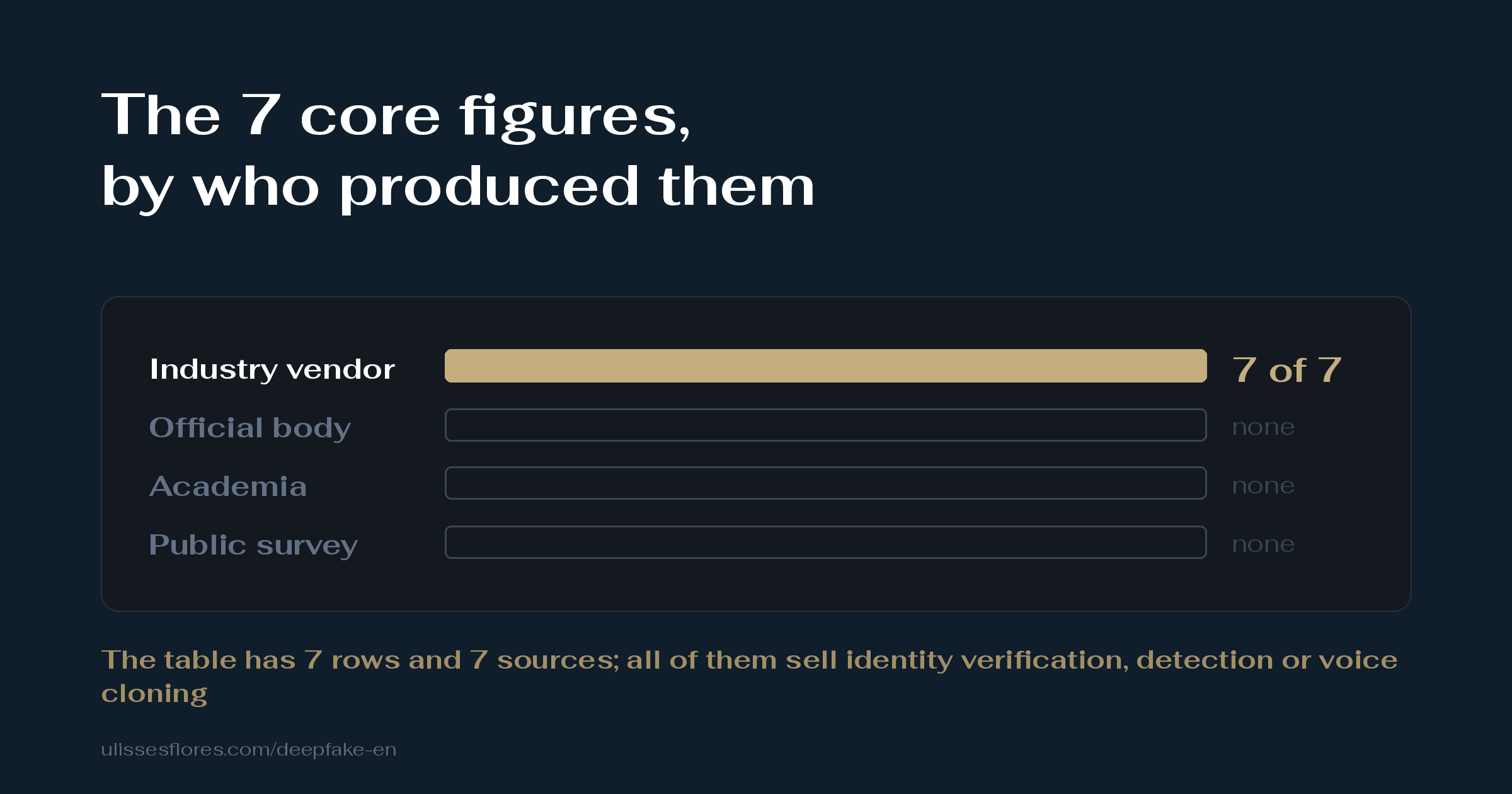
The most complete deepfake-statistics article I could find opens with an honest warning: "Deepfake-Statistiken stammen überwiegend von Anbietern für Identitätsprüfung und Betrugserkennung, die ein kommerzielles Interesse am Thema haben" — "deepfake statistics come predominantly from identity-verification and fraud-detection vendors, who have a commercial interest in the subject". Two screens later comes the table of the article's seven core figures. I checked them one by one: all seven belong to those vendors. Signicat, Entrust Onfido twice, Sumsub twice, Resemble AI and iProov.
This is not sloppiness on the author's part — and that is what makes the case interesting. He declares the conflict, does the growth arithmetic the right way, flags when a number has no basis. The table still comes out 7 out of 7, because there is nothing else to cite. I spent three days chasing what does exist: the only official damage figure is an FBI tag defined as "mentions artificial intelligence"; the only independent measurement of the human ability to spot a deepfake is academic and lands at 55%, with a margin that brushes against a coin flip; and the best public data in the world on the subject — with an objective test instead of self-report — is Brazilian.
Methodological note. I checked every number against its original source between 26 and 28 August 2026 — company press release, PDF report, official-gazette instrument, DOI-bearing paper — and I say so in the text whenever I could only reach a secondary source. The German page that prompted this piece was captured on 26/08/2026 with a real browser (
curlgets a 429 error). Three measurements are my own and reproducible: the line-by-line provenance of the seven-figure table; the percentages computed from the FBI's annual-report PDF; and the count of Resemble AI's public incident dashboard, done on 28/08/2026 with the script I publish at the end. What I could not read is declared: the full reports from Signicat, Sumsub and Resemble sit behind a registration form (I used the public releases), the Stockner 2026 paper gave me only its abstract, and the ruling by Justice Mendonça at Brazil's Superior Electoral Court has no published full text — I say so where it appears.
The scoreboard: 7 core figures, 7 vendors
The verdict before the argument. The middle column is the only question that matters: who measured, and measured what?
| The figure in circulation | Who measured it | What the check found |
|---|---|---|
| 6.5% of fraud attempts in Europe are deepfakes (1 in 15) | Signicat — sells identity verification | ⚠️ Not a measurement: it is an opinion survey of 1,206 fraud managers in 7 countries (Censuswide, 2024) |
| One deepfake attack every 5 minutes (2024) | Entrust Onfido — sells identity verification | ⚠️ Measured on the company's own platform, not in the world |
| 1 in every 5 biometric frauds is a deepfake (Nov 2025) | Entrust — the same company | ⚠️ Same base: its own customers |
| Incidents in Germany grew 53% in 2025 | Sumsub — sells identity verification | ⚠️ Same nature: traffic on its own platform |
| 88% of deepfake cases are in the crypto sector (2023) | Sumsub — the same company | ⚠️ Says more about its client book than about deepfakes |
| ~US$ 1.3 billion in documented damages in 2025 | Resemble AI — sells detection and voice cloning | ⚠️ I counted the dashboard: the figure describes 159 incidents, not the 2,266 in the database |
| Only 0.1% of people reliably recognise deepfakes | iProov — sells identity verification | ❌ It is an all-or-nothing statistic across 7 tests; the company does not publish per-item accuracy |
| "The FBI created its own AI category for the first time" | The German page, on the FBI report | ❌ Wrong. The FBI defines the tag as "contains a reference to artificial intelligence" — a descriptor, not a crime category |
| The US law's 48-hour takedown takes effect in May 2026 | The German page, on the TAKE IT DOWN Act | ❌ Wrong. It has been in force since 19/05/2025; May 2026 is the deadline for platforms to have the process ready |
| Denmark passed a right-to-your-own-likeness law | The German page | ❌ Wrong. There is only a draft bill in public consultation, never introduced in parliament |
| 95,800 deepfake videos, 98% pornographic, 99% featuring women (2023) | Security Hero | ⚠️ It is an affiliate site, and the study was commissioned by an identity-protection company |
| 55.54% human accuracy, with an interval that crosses 50% | Diel et al., 2024 — peer-reviewed meta-analysis | ✅ Checks out. 56 papers, 67 experiments, 86,155 participants. The German page cites no study like it |
| 41% say they can identify fake content; 17% did well on the test | Cetic.br / NIC.br — Brazilian public survey | ✅ Checks out. n = 5,250, with an objective test, not self-report |
Eleven of the thirteen rows either come from whoever sells the solution or are simply wrong — four are wrong. The two that stand on their own are the two nobody repeats: an academic meta-analysis and a Brazilian public survey.
The ruler: five ways to "measure" deepfakes, and only two measure the world
Before believing any deepfake figure, one question settles almost everything: did the number come from counting the world, or from counting the customers of whoever sells the cure? The figure is the whole ruler; the rest of the article is the demonstration, line by line.
Note that the ruler does not say "vendors lie". It says each box answers a different question. The vendor's platform measures its own client book with precision: if Sumsub serves a lot of crypto exchanges, "88% of cases are crypto" describes the clientele, not the crime. The opinion survey measures what fraud managers think they saw. The official body measures what was reported, filtered through the words on the form. Academia measures human ability in a laboratory, not prevalence out there. And the last box — ask and then test — is the only one that shows the gap between the two. I found exactly one survey like that, and it is Brazilian.
The error that runs through the entire subject is not making numbers up. It is putting all five boxes in the same sentence, with the same verb.
Seven out of seven. No official body, no peer-reviewed study, no public survey — in the table that summarises the article. The official numbers do appear in the body of the text, further down, and they are precisely the ones that do not support the headline.
Growth: the text gets the arithmetic right, and its source is the one that gets it wrong
I expected to find the classic error here — and did not. The German text does the arithmetic correctly; the company that signs the headline is the one producing the inconsistency.
Signicat says the deepfake share of fraud attempts went from 0.1% in 2022 to 6.5% in 2024. The
German page describes this as +6.4 pp — plus 6.4 percentage points. That is correct: it is the
difference between two percentages, and that is how you write it. In the next sentence it adds,
with explicit attribution: "Signicat selbst beziffert das Wachstum […] auf 2.137 %" — "Signicat
itself puts the growth at 2,137%".
The problem lives in the source. Going from 0.1% to 6.5% means multiplying by 65 — growth of
+6,400%, not +2,137%. Both numbers coexist in the same company release, with not one line
reconciling them, and the release's address carries the second one:
fraud-attempts-with-deepfakes-have-increased-by-2137-over-the-last-three-year. The +2,137%
corresponds to multiplying by 22.4, not by 65.
I do not know which of the two Signicat considers correct, because the full report sits behind a registration form and the public release does not explain. I do know that the two cannot be the same measurement, and that the one which travels is always the larger.
And there is a methodological detail that weighs more than the arithmetic: that "6.5%" is not a count of any attack at all. It came out of a questionnaire administered by Censuswide to 1,206 fraud managers in seven European countries in 2024. It is the average of what professionals estimated about their own companies. The German page calls the series "the cleanest before-and-after measurement" on the subject — and it is, in fact, the cleanest available. That is the size of what exists.
Human detection: 0.1% and 55% answer different questions
The most-cited number in the field belongs to iProov: 0.1% of people reliably recognise deepfakes. It is true and misleading at the same time, and the difference lies in the word that vanishes along the way.
The iProov test showed seven stimuli to 2,000 people in the United Kingdom and the United States. The 0.1% is the share that got all seven right. It is an all-or-nothing bar: get one of seven wrong and you fall outside it. I wondered what per-item accuracy would be — what percentage of the individual judgements were correct — and the answer is that the company does not publish that number. It publishes only the all-or-nothing figure and one relative claim ("video is 36% less detected than images").
Per-item accuracy does exist, and it is academic. Two meta-analyses have estimated it, and both are worth giving because they do not say exactly the same thing:
| Study | Scope | Accuracy | Verdict on chance |
|---|---|---|---|
| Diel et al., 2024 | 56 papers, 67 experiments, 86,155 participants, all modalities | 55.54% — 95% interval between 48.87% and 62.10% | The interval crosses 50%: indistinguishable from a coin flip |
| Stockner et al., 2026 | 36 studies, 51 experiments, 13,197 participants, static faces only | 56.1% | Above chance, by a small margin |
| Stockner et al., 2026 — trained subgroup | Experiments that tried to improve detection | 62.2% | Better, and the authors urge caution about practical relevance |
The two converge on the point estimate — 55.5% and 56.1%, half a point apart — and diverge on the statistical verdict. The larger one cannot separate human performance from a coin toss; the more recent one, with a narrower scope and a sample six times smaller, can, by six percentage points. The claim both support is the only one worth repeating: humans sit in the 55% range, and even people trained to detect do not get past 62%.
That changes how the 0.1% should be read. It does not mean "almost nobody notices a deepfake". It means "almost nobody gets seven out of seven" — and an all-or-nothing ruler produces tiny numbers by construction. Do the maths: at 55% accuracy per item, getting seven right in a row comes to about 1.5%. In other words, the literature already predicts that almost nobody passes a test like that — and it still predicts fifteen times more people than iProov found. I cannot explain the gap from what is public: the seven stimuli may have been harder than the average academic experiment, or the judgements may not be independent of each other. What the 0.1% definitely measures is the design of the metric, not the blindness of the public — which is why it should not be read as "only one person in a thousand notices a deepfake".
Notice the jump between the two halves of the figure. At the top, what people say about themselves — between 34% and 47%, in two countries. Below, what happens when somebody measures. The first three bars below are average accuracy per judgement; the 17% one is a different unit — it is the share of people who landed in the best-performing group of the Brazilian test. They are not additive, and the comparison that matters is with the 41% in the top block: same survey, same people. And the 17% bar is of a different nature altogether: it is the only one in which the same people were asked and then tested. I have written about this distance before, in how many people really use AI; it holds here too. A declaration is not a measurement, not even when the declaration is modest.
The damage: the only official number counts "mentions of AI"
When the subject turns to money, one figure shows up everywhere: US$ 893.35 million, from the 2025 annual report of IC3, the FBI's cybercrime complaint centre. It is the only damage number with a government stamp, and that is why it travels.
I went to the PDF. The report defines the tag as follows, and I quote it in full: "AI Related: Information reported contains a reference to artificial intelligence (AI)". It is not a crime category. It is a text flag: a complaint enters the tally if somebody wrote "artificial intelligence" somewhere in it. The word "deepfake" appears three times in the entire report, always in running prose, never as a heading with a number behind it.
The German page describes this as "erstmals eigene KI-Kategorie" — "for the first time, its own AI category". It is the text's most consequential error, because it turns a descriptor into criminal statistics.
The percentages also change the reading, and they are division anyone can redo:
| From the FBI's 2025 report | Total | "AI related" tag | Share |
|---|---|---|---|
| Complaints filed | 1,008,597 | 22,364 | 2.22% |
| Reported losses | US$ 20.877 billion | US$ 893.35 million | 4.28% |
The figure read as "the cost of deepfakes" is 4.28% of one country's losses, in a bucket that any complaint enters once the acronym has been typed. Its largest component, according to the report itself, is investment fraud — the category that came in at US$ 632 million.
I counted the incident database that produces the "US$ 1.3 billion"
The other big figure in the field belongs to Resemble AI: about US$ 1.3 billion in documented damages in 2025, across 1,567 verified incidents. The company maintains a public dashboard, and the German page already warns that "bei über 80 % wurde kein Schaden beziffert" — "in over 80% no damage was quantified at all". I went and counted it myself.
On the "all time" window, the dashboard held 2,266 incidents on 28/08/2026 (the pivot table
closes row by row; the last twelve months sum to 1,537, matching the "1.5K" the dashboard displays).
And right beneath the US$ 1.3 billion figure sits, in fine print, the caption that does not travel
with it: 159 incidents with verified losses.
That is 7.0% of the database. The other 93% have no value attributed to them. Among the 159 that do, the average is US$ 8.18 million per incident — a level that only holds because cases like Arup's (US$ 25.6 million on a single video call) pull the average up. The number does not describe "the losses caused by deepfakes": it describes the sum of a minority of cases big enough to become news with a figure attached. The right sentence is not "deepfakes caused 1.3 billion"; it is "159 reported cases added up to 1.3 billion".
And the count revealed something none of the articles on the subject mentions: the dominant category in the database is not fraud.
A third of the database is brand and reputation damage. Sexual abuse — non-consensual intimate imagery plus child abuse material — is 21.8%, and that is where the cut nobody publishes lives: 95.8% of the catalogued child abuse material (229 of 239 cases) has a private individual as the victim, not a celebrity. Corporate fraud, meanwhile — the executive-duped-on-a-video-call scenario that opens virtually every article on the topic — is 8.2%, the smallest of the six categories.
Two caveats honesty demands, because the database has defects too. Among the eight most recent incidents on the list, two are the same case with different records and different addresses: the same US$ 180,000 romance scam against a retired psychologist, told twice. I cannot say how much that inflates the total — the page that lists incidents one by one responds, but does not render a single row, and without it there is no way to measure the duplication rate. The second caveat is in the dashboard's favour: I looked for a methods note, a glossary or a calculation explanation in the page's code and there is none — which also means the "633.5B potential monthly audience" readout, seventy-seven times the population of Earth, is published without a line saying what it measures.
The law that is actually in force
Here the German page is wrong three times, and all three errors run in the same direction: they make regulation look further along than it is. I checked every deadline against the original instrument, and the law is further behind than the headline — except on one point, which is the Brazilian one.
The figure is the list of what can be enforced today. What is not in it, and circulates as if it were:
- The TAKE IT DOWN Act's 48-hour takedown has been in force since 19 May 2025. The German page marks May 2026 as the entry into force — but that date is the deadline for platforms to have their intake process ready, not the start of the obligation. It is an error that delays the victim's right by a full year.
- Denmark has passed no law at all. What exists is a draft bill that went to public consultation and was never introduced in parliament. The text describes it as an enacted milestone.
- The US NO FAKES Act is not law. It was approved by the Senate Judiciary Committee on 18 June 2026 — a real step, but still halfway.
And there is a fourth correction, in the opposite direction, which only appears when you read the British instrument: the United Kingdom made the creation of fake intimate imagery a standalone offence, in force since 6 February 2026. It is not merely about removal: it criminalises the maker. None of the compilations I read had that date.
The biggest case of 2026 is in no statistics article
Every deepfake text opens with Arup — the US$ 25.6 million lost on a video call in January 2024. None mentions what happened at the turn of 2025 into 2026, which mobilised five regulators in three weeks: Grok's image-editing feature on X began honouring requests to "undress" photos of real people.
| Body | Action | Date | Possible penalty |
|---|---|---|---|
| Ofcom (United Kingdom) | Formal investigation into X under the Online Safety Act | 12/01/2026 | up to £18 million or 10% of worldwide revenue |
| European Commission | Formal investigation under the Digital Services Act (IP/26/203) | 26/01/2026 | proceedings under way |
| California Attorney General | Investigation into xAI | 14/01/2026 | proceedings under way |
| ICO (United Kingdom, data protection) | Formal investigation | 03/02/2026 | up to £17.5 million or 4% of turnover |
| French government | Referral to the public prosecutor (art. 40 CPP) and escalation to Arcom | 02/01/2026 | proceedings under way |
No fine has been imposed to date; all the proceedings remain open. And the case repeats, in real time, exactly the problem of this article: the five regulatory actions are public, checkable documents; none of the volume figures circulating about it are. The "one non-consensual sexualised image per minute" comes from a detection company; the "6,700 per hour" sits behind a subscription; the "7,751 per hour" and "1.8 million posts" appear in a US congressional release attributed to "researchers", with no link to the research. I use none of the four. What can be proven goes on the record: five regulators opened investigations in three weeks, and that is not a small thing.
What European legislation now requires — labelling machine-generated content — is the subject I covered in the watermark Claude started embedding in text: the AI Act mandates the marking, and the hard part is that marking works far better for those who want to be honest than against those who do not.
Brazil: the world's best public measurement is from here, and the election is in October
The data I was looking for worldwide exists, is public, and is Brazilian. The Cetic.br/NIC.br ICT Panel (n = 5,250, fieldwork between August and September 2025) did what none of the European surveys did: it asked and then tested.
- 41% say they encounter synthetic content daily;
- 41% say they are confident they can identify fake content;
- 17% landed in the best-performing group on the objective test;
- and there was no correlation between declared confidence and actual accuracy.
That last line is the most important of the four, and the one that never circulates. People who think they are good at spotting deepfakes are not better at spotting deepfakes — confidence predicts nothing. It is the same finding as Köbis et al. (2021), which measured a negative correlation between confidence and accuracy (r = −0.475), now reproduced in a representative Brazilian sample.
The ruler from the start of the article, now with each section's data slotted in:
Notice that the first two boxes — the ones that produced seven of the seven figures in the German table — are the only ones that measure no population at all. And the last one, the only one that measures, produced the number nobody repeats.
What already applies here, and what comes in October
Resolution 23,755 of the Superior Electoral Court, dated 2 March 2026, is tougher than the coverage suggests, and it has a quirk that closes this article's circle: the word "deepfake" does not appear once in the text. The rule speaks of "multimedia synthetic content generated by means of artificial intelligence or equivalent technology" — the same move as the FBI, which also avoids the press's term. The bodies that need the definition in order to impose sanctions flee the word; those who produce headlines do not.
Three provisions that change the game in October:
- A 72-hour blackout (art. 9º-B, § 3º-A). Between 72 hours before and 24 hours after the vote, publication, republication and paid amplification of synthetic content are prohibited — and the rule says "even if labelled". Paragraph 4 orders immediate removal.
- Reversal of the burden of proof (art. 9º-I). The judge may reverse the burden when the manipulation is technically hard to prove. It is the exact legal answer to the 55.5% human accuracy rate: if the literature says nobody detects reliably, requiring the victim to prove the forgery is requiring the impossible — so the publisher proves it instead.
- A prohibition on the AI provider itself (art. 28, § 1º-C). The provider is barred from ranking or recommending a candidate, from opining on how to vote — including via automated replies — and from generating sexual or nude scenes involving a candidate. The rule does not aim only at whoever uses the tool; it aims at whoever operates it.
A hot hook, labelled for what it is. On 25 August 2026 — three days before I closed this text — Justice André Mendonça, of Brazil's Supreme Court and vice-president of the Superior Electoral Court, ruled on an electoral complaint, ordered a synthetic video removed within 24 hours, and, in the same ruling, proposed to the full court a thesis on what counts as a "deep fake": for the purposes of art. 9º-C, § 1º, it would be synthetic content that "presents a degree of realism or verisimilitude objectively capable of producing a false perception of authenticity". It is a proposed thesis inside a single-justice ruling — it is not a full-court judgement, nor a change to Resolution 23,755, which stands as it is. And it enters here as press reporting, not as a verified instrument: four outlets transcribe the criterion consistently, with byline and timestamp — O Globo at 20:01, g1 at 20:31 and Agência Brasil at 21:44 on the 25th, JOTA at 10:36 on the 26th — but the full text and the case number are not in the public electronic-filing system, on the court's news page, or in any of the portals I consulted. If they surface, I will update with the docket number. I record it this way because this is the point where the article's ruler turns on its own author: the verb that became the headline is not the justice's — "relax" is in g1's title, not in any of the quotes attributed to the ruling — and the reading that caricature and parody would fall outside the special regime is an interpretation of the criterion, not the text of the thesis. It is the same mechanism the rest of this article audits, happening to a hook I have an interest in.
The rest of the Brazilian picture, checked
- Law 15,487/2026 (6 August 2026) rewrote arts. 241-C, D and E of the Child and Adolescent Statute to reach synthetic material. Already in force.
- Lupa: AI-assisted disinformation cases jumped from 39 (4.6% of the total) in 2024 to 159 (25%) in 2025 — from one in twenty to one in four.
- SaferNet: 16 documented school cases between 2023 and 2025, across 10 states, with 72 victims and 57 perpetrators; the hotline received 87,689 reports in 2025, up 28.4%.
- Three negatives that are also results: Febraban does not measure deepfakes; Law 14,811/2024 and the Digital Child Statute (Law 15,211/2025) do not mention the term, contrary to what circulates; and I found no Brazilian polling-institute survey on deepfake perception.
What I would do with this
Three habits — what is left after three days of checking.
Before repeating a figure, ask which of the five boxes it came out of. You do not need to be an expert: it is enough to look for who paid for the measurement and what was counted. If the answer is "the platform of the company that sells the detector", the number is true and it describes that company's clientele.
Treat "I would recognise it" as the least reliable piece of data you have about yourself. Two meta-analyses put human accuracy in the 55% range. And where the same people were asked and then tested, in Köbis's experiment and in Cetic.br's national sample, declared confidence did not predict accuracy. The defence that works is not the eye — it is the second channel. At Arup, one call to a known number would have cost thirty seconds and saved US$ 25.6 million. Agree today on a word or a confirmation channel with anyone who might ask you for money; it is free.
If you work in elections, put 72 hours on the calendar. From 72 hours before the October vote, synthetic content cannot be published or amplified — even labelled. A label does not save you during the blackout.
And if you want to redo what I did: it is three commands. Download the IC3 report, extract the text and count the tag yourself:
pdftotext ic3-2025-annual-report.pdf - | grep -c "AI Related"
The Resemble AI dashboard count is in the script I publish alongside this text
(capturar-resemble.py, a real browser because the page is rendered by JavaScript). The Cetic.br
table is public and comes as a spreadsheet. If you get a different result from what I published,
send it to me — I will update and credit you.
Sources
- Signicat — Fraud attempts with deepfakes have increased by 2137% over the last three years (Feb 2025). Censuswide survey, n = 1,206 fraud managers, 7 countries.
- Entrust / Onfido — Identity Fraud Report 2024-2025.
- Sumsub — Identity Fraud Report 2025 and 2023.
- iProov — Deepfake detection study (Feb 2025), n = 2,000 (United Kingdom and USA).
- Resemble AI — Global Deepfake Incident Database, https://www.resemble.ai/learn/deepfake-incident-database (own count, 28/08/2026) and 2025 Deepfake Threat Report.
- Deloitte — Generative AI is expected to magnify the risk of deepfakes and other fraud (May 2024).
- FBI IC3 — 2025 Internet Crime Report (Apr 2026).
- Diel, A. et al. — Human performance in detecting deepfakes: A systematic review and meta-analysis. Computers in Human Behavior Reports, 2024. DOI: 10.1016/j.chbr.2024.100538.
- Stockner, M.; Convertino, G.; Cambedda, S.; Mazzoni, G. — Are humans able to discriminate between real and deepfake faces? A systematic review and meta-analysis. Computers in Human Behavior: Artificial Humans, 2026. DOI: 10.1016/j.chbah.2026.100332.
- Köbis, N. et al. — Fooled twice: People cannot detect deepfakes but think they can. iScience, 2021.
- Groh, M. et al. — Deepfake detection by human crowds, machines, and machine-informed crowds. PNAS, 2022.
- Bitkom — Deepfakes (Jun 2026), n = 1,006.
- BSI — Cybersicherheitsmonitor 2026 (Apr 2026), n = 3,060.
- Cetic.br / NIC.br — ICT Panel — Perceptions of disinformation and synthetic content (n = 5,250, fieldwork Aug-Sep 2025).
- TSE (Brazil) — Resolution 23,755 of 2 March 2026, and Resolution 23,610/2019 (arts. 9º-B and 9º-C).
- Ruling of 25/08/2026 by Justice André Mendonça (TSE) — press reporting, full text not located. Secondary journalistic sources: O Globo, Mariana Muniz, 25/08/2026 20:01; g1, Márcio Falcão, 25/08/2026 20:31; Agência Brasil, André Richter, 25/08/2026 21:44; JOTA, Flávia Maia, 26/08/2026 10:36 (fullest transcription of the thesis).
- Brazil — Law 15,487/2026; Law 15,123/2025.
- European Union — Regulation (EU) 2024/1689 (AI Act), arts. 50(4), 99(4)(g) and 113.
- United States — TAKE IT DOWN Act (Public Law 119-12, 19/05/2025); NO FAKES Act, S.4591.
- United Kingdom — Online Safety Act 2023; SI 2024/1188; Data (Use and Access) Act 2025.
- Ofcom — Ofcom launches investigation into X over Grok sexualised imagery (12/01/2026).
- European Commission — IP/26/203, Commission investigates Grok and X's recommender systems under the DSA (26/01/2026).
- ICO — ICO announces investigation into Grok (03/02/2026).
- California Attorney General — statement of 14/01/2026.
- Lupa and SaferNet Brasil — 2025 surveys.
What was verified, against what, and when. All the figures above were checked against the named source between 26 and 28 August 2026. I did not read the full reports from Signicat, Sumsub or Resemble AI — they sit behind a registration form, and I used the public releases. Of Stockner et al. (2026) I read the abstract deposited by the publisher, not the full text. I did not locate the full text of Justice André Mendonça's 25/08/2026 ruling at the TSE in any of the sources I consulted — nor the case number — and that is why it enters the text marked as press reporting, on the consistent transcription of four outlets, and not as a verified instrument. I did not re-verify the volume figures for the Grok case, and that is why none of them is in the text.