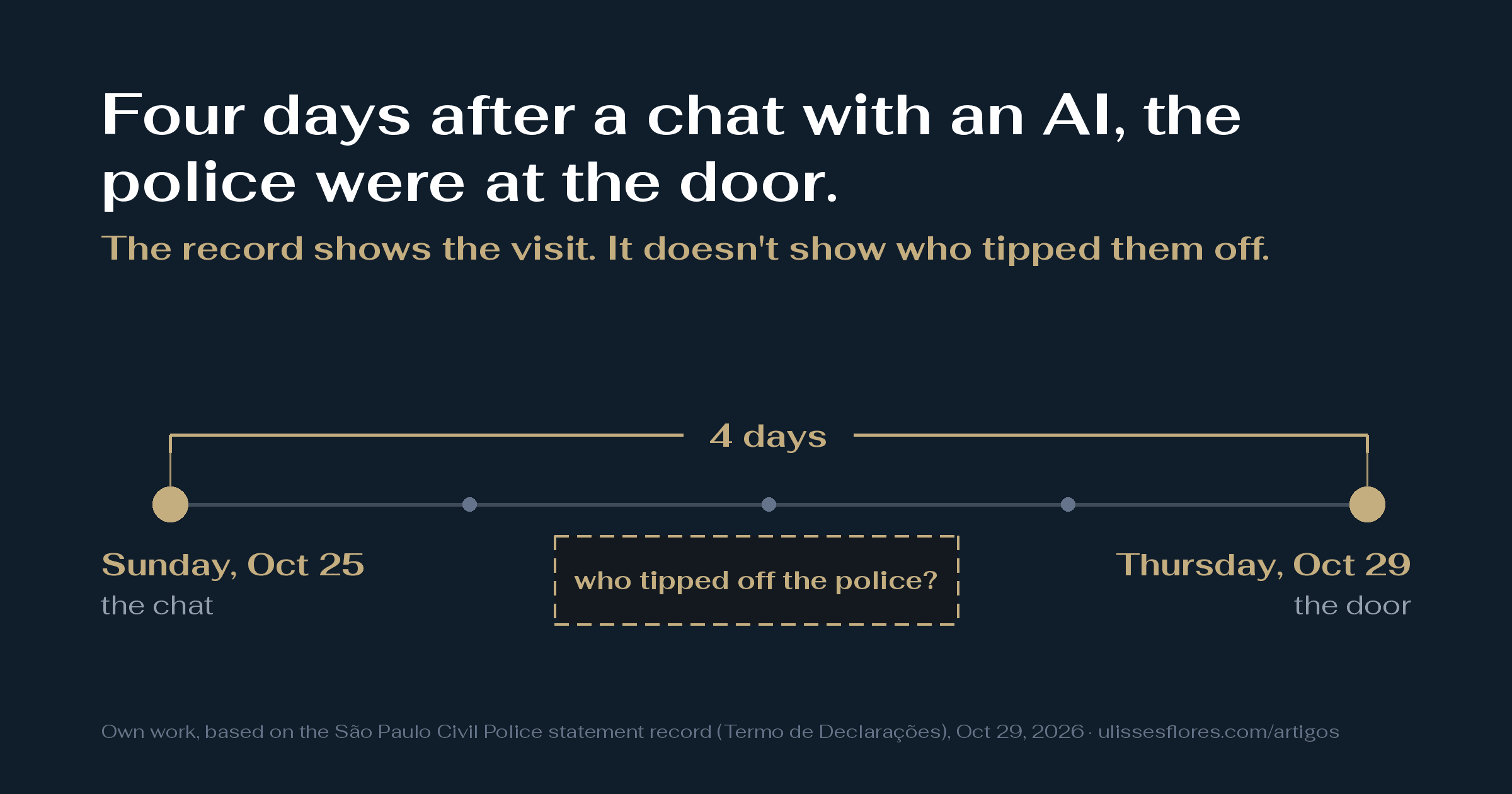
Sunday, October 25, the night the votes were counted. A 31-year-old businessman was at home with his wife and his brother-in-law; they were drinking and playing cards. The result came out, and he went to Claude, Anthropic's artificial-intelligence assistant, to ask whether the election could have been rigged, given how many votes the winner had received. Then the conversation changed character. He "began asking the platform for a plan to kill the President of the Republic" (Brazil's, that is), and added the caveat that it was "in a joking tone." That is what the Termo de Declarações, the official record of his statement to São Paulo's Polícia Civil (the state investigative police), says, in his own voice. In that same version, it was the machine that told him to calm down: it replied that he "was very agitated" and that he "should stop with that kind of questioning."
Early in the week, his Claude account was suspended, and he says he didn't understand why. On Thursday the 29th, police officers showed up at his house and invited him to give an explanation at a Delegacia Especializada (a specialized police unit), an invitation he accepted "promptly." He handed over his firearm for seizure; he is a CAC ("colecionador, atirador desportivo e caçador", collector, sport shooter and hunter: a category of civilians licensed to own guns), has owned a gun since 2022 and, according to the statement, has his paperwork in order. He gave them access to his phone. Nothing on it turned up "any relevant element related to the facts under investigation," and the device was handed back to him on the spot.
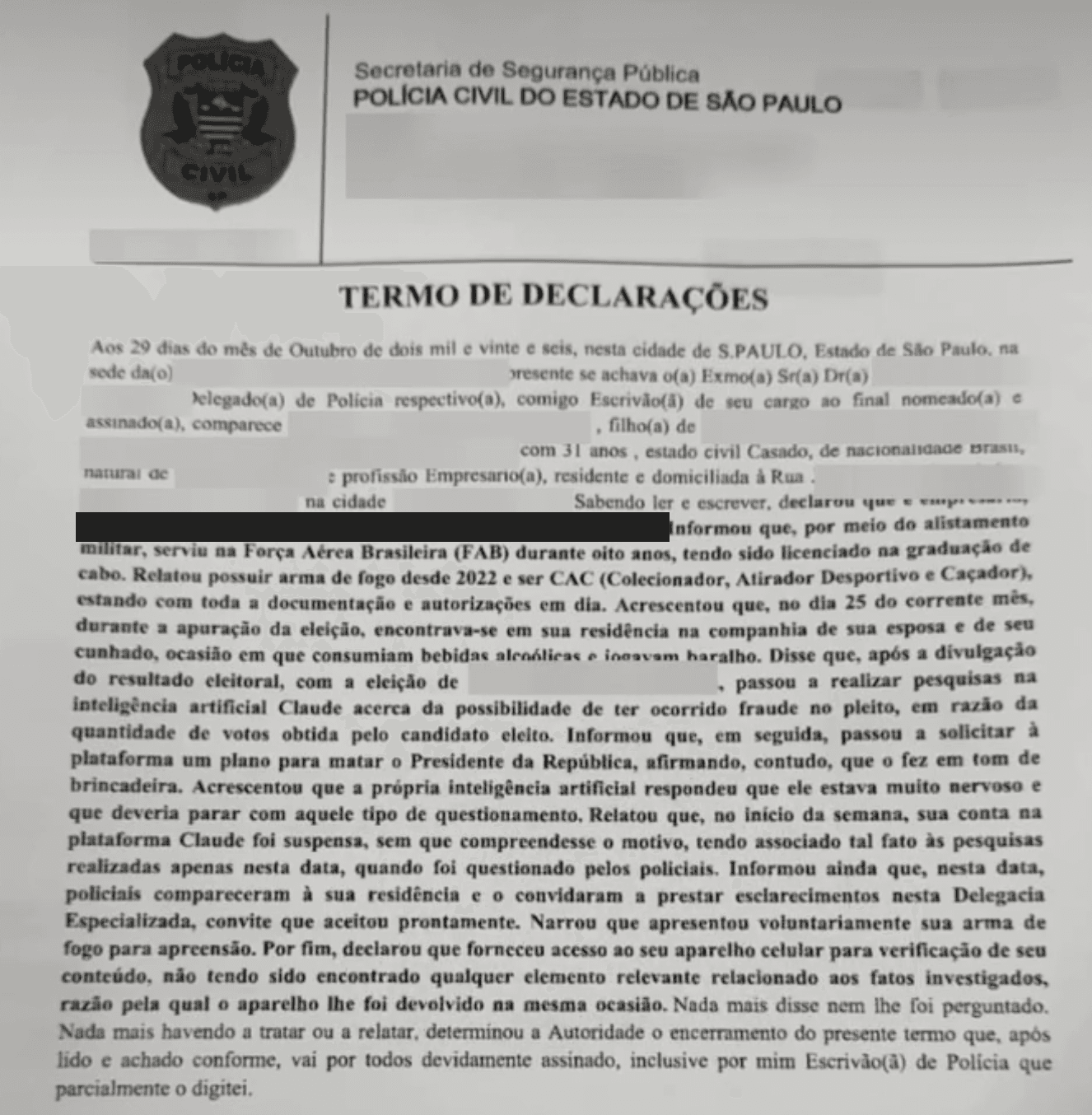
Look at the verbs. Declared, informed, reported, added, said, recounted. The whole document is in the declarant's voice, typed up by the escrivão, the police clerk who takes down statements; even the phone with no "relevant element" comes wrapped inside a "declared that." This is not the police telling you what they did. It is his version, in the station's format and with the station's signature.
Let's get one thing out of the way. Asking an AI, with drinks going around and the count barely over, for a plan to kill the president is a terrible idea, joke or no joke. But that isn't the story.
The story is that four days after a conversation with a machine, the police were at the door, and the subject, as far as the statement lets on, was that conversation. That should bother anyone who types their life into an AI assistant, including people who would never ask for anything of the sort. His lawyer asked the right question in an Instagram video: "how do they get access to what we say to artificial intelligence?" The statement doesn't answer. The contracts you accepted when you opened your account do, at least in part.
Four days and a hole in the middle
The document is called a Termo de Declarações. It was drawn up "on the 29th day of the month of October of two thousand and twenty-six, in this city of S.PAULO," before a delegado (a police chief, the officer who presides over police investigations in Brazil) and an escrivão, and it ends the way these documents always end: "having been read and found accurate, it is duly signed by all." The declarant describes himself as a businessman, married, 31 years old. He served eight years in the Brazilian Air Force and was discharged as a corporal. He is a CAC (collector, sport shooter and hunter) and has owned a firearm since 2022, "with all documentation and authorizations up to date."
The timeline he gives fits in three lines:
- October 25, Sunday. Election count, at home, with his wife and brother-in-law, "at which time they were drinking alcoholic beverages and playing cards." After the result, the searches about fraud; "next," the request for the plan; finally, the AI's reply telling him to stop.
- "Early in the week," no day given. The Claude account is suspended, "without his understanding the reason."
- October 29, Thursday. Police at the house, the invitation to the Delegacia Especializada, the gun handed over for seizure, the phone checked and returned, the statement signed.
Two ends with dates and a middle with no calendar. The statement carries no inquérito number (the formal police investigation), attributes no crime, cites no warrant, and says neither why the account went down nor how the police got to his name. But it isn't a neutral piece of paper on the matter either: it speaks of "facts under investigation" and of a Delegacia Especializada. Someone, somewhere, is investigating something.
The statement dates the conversation and the visit; the account suspension, which falls between the two, has no day.
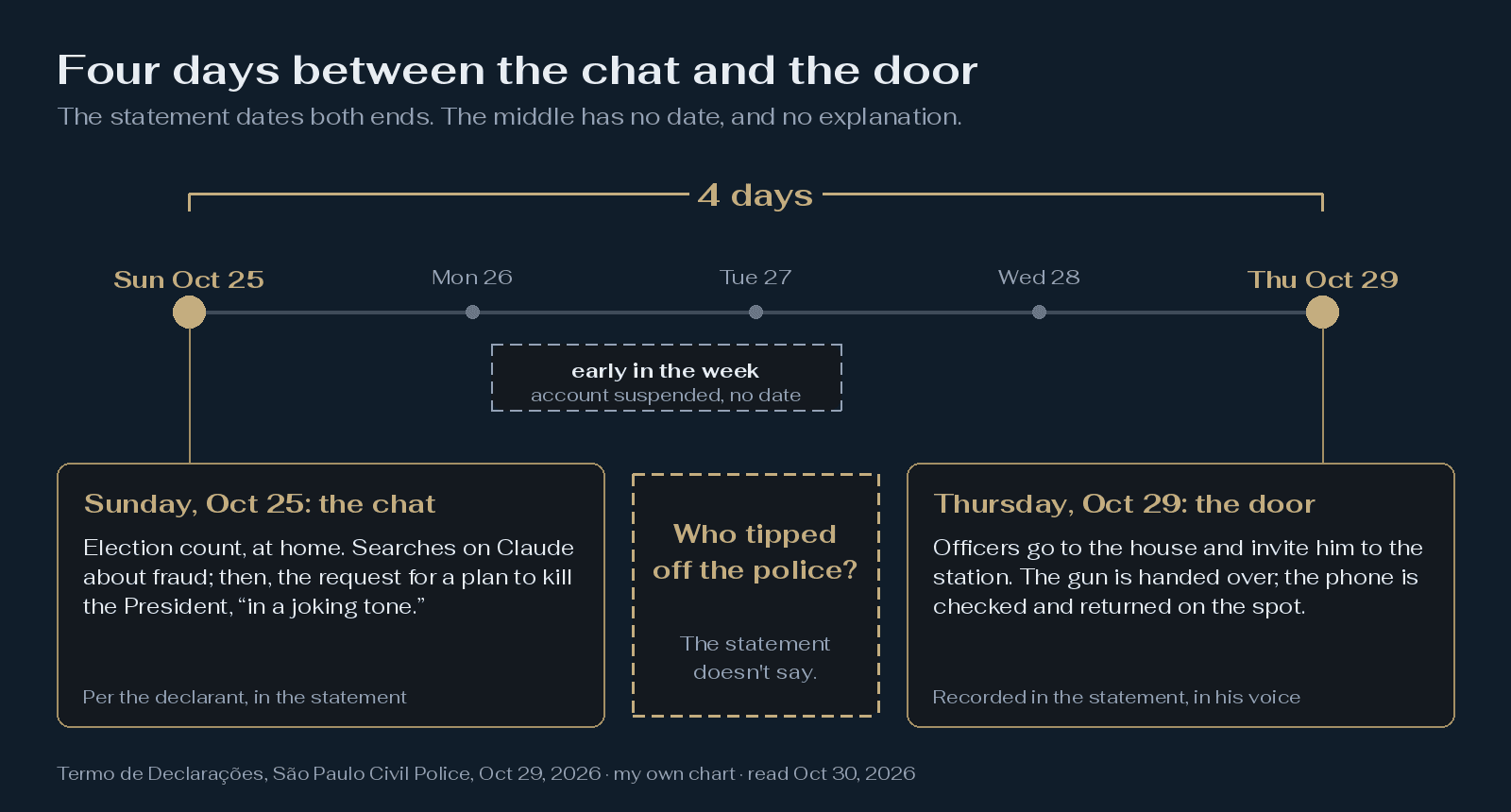
Look at the dashed stretch. The account suspension is the only event of the week without a date, and it is precisely the one that could tell us something about how the conversation traveled to the police. The lawyer's video was recorded the next day, and he says "yesterday, right, 10/29," which matches the date on the document.
Five words that turn the story inside out
In the middle of the statement sits a clause that, read slowly, changes the meaning of everything before it. The full sentence:
"He reported that, early in the week, his account on the Claude platform was suspended, without his understanding the reason, having associated that fact with the searches carried out only on this date, when questioned by the police."
"Relatou que, no início da semana, sua conta na plataforma Claude foi suspensa, sem que compreendesse o motivo, tendo associado tal fato às pesquisas realizadas apenas nesta data, quando foi questionado pelos policiais."
The five words are the last ones: "quando foi questionado pelos policiais," when questioned by the police. In his version, the order goes like this. He talks to Claude on Sunday. He loses the account days later and doesn't understand why. The police show up. And only then, faced with their questions, does he connect one thing to the other. In my reading, it was the police who brought the subject of Claude into the room, not the other way around. He didn't know why he had lost the account; the explanation arrived with the officers.
There is an ambiguity, and I'd rather show it than pick a side in silence. "Apenas nesta data" ("only on this date") can refer to the searches, done only on that day, the 25th, with the paperwork's boilerplate "nesta" ("this") standing in for "naquela" ("that"); or to the association, made only on the 29th, when he was questioned. The very next sentence of the same statement uses "nesta data" for the 29th ("He further stated that, on this date, police officers came to his residence"), and both readings stand. The one that matters doesn't change: the link between the account and the conversation shows up "quando foi questionado pelos policiais."
By the statement's own account, he only linked the suspended account to his Claude conversation "when questioned by the police."
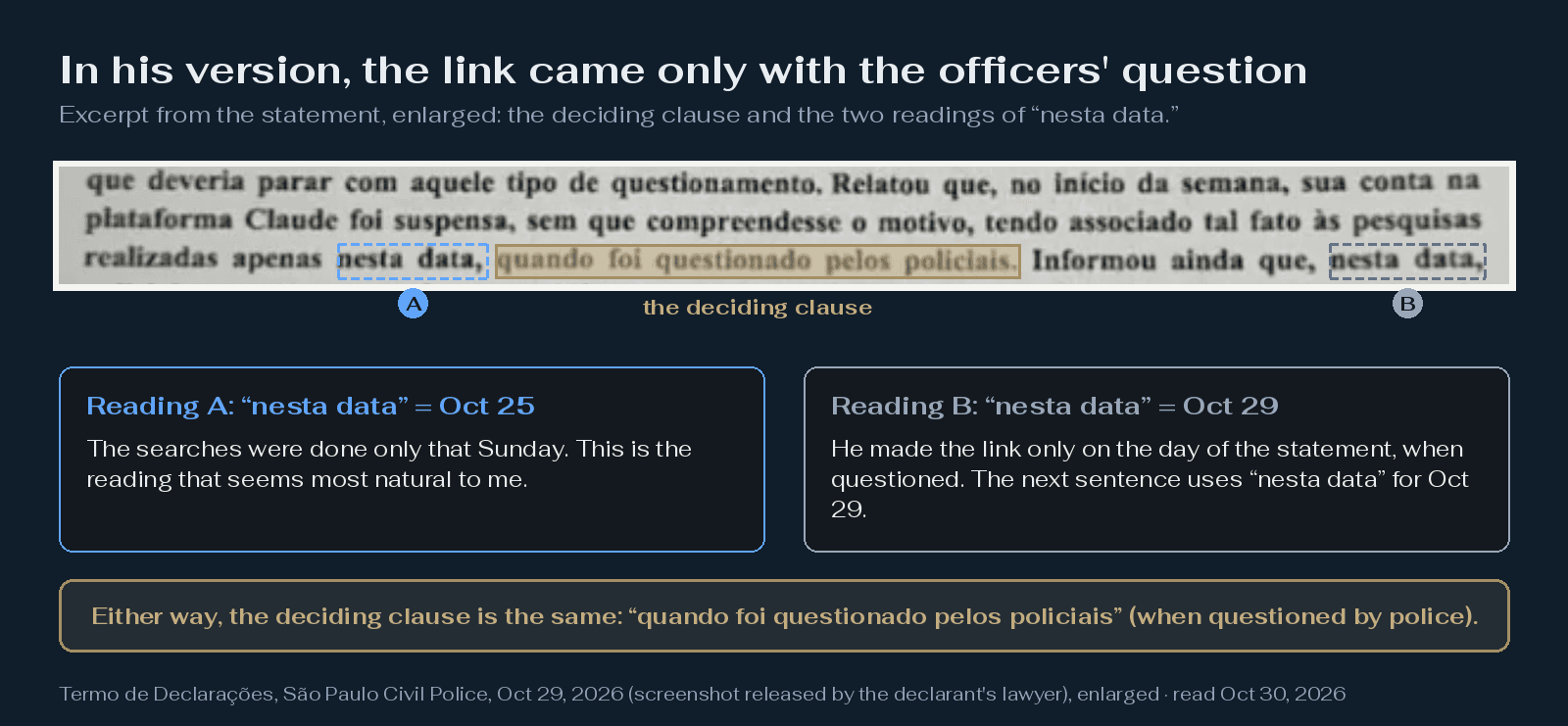
Notice where the gold highlight sits: not on the dashed "nesta data," A and B, which is the ambiguous part, but on the clause that doesn't move. Pick whichever reading you like for the date; in both, the ones asking the questions were the police.
Warrant or invitation: the same Thursday told twice
The second source in the case is a video by the declarant's lawyer, posted on Instagram on the @dr.andreyblanco profile with the caption "Be very careful! U could end up in jail!" He says the client came to him and authorized the recording, and he shows the statement on screen, with the personal details hidden. The tone is a warning: he asks that the video be shared "especially in all the WhatsApp groups," so that nobody wakes up "with the police at your door" for "having a chat with your pet artificial intelligence."
The visit he describes is rougher than the one in the statement:
| Topic | The lawyer, in the video | The statement |
|---|---|---|
| How the police arrived | "Several Polícia Civil cars at your house executing the search and seizure warrant" (mandado de busca e apreensão) | Officers "invited him to provide clarifications," an "invitation he promptly accepted" |
| The gun | The police went to the house to seize his weapons | "Voluntarily presented his firearm for seizure" |
| What comes next | "He's going to have to answer to a case"; "get this inquiry quashed" | No inquiry number and no crime attributed; speaks of "facts under investigation" |
| The alcohol | "Under the influence of alcohol," "just idle chatter" | "They were drinking alcoholic beverages and playing cards" |
I don't pick between the two columns, and there's no reason to call either one false. A statement record captures the testimony, not the whole police operation: nothing in the screenshot rules out a warrant, and nothing in it shows there was one. "Invitation he promptly accepted" and "voluntarily presented" are formulas that serve both sides; they record a declarant who cooperated and a visit without friction. The lawyer, for his part, is doing his job: defending his client and warning the public.
What the two columns share is what matters here: there was a visit on Thursday, the gun stayed with the police, and nobody, in either version, says where the information came from.
The speech-recognition program I used to transcribe the video heard "cloud cloud cloud" where the lawyer said Claude. Cloud. For a video asking where your conversation ends up, the machine was wrong in exactly the right way.
Lawyer and statement agree there was a visit and that the gun stayed with the police; they differ on how it happened.
Where what you type ends up
First, the distinction almost nobody has straight. In an encrypted message between two people, the company carries the text without being able to read it; the recipient reads it, and can forward it or report it. That's what I showed when I checked the claim that nobody has proved Meta reads WhatsApp: the conversation stays private only as far as the other side decides. In a conversation with an AI, the other side is the company itself. The text arrives readable on its servers, because that is exactly what the model has to read in order to answer.
And the company says, in writing, what it may do with it. Anthropic's Privacy Policy, in effect since September 10, 2026 according to the page's own header, provides in section 3 that personal data may be shared with authorities when there is a "good-faith belief" that doing so is reasonably necessary to, among other reasons, "prevent serious harm to any person or to property."
The Consumer Terms, in effect since October 8, 2025, are more direct, in the Legal Compliance clause:
"We reserve the right, at our sole discretion, to report information from or about you, including but not limited to Inputs, Outputs, or Actions to law enforcement."
Inputs, Outputs, Actions: what you type, what Claude answers, and what it does on your behalf. "At our sole discretion." Read that again. There is no requirement there of a police request, a court order or an imminent threat. I've already shown here that the assistants' terms of use forbid even measuring the answers they give voters; the same contracts spell out what the company may do with what you write, and almost nobody reads them before the first prompt.
The government-requests policy covers a different door: the one for when the police ask. The rule is to hand over data only with valid legal process, such as a subpoena or a warrant. The exception is "an emergency that may result in imminent physical harm or death," when handing it over without delay could prevent it. A tip the company sends on its own initiative rests on the Terms and the Privacy Policy.
This isn't theory. In 2026, the route was described twice in the United States.
In Florida, according to the arrest report cited by WINK News on September 30, a user wrote on September 26 that she would "shoot up" the Lee County Sheriff's Office and, the next day, that she had gotten a new gun. The report says Anthropic's platform monitors "key phrases" and potentially threatening content, and that, given the severity, the case was "escalated to a human review team," which reported the messages to police, always according to the report. She was charged with a written threat of violence under Florida law. The sheriff said she later told them she used the AI as a "diary," and warned that users are never "truly anonymous." An AI and management professor at Florida Gulf Coast University put the problem in one line: "AI is not your best friend," and advised caution about treating the platform as a "private diary." WINK says it reached out to Anthropic; the story carries no response from the company.
In San Francisco, according to a police report obtained by the San Francisco Standard, a user wrote to Claude on Friday, August 14, at 14:30, that he had bought an AR-15 rifle and had Anthropic's CEO "in his sights." The company notified police the following Tuesday, August 18, at 9 a.m. This time there was an official statement. A spokesperson told the paper:
"We banned this account, consistent with our standard practice, and referred the case to law enforcement. This is our safeguards process working as intended."
Safeguards, in this business, are the system's safety locks. The user, reached by phone, told the paper he was joking, in considerably cruder terms, and that he was embarrassed. He was not arrested or charged, and the paper did not identify him. The story doesn't confirm the gun purchase. A Santa Clara University law professor interviewed by the Standard laid the dilemma on the table: if companies don't report, they're on the hook if the crime happens; and the more unpopular they get, the more pressure they feel to over-report, knowing that some of the people flagged "shouldn't be targeted at all."
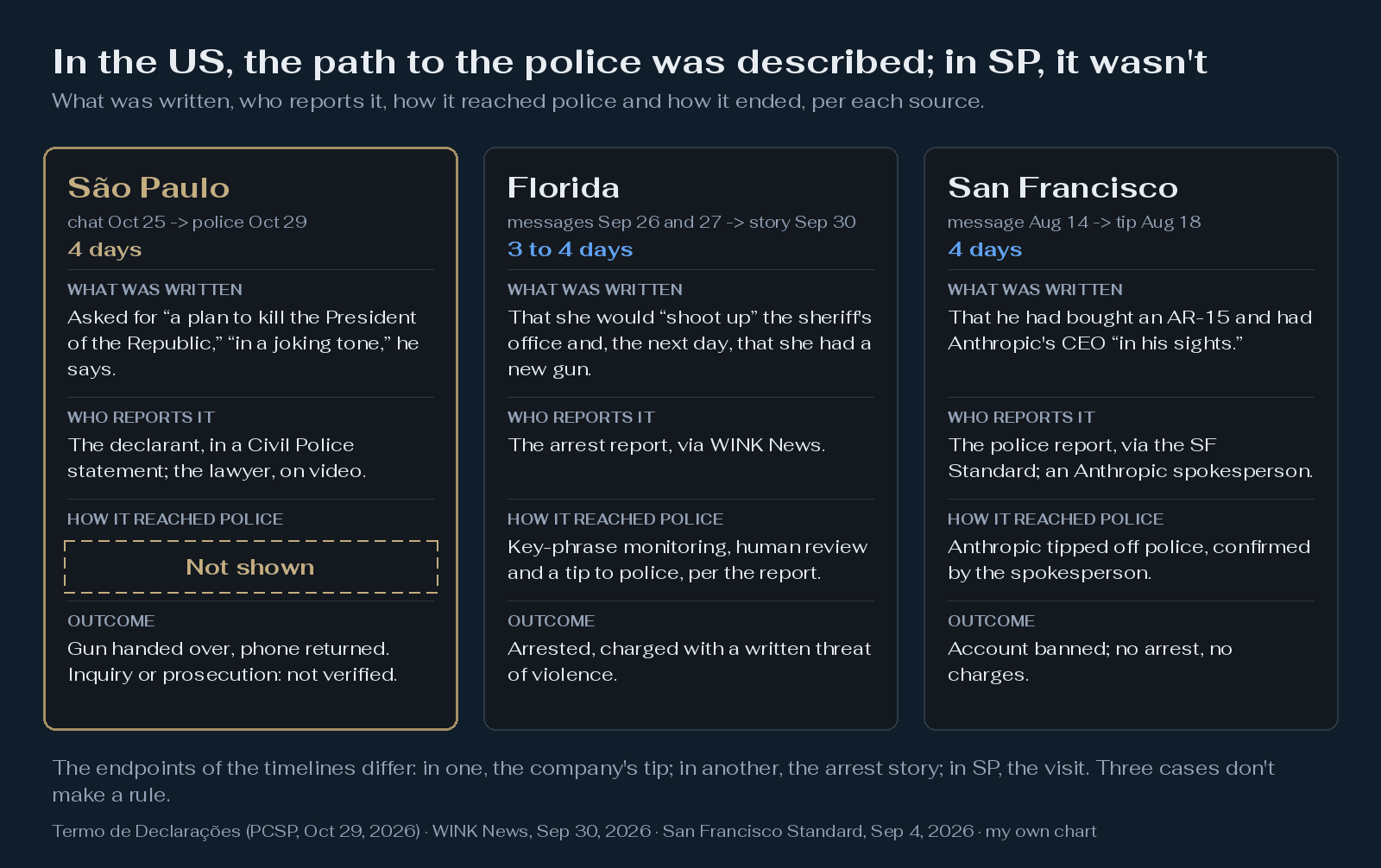
Look at the "how it reached police" row. In Florida, the one describing the route is an arrest report as told by a local TV station; in San Francisco, the company itself, through a spokesperson. In São Paulo, the cell is dashed. And look at the timing: four days between the message and the tip in San Francisco, four days between the conversation and the visit in São Paulo. The endpoints aren't the same, and three cases don't make a rule. But the coincidence is there, and I'm not going to pretend I didn't see it.
Here comes the one caveat this piece needs to spell out in full. Nobody has shown who tipped off the police in São Paulo. The statement doesn't mention Anthropic, a complaint, an official request, or how the information arrived. My hypothesis, and I'm flagging it as a hypothesis, is that the possibilities run from the platform itself, along the route its own documents describe and that has already been used in the US, to a third party who learned of the conversation some other way. The account suspended before the visit is consistent with the first and doesn't prove it: suspending an account and calling the police are different acts, and one doesn't imply the other. It's the lesson of the WhatsApp case, in reverse. There, a ban didn't prove reading; here, a suspension doesn't prove a report.
The automated filter that reads your request, in any case, is no abstraction. I've had a study of mine cut short by a safeguards classifier, and I told the story of when the refusal stopped the study of refusals. The machine reads. That's what it's for.
Anthropic's Terms reserve the company's right to report what you write to the police, "at our sole discretion."
What the Penal Code says, and what it doesn't decide
This section isn't legal advice. It's a reading of the statute's text, so you know where each argument starts from.
In the video, the lawyer says he learned in law school that "atos preparatórios" (preparatory acts, the steps taken before a crime begins) "are not punishable" and that "that's what's written in the penal code." I went to the consolidated text of the Código Penal, Brazil's Penal Code, on the Planalto site, the federal government's official portal for legislation.
| Article | What the text says |
|---|---|
| Art. 14, II | A crime is attempted "when, once execution has begun, it is not consummated for reasons beyond the agent's will" |
| Art. 31 | "Agreement, determination or instigation, and aid, unless expressly provided otherwise, are not punishable if the crime does not at least reach the stage of an attempt" |
| Art. 147 | "To threaten someone, by word, writing or gesture, or any other symbolic means, with causing them unjust and serious harm: Penalty - detention, from one to six months, or a fine". Under §2, outside the case in §1, prosecution depends on a formal complaint by the victim |
| Art. 359-L | "To attempt, with the use of violence or serious threat, to abolish the Democratic Rule of Law, preventing or restricting the exercise of the constitutional powers" (imprisonment of 4 to 8 years) |
| Art. 359-M | "To attempt to depose, by means of violence or serious threat, the legitimately constituted government" (imprisonment of 4 to 12 years) |
Art. 31 lists agreement, determination or instigation, and aid. In plain words: arranging, ordering or inciting, helping. Those are ways of taking part in a crime, and the article says they go unpunished if the crime doesn't at least reach an attempt, "unless expressly provided otherwise." The phrase "ato preparatório" doesn't appear there. In my reading, the line between preparing and executing comes from Art. 14, II: there is only a "tentativa," an attempt, "once execution has begun."
The text itself sets two things beside that argument, and both are my reading, not a legal opinion. Under Art. 147, the crime is the act of threatening itself, "by word, writing," with no requirement that the announced harm happen; whether a request typed to a machine counts as "threatening someone," the text alone doesn't say. And Arts. 359-L and 359-M, added by Law 14.197 of 2021 under the title of crimes against the Democratic Rule of Law, describe the conduct of "attempting" as the crime; there, the attempt already is the crime, and the general rule of Art. 31 has to be read with that alongside it.
Which of these articles applies to what he wrote, if any does, isn't in the statement and isn't mine to say. Classifying the offense falls to the police station and, later, to the Ministério Público, the public prosecutor's office, which decides whether to file charges. I don't know if it will.
The idea that preparatory acts aren't punished is the lawyer's; the police classify the offense, and prosecutors decide on charges.
What I'd do with this
I don't know who tipped off the police in this case. I know what the documents show, and that's enough to change some habits.
- Treat your conversation with an AI as a document other people can read, not as a diary. The Florida user, according to the sheriff, used the AI as a diary. The professor interviewed by WINK News already gave the answer: AI is not your best friend. The text you type arrives readable at the company, because that text is what the model reads.
- Read the clause before you need it. The Consumer Terms reserve to Anthropic, at its sole discretion, the right to report what you write to the police.
- Don't write threats, not as a joke, not with drinks on the table. In San Francisco, the user told the paper he was joking; the company had already called the police. In São Paulo, the "joking tone" shows up in the testimony, after the police visit. In both cases, the joke got explained when the police were already on it.
- If your account gets suspended, save the notice, the date and the time. The São Paulo declarant says he didn't understand why; the link to the conversation, according to the statement, he only made when the police asked.
- If the police come looking for you, talk to a lawyer before anything else, before giving a statement and before handing over your device. This isn't legal advice; it's the bare minimum the case teaches.
A chat with an AI is not a diary: the text reaches the company readable, and its own Terms let it take that to the police.
Whether the São Paulo case becomes a prosecution, none of us knows yet. When the inquiry, the warrant or Anthropic's word on this case turns up, come back to the scorecard below and see which line changed. And check the foundation of all this with your own eyes: the sharing clause is in section 3 of the Privacy Policy, and the one on reporting to authorities, under Legal Compliance, is in the Consumer Terms. If the text you read differs from what I quoted, send it to me; I'll update and credit you.
The case scorecard
The statement confirms the visit, the surrendered gun and the returned phone; it doesn't show who took the conversation to the police.
| Claim | Who claims it | Verdict |
|---|---|---|
| Police went to his house on Oct 29 | Lawyer, in the video | ✅ The statement records: "on this date, police officers came to his residence" |
| The conversation with Claude was on Oct 25, after the election result | The declarant, in the statement | ✅ Recorded in the statement, in his words |
| He asked for "a plan to kill the President of the Republic" (Brazil's), "in a joking tone" | The declarant, in the statement | ⚠️ Only his word: nobody has published the conversation |
| He only linked the account suspension to the searches when questioned by the police | The declarant, in the statement | ✅ Verbatim: "having associated that fact with the searches [...] when questioned by the police" ("quando foi questionado pelos policiais") |
| The police arrived with a "search and seizure warrant" and "several cars" | Lawyer | ⚠️ The statement records an accepted "invitation" and cites no warrant or cars. Not verified |
| The gun stayed with the police | Lawyer and statement | ✅ The statement: "voluntarily presented his firearm for seizure" |
| The phone was checked and returned | The declarant, in the statement | ✅ Returned "on the same occasion," without "any relevant element" |
| "He's going to have to answer to a case" | Lawyer | ⚠️ The statement speaks of "facts under investigation," with no case number or crime. Not verified |
| The statement shows Anthropic tipped off the police | Inference the case invites | ❌ The statement doesn't mention Anthropic, a complaint, or how the police found out |
| Anthropic can take what you write to the police | Anthropic's Consumer Terms | ✅ "At our sole discretion," in a clause in effect since Oct 8, 2025 |
| It has already happened | WINK News and SF Standard | ✅ In two US cases in 2026, according to police reports and, in one of them, a company spokesperson |
Methodological note. This case has two sources, and both are interested parties: the video the declarant's lawyer posted on Instagram (profile @dr.andreyblanco, viewed on October 30, 2026) and the screenshot of the Termo de Declarações he shows in it, with personal data blacked out at the source and one more line, which described the declarant's occupation, blacked out by me. The transcription of the statement is mine, made from the image. In the headline, "in São Paulo" comes from the statement, drawn up "in this city of S.PAULO" by the State Civil Police; the declarant's city of residence is blacked out. The days of the week (Sunday the 25th; Thursday the 29th) come from the calendar, not from the statement. The lawyer says in the video that the client authorized the recording; the authorization to release the screenshot was stated by him and passed on to me, with no document that I have seen. I have no confirmation from the Civil Police, the courts or Anthropic, and I found no independent coverage of the case as of October 30. I have not seen the conversation with Claude: what is known about it is what the declarant said. The lawyer's words were transcribed by speech-recognition software, and the quotes follow the transcription, with my punctuation and without the verbal stumbles. I did not read the video's 187 comments, which require a login. The Privacy Policy's effective date is taken from the page's own header; the published version history lists versions only up to January 12, 2026. The Privacy Policy, the Terms, the government-requests policy, the US stories and the Penal Code were read in the full text of the pages on October 30, 2026. Nothing here is legal advice. The article was written first in Portuguese; the English version is my own translation.
Verified on October 30, 2026; text rewritten and revised on October 31, 2026. Read from the screenshot of the Termo de Declarações and the lawyer's video (automatic transcription); checked against the full text of the pages, on October 30: Anthropic's Privacy Policy and Consumer Terms, the government-requests policy, the WINK News and San Francisco Standard stories, and the consolidated Penal Code on the Planalto site. Not verified: whether there was a warrant, an inquiry or a prosecution; the reason for and the date of the account suspension; how the police learned of the conversation; the content of the conversation with Claude, which nobody has published; the authenticity of the statement beyond the screenshot; and the video's 187 comments. I did not contact the Civil Police, the courts or Anthropic for this piece.
Sources
- Video by the declarant's lawyer on Instagram, profile @dr.andreyblanco (in Portuguese; viewed October 30, 2026)
- Termo de Declarações (statement record), São Paulo State Civil Police, October 29, 2026: screenshot shown in the video above, no link of its own (in Portuguese; read October 30, 2026)
- Anthropic, Privacy Policy, in effect since September 10, 2026, section 3 (captured October 30, 2026)
- Anthropic, Consumer Terms of Service, in effect since October 8, 2025, Legal Compliance clause (captured October 30, 2026)
- Anthropic, What is Anthropic's policy for handling governmental requests for user information? (captured October 30, 2026)
- WINK News, Woman arrested after AI threat against Lee County Sheriff's Office: Investigators, September 30, 2026, updated October 1, 2026 (captured October 30, 2026)
- San Francisco Standard, Rachyl Jones, Anthropic called SFPD over threat against CEO. Claude user says it was a misunderstanding, September 4, 2026 (captured October 30, 2026)
- Planalto, Código Penal (Decreto-Lei 2.848/1940), consolidated text (in Portuguese; captured October 30, 2026)