Short report. All measurements taken 25 August 2026 (UTC). Code, raw responses and cryptographic hashes are released with this report so that every number below can be re-derived or refuted.
Concept DOI (all versions) 10.5281/zenodo.22102596 · repository github.com/ulissesflores/rebec-search-fidelity
Version note. This English text is the version of record. A full Portuguese translation is deposited under the same DOI; where the two diverge, this file governs.
1. Introduction
Trial registries exist so that studies can be found, and — under the World Health Organization's updated guidance — so that their summary results can be read there [1]. That function is load-bearing: systematic reviewers search registries to detect unpublished and ongoing studies [2], a practice frequent enough to be measured within a single surgical specialty [3]; clinicians and patients search them to find studies they might join, and have called for search filters that registry interfaces do not currently offer [4]; journalists and meta-researchers search them to make claims about what a country, or a field, is and is not studying [5]. All of these uses share a property that makes them fragile: an empty result is informative. "There are no registered trials on X in Brazil" is a conclusion people draw, publish, and act on — and for ReBEC, a WHO ICTRP primary registry, that conclusion rests on nothing, because the registry's public search never queries the registry's database. What it queries is a third-party web index of the registry's own pages, and the filtering it performs happens in the visitor's browser.
That inference is valid only if the search actually searched, which is a falsifiable claim and the measurement this report makes. We state the outcome before the results because the three defects below are not three independent faults: two of them are what that single decision produces, and the third is where the decision meets a separate certificate configuration.
ReBEC was created to strengthen the management of clinical research in Brazil [6] (the 2009 notice announces it under the acronym Rebrac) and is operated within the Brazilian public health system; it is one of the WHO ICTRP primary registries [7]. Latin American registration practice, including Brazil's, has been studied for adherence and completeness [8,9,10], and meta-research on registries at large has concentrated on the content of the entries — typically their agreement with the journal article that follows [11,12,13]. We found no prior report evaluating whether a trial registry's public search interface returns what its database contains. The gap we address is therefore narrow and stated as such (§4.3).
2. Methods
2.1 Design and positive controls
Every measurement pairs a term of interest with a positive control — a term known to have
records in the registry (dengue, diabetes). Without a positive control, an empty result cannot
distinguish "there is nothing" from "the search did not run"; that distinction is the entire subject
of this report. Both controls were fixed before the measurements, not chosen post hoc.
8 terms were used in all, in two sets that this report keeps distinct. 6 of them — dengue,
diabetes, prion, Creutzfeldt, Jakob, priônica — were run against both the public interface
and the registry's own data endpoint, and they are the set behind defect 2 (§3.3). The browser arm
of §3.4 added 2 more, doença priônica and príon, for which no data-endpoint measurement was
taken.
2.2 Instruments and identifiers
Three command-line instruments accompany this report, one per defect:
| Instrument | What it measures |
|---|---|
code/measure_public_search.py | The served response of the public search endpoint for each term; the registry's own data endpoint for the same terms |
code/measure_archive_timeline.py | Internet Archive captures of the same endpoint for three different query terms |
code/measure_defect1_tls.py | The two links of defect 1: the URL the published widget configuration names for this site, and whether the certificate served for that hostname covers it |
They share one exit convention, and it is the report's own argument (§2.1) applied to the report's own instruments — a measurement that failed must never be readable as a negative result:
| Exit code | Meaning |
|---|---|
0 | the finding held on this run |
1 | the measurement was valid and the finding did not hold — the defect may have been repaired |
2 | the measurement could not be made, which says nothing at all about the finding |
Validity is therefore decided before the verdict: measure_public_search.py declares a run invalid
if any request never completed or if a positive control comes back with no records, and in that case
writes finding_confirmed: null rather than false. Re-running any instrument writes under
output/reruns/, never over the sealed JSON whose hash this report publishes.
All three record byte counts, MD5 and SHA-256 of every response, so that any reader can verify that the artefacts distributed with this report are the responses we actually received.
The registry's own data endpoint is /api2/api/search, whose contract is published by the registry
itself at /api2/openapi.json. It follows the DataTables server-side convention, in which the global filter
parameter is search[value] [14]. Passing an unrecognised parameter (e.g. q=) does not raise an error; the
endpoint ignores it and returns the entire base (9,629 records on the day of measurement). This is
ordinary REST behaviour rather than a defect, but it is a trap for anyone writing a script against
this endpoint, and we note it for that reason alone.
2.3 Browser measurement
Defect 1 concerns what a person experiences, so it was measured in an ordinary, logged-in desktop Chrome browser rather than by any headless automation: the search box on the registry home page was used exactly as a visitor would use it. The result set for defect 3 was likewise enumerated from the rendered page, paging until no new results appeared, and the enumeration was repeated in a second independent run to test stability.
2.4 Recall by identifier, not by result count
The interface displays an estimate ("approximately N results"). That estimate is unstable and we do
not use it: the same query for dengue produced "approximately 38 results" on first render and
"approximately 20" on the two subsequent runs. Recall is therefore computed over sets of trial
identifiers (RBR-*), which were identical across the two independent runs, and in the standard
sense: the fraction of the relevant set that the system returns [15].
2.5 Statement on research conduct
Our instruments send a browser User-Agent string. This is not cosmetic and not an attempt to
misrepresent: the registry's web server returns HTTP 403 to clients that do not send one, so without
it the measurement would record "403 for everything" and would be reporting a third cause. We did
not circumvent authentication, rate limits, or robots.txt. The registry's robots.txt permits
Googlebot and Algolia Crawler at /, and disallows /assets/, /uploads/ and /matomo/ for
all agents plus /xml_ictrp/ for generic agents; the paths we retrieved are not among the disallowed
ones. No personal data was collected. No account was created or used.
3. Results
3.1 The public search of ReBEC does not query the registry
The served HTML of the registry contains an active Google Custom Search widget
(cse.google.com/cse.js?cx=ad5f3224a2a0fa826): a gcse-searchbox-only element on the home page and
a gcse-searchresults-only element on the results page. The registry's earlier native search forms
are still present in the served HTML but are enclosed in HTML comments, one of them carrying the
developer's own note, "comentando busca antiga" ("commenting out the old search").
The consequence is structural rather than incidental: what a member of the public queries is Google's index of the website's pages, not the registry's 9,629 records. The de facto search of a WHO ICTRP primary registry is a third party's index of that registry's own web pages.
That single decision organises what follows, and we set the relation out before the measurements so that the three are not read as three independent faults. Defect 2 (§3.3) and defect 3 (§3.4) are consequences of it: filtering moved into the visitor's browser, and coverage became a third party's index of pages rather than the registry's own records. Defect 1 (§3.2) is not a consequence of it alone — it is where the configured target host of the outsourced widget meets a TLS certificate that does not cover that host, which is a separate configuration fault. We report all three because each was measured separately, and we subordinate them here because they do not carry equal independence.
3.2 Defect 1 — the registry's own search box ends on a browser security warning
This defect was repaired after the measurement. Everything in this section is what was observed on 25 August 2026 and is left as measured; the certificate served for the
wwwhost changed later that day and no longer produces the interstitial. See §5.1 for the dated record.
Typing dengue into the search box on the ReBEC home page and pressing Enter navigates to
https://www.ensaiosclinicos.gov.br/search/query/simple?q=dengue and Chrome displays a privacy
error. The search never runs. Each link of the chain was measured independently
(Figure 1):
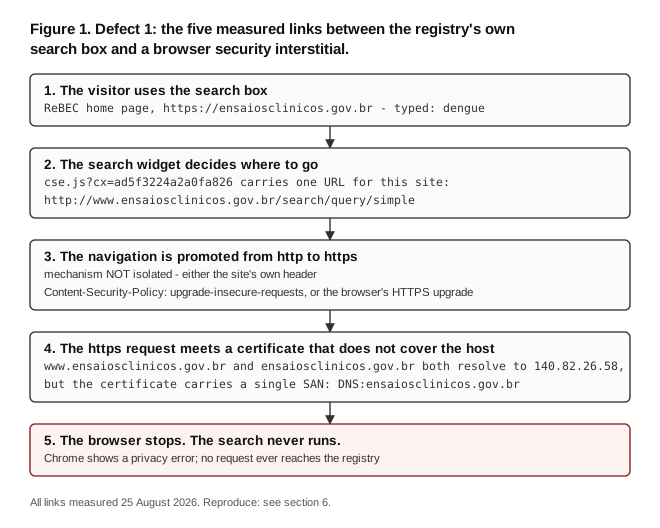
| Link | Measurement |
|---|---|
The search widget is configured to send visitors to the www host, over http | cse.js?cx=ad5f3224a2a0fa826 contains exactly one URL for this site: http://www.ensaiosclinicos.gov.br/search/query/simple |
The www host resolves to the same server | www.ensaiosclinicos.gov.br → ensaiosclinicos.gov.br → 140.82.26.58 |
The certificate does not cover the www host | The identity a TLS client must check is the certificate's subjectAltName [16]: here CN=ensaiosclinicos.gov.br, single SAN DNS:ensaiosclinicos.gov.br (Let's Encrypt, valid 4 Jul 2026 – 2 Oct 2026). curl: "no alternative certificate subject name matches target host name" |
The server would fix this itself, if it were asked over http | http://www.ensaiosclinicos.gov.br/search/query/simple?q=dengue → HTTP 301 → https://ensaiosclinicos.gov.br/search/query/simple?q=dengue |
| But the browser never asks | The navigation is made over https to the www host, so it meets the wrong certificate and stops before the server can answer. We did not isolate which of two mechanisms performs that upgrade, and both are present: (a) the registry itself serves Content-Security-Policy: upgrade-insecure-requests on the home page and on the search page, and the specification upgrades form submissions under that directive regardless of host [17]; or (b) the browser's own automatic HTTPS upgrade, which upgrades main-frame navigations optimistically and falls back to http only when the upgrade fails [18]. No HSTS [19] preloading is involved: hstspreload.org reports status unknown for both gov.br and ensaiosclinicos.gov.br |
A visitor who reaches the canonical host directly — by editing the URL, or following a link that does not pass through the search box — does get results. The defect is in the path the registry itself offers.
3.3 Defect 2 — the served response does not vary with the query, so every non-JavaScript client sees a search that never filters
On the canonical host, the search endpoint returned HTTP 200 with a byte-identical body for all six
terms: 69,877 bytes, a single SHA-256 (bbf0281011e6a783334172b4b1b94e415d08bcda97cabf26480dd5ad2cf47946),
while the registry's own data endpoint discriminated between the same terms on the same day:
| Term | Public search: HTTP | Public search: body (bytes) | Public search: SHA-256 | Registry database: records (of 9,629) |
|---|---|---|---|---|
dengue | 200 | 69,877 | bbf0281…f47946 | 17 |
diabetes | 200 | 69,877 | bbf0281…f47946 | 1,452 |
prion | 200 | 69,877 | bbf0281…f47946 | 1 |
Creutzfeldt | 200 | 69,877 | bbf0281…f47946 | 0 |
Jakob | 200 | 69,877 | bbf0281…f47946 | 0 |
priônica | 200 | 69,877 | bbf0281…f47946 | 0 |
The left three columns do not vary; the right one does. That contrast is the defect.
HTTP 200 is not itself the defect: it is the correct status for a page that renders a form. What we measured is the served body, and it does not vary with the query string; we make no claim about how the server handles the parameter internally, only that nothing of it reaches the response. The defect is that the page presents itself as a search result, is reachable with a query string, and never filters server-side. Because filtering happens only in client-side JavaScript, every client that does not execute JavaScript — command-line tools, harvesters, and web archives — receives a search page that silently ignores the question it was asked. For archival crawlers this is a documented trade-off rather than an oversight: a browserless crawler is cheap and misses whatever appears only once scripts have run [20].
3.4 Defect 3 — what the public search returns is not what the registry holds
Measured for dengue, by identifier:
| Source | Result |
|---|---|
Registry database (/api2/api/search, search[value]=dengue) | 17 trials |
| Public search (Google Custom Search, rendered in Chrome, paged to exhaustion) | 16 distinct RBR- identifiers |
| Intersection | 14 |
| Recall | 14/17 |
The three trials the public search did not surface were inspected individually:
RBR-69pf3bandRBR-7gstxs6— the public trial page exists (HTTP 200) and contains the worddengue, and the public search still does not return it. These are attributable index failures.RBR-5vpyh4— the public page exists but does not contain the term; the database matched on a field that the public page does not display. A text index could not have found it. We do not count this as an index failure; it is a different problem (what the database indexes is not what the page publishes), and we report it rather than absorb it into the headline number.
Two identifiers went the other way (RBR-7jmj48v, RBR-84nk5q6): surfaced by the public search,
not returned by the database filter for that term, and their pages do not contain the term. The
divergence therefore runs in both directions, and we report both — but they are not the same
quantity. The three trials the search omits are a recall failure; the two it surfaces outside
the database's own filter for that term are a precision failure. We measured only the first.
The distinction is the standard one in information retrieval [15], and it has a sharp edge here: an
interface backed by a web index over pages returns something for almost any query, which reads as
responsiveness while leaving recall unmeasured — and, by the interface's own design, unmeasurable
from the outside without a second source to compare against.
All 8 terms were run through the browser path. dengue and diabetes returned results;
prion, Creutzfeldt, Jakob, priônica, doença priônica and príon returned "A pesquisa não
encontrou resultados". The single prion hit at the data endpoint is a substring false positive
(RBR-3w2scz, a smoking-cessation trial), confirmed by opening the record. For this class of terms
the two independent routes agree.
3.5 Duration: the behaviour is not a maintenance window
The Internet Archive captured three different queries to the same endpoint on 23 September 2025,
within two minutes of one another: ?q=crohn (17:08:18 UTC), ?q=artrite psoriática (17:09:46 UTC)
and ?q=psoriatic arthritis (17:09:59 UTC). All three captures are byte-identical (66,525 bytes,
SHA-256 e47f39fbc73fede9f75e40ac37013d610581b4866f54d923b8f46cb76dbfca16), and none of them
contains the term that was searched. The archive's own CDX index records a single digest for the
three, independently of our retrieval.
Defect 2 therefore holds at two measured points 11 months apart (23 Sep 2025 and 25 Aug 2026).
We claim persistence between those two points and not continuity across the interval, and the
distinction is in the data rather than in caution. The archive's CDX index lists six captures of
this endpoint that carry a query string: the three of 23 September 2025 above, and three of 5 June
2024 (two 200, one 301 on the http host). Only the 2025 trio can test the identity of the
response, because only there do different terms meet a single digest. The two 2024 bodies are
byte-identical to each other, but they are the same identifier written with and without a trailing
dot, and that pair would come back empty from a search that worked; we do not offer it as evidence of
defect 2. The other four 200 captures the archive holds (4 Apr 2025, 13 Sep 2025, 13 Nov 2025,
20 Feb 2026) are bare — retrieved without ?q= — so they cannot test whether different terms
return the same response, and their CDX digests differ from one another for that reason. We do not
offer them as corroboration either, and an earlier draft of this report that described them as
consistent and uncontradicted overstated what they can show.
What the 5 June 2024 capture does establish is the decision of §3.1, and it establishes it earlier
than any measurement in this report: its body carries the same Google Custom Search widget,
cse.js?cx=ad5f3224a2a0fa826, that we measured live on 25 August 2026. The same cx is present in
every archived body this repository distributes — 5 Jun 2024, 13 Sep 2025, 23 Sep 2025 and
20 Feb 2026 — so the outsourcing of the search is documentable from 5 June 2024, 15 months before
the first point at which we measure defect 2. The two claims carry different spans and we keep them
apart: in the archive, the outsourcing runs 5 Jun 2024 → 20 Feb 2026, while defect 2 runs
23 Sep 2025 → 25 Aug 2026. The 2024 capture cannot narrow the second, and that is the specific reason
the start date of defect 2 is unknown and unrecoverable: what it shows is a client-side search
widget, and a web archive does not preserve what JavaScript rendered. We therefore do not claim
that the search never worked.
4. Discussion
4.1 What this means for people who search registries
Whoever reaches the registry's records through this interface is searching a third-party web index of the registry's pages, with coverage that is measurable and, in our one measured case, incomplete. The failure is fail-silent rather than fail-fast: nothing in the response tells the caller that the question was never put to the database. A reader cannot tell this from the interface, and the method sections of downstream work cannot record a distinction they were never shown.
We did not measure who arrives by this route, and that limit is sharper than it looks. The same records are aggregated by the WHO ICTRP portal, which we did not measure; the methodological review most relevant to registry searching [2] searched the ICTRP portal rather than the national site. So a systematic review that records "we searched ReBEC" may or may not have passed through the interface measured here, and we do not claim that it did. As a crude indication of how much work sits somewhere downstream of this registry, Europe PMC returns 2,798 records mentioning "ReBEC", 1,234 mentioning "Brazilian Registry of Clinical Trials" and 494 mentioning "ensaiosclinicos.gov.br" (25 Aug 2026). These are co-occurrence counts, not verified claims of having searched, still less of having searched by this route, and we deliberately do not convert them into an estimate of harm.
The archival consequence is separate and worse, because it is silent and permanent: what the Internet Archive holds for this endpoint is a search page that never filtered. Replaying client-side-rendered pages out of an archive is an active problem in digital libraries [21]; here the page replays faithfully, and what it faithfully shows is a search that never filtered. Anyone reconstructing, years from now, what the Brazilian registry could be searched for will find query-insensitive pages.
4.2 What this report does not claim
It makes no claim about intent, negligence or fault. It describes observable properties of a public system on a stated date. It does not claim that ReBEC's records are incomplete — the database answered every query we put to it. It does not claim the search is unusable: on the canonical host, in a browser, it works. It does not claim to know by which route people reach ReBEC's records — the WHO ICTRP portal carries the same records and was not measured here. And it does not generalise defect 1 beyond current Chrome.
4.3 Limitations, stated rather than discovered by the reader
- One browser, and one unisolated mechanism. Defect 1 was observed in current Chrome; Firefox
and Safari were not tested. More importantly, we did not determine which mechanism performs the
http→httpsupgrade (§3.2). This matters in the direction that makes our claim conservative: if the upgrade is performed by the registry's ownupgrade-insecure-requestsheader, the defect is not browser-specific and would reproduce in any conforming browser. We report the header as measured and the attribution as open, rather than claiming either. - One term for recall. Recall was measured for
dengue(17 records). It does not scale by this route: the search element returns at most about one hundred results, so recall for a term such asdiabetes(1,452 records) is not measurable this way. The strong number in this report comes from a small case, and that is a real limit. - Unknown start date, for the reason given in §3.5.
- Response size varies between days. An earlier measurement of ours recorded 69,876 bytes and a different MD5 from the 69,877 bytes reported here. The identity that matters is between terms within a single run; between days the body changes because the page footer carries live counters. We state this because a reader comparing our two datasets would otherwise find the discrepancy and be right to distrust the rest.
- One registry. The obvious next step, which we did not take, is to run this same two-armed protocol (positive control + response-identity test) against the other ICTRP primary registries and publish the census — how many discriminate, how many fail silently, and for how many the protocol does not apply. That is what would turn a single measured case into a survey.
- Prior-art search. Europe PMC and Crossref were searched in English, and SciELO in Portuguese. The claim of novelty is correspondingly narrow: we found no prior report evaluating whether a trial registry's public search returns what its database holds.
4.4 Future directions
Three steps follow from the limits above, and none of them was taken here: (i) run the same
two-armed protocol — positive control plus response-identity test — against the remaining ICTRP
primary registries and publish the census, which is what would turn one measured case into a survey;
(ii) replicate defect 1 in Firefox and Safari and isolate which mechanism performs the http→https
upgrade, by instrumenting the form submission itself rather than a programmatic click, which is the
measurement that would close the open attribution in §3.2; and (iii) measure the downstream
consequence directly, by sampling systematic reviews that record having searched ReBEC, establishing
by which route they searched, and checking whether the trials the public search omits are the ones
those reviews missed — replacing the co-occurrence counts of §4.1 with an effect.
5. Notification
Notification precedes deposit. This report was sent in Portuguese to the registry's operator
(ReBEC, operated within ICICT/Fiocruz) on 25 August 2026 (UTC), before deposit, at two addresses:
the one the registry publishes on its own site, and sic@fiocruz.br, the institutional Citizen
Information Service of the operating foundation, verified on the foundation's own
access-to-information page on the same date. The notice identified this text by its SHA-256 and by
the immutable commit that freezes it, offered the typeset PDF on request, and said plainly that
deposit was imminent. No response was awaited, and none is treated as consent: the
purpose of notifying first is that the operator should not learn from a permanent identifier that a
report naming their system exists.
We do not claim a receipt we do not hold. No formal request under the Brazilian access-to-information statute was filed, and therefore no dated government protocol number accompanies this section: that route runs through a platform requiring an authenticated national-identity account, which is a personal credential rather than an instrument of this report. What exists is the sent message, on the stated date, to the two addresses above. A reader weighing this should weigh it as that and nothing more.
Notice did not go to a computer security response team. The finding in §3.2 is a certificate-coverage fault on a hostname that redirects to the covered one; it exposes no primitive an attacker gains from, so treating it as a vulnerability report would misdescribe it and would escalate over the operator. Escalation remains conditional and is stated as such: it would follow only from a persistent failure to reach anyone, which notification at an institutional address is meant to prevent. The WHO ICTRP was not notified as a disclosure counterparty; it is named in this report only as the platform whose primary registry this is.
Should the interface be repaired, the instrument that watches the repaired defect changes its exit code, and the repair — not this report — becomes the outcome of record. Each of the three defects has one, with the single stated exception that the public arm of defect 3 is enumerated in a browser (§2.3) and is not reproducible by command. That is the intended end of this finding, and the reason the notification carries a date: a reader comparing the repair to this text should be able to tell "fixed after being told" from "never true".
5.1 Repair status — defect 1 was repaired, and this is the record of it
Measured 4 September 2026 (UTC), with code/measure_defect1_tls.py, exit 1. Both measurements of
this section are released as evidence, not asserted: output/repair-2026-09-04/defect1-tls.json and
output/repair-2026-09-04/public-search.json, hashed in the table of §6 like every other artefact
here. The certificate now served for www.ensaiosclinicos.gov.br carries two subjectAltName
entries —
DNS:ensaiosclinicos.gov.br and DNS:www.ensaiosclinicos.gov.br — where the one measured for §3.2
carried a single name. The second link of defect 1 is gone, and with it the defect: the widget's
target host now presents a certificate that covers it, and the request completes on the redirect the
server was always willing to serve.
The dates are the reason this section carries them, and they come from a log neither party controls.
Certificate Transparency records five certificates for this host in 2026
(output/repair-2026-09-04/ct-log-ensaiosclinicos.json, retrieved from crt.sh): 5 January, 6 March,
5 May and 4 July — exactly sixty days apart, each carrying the bare domain and nothing else — and
then 25 August at 22:54:08 UTC, fifty-two days after its predecessor, which still had thirty-eight
days of validity, and the first of the five to carry www.ensaiosclinicos.gov.br. That
fifth broke a renewal rhythm the previous four had kept, and added the name defect 1 turned on, on
the day this report was measured (02:36 UTC) and notified (§5). We do not claim the notice caused
the repair. We measured a re-issue, on that date, adding that name; intent is not observable from
here, and a reader should weigh the coincidence as a coincidence with a date on it.
Two things did not change, and reporting the repair without them would overstate it:
| Element | Status on 4 September 2026 |
|---|---|
Defect 1, first link — the widget still names http://www.ensaiosclinicos.gov.br/... | unchanged; the configuration still points at the non-canonical host, now harmlessly |
| Defect 2 — the served response does not vary with the query | still holds: code/measure_public_search.py, valid run, identical body across the six terms while the database discriminated (dengue 18, diabetes 1,457, base 9,661) |
Defect 3 was not re-measured: its public arm is a browser enumeration (§2.3) and is not reproducible by command. §3.2 therefore describes a state of the system that ended on 25 August 2026, and §3.3 describes one that had not ended nine days later. The measurements of §3 are unchanged and remain what was observed on their stated date; this section is what the report promised would happen when a defect was repaired.
6. Data and code availability
All instruments, raw responses, and hashes are released with this report. The two central claims — defect 2 and its duration — are falsifiable in one command each, and each remaining claim is bound here to the command that produces it, rather than left for the reader to infer:
| Claim | Reproduced by |
|---|---|
| Defect 2: the response does not vary with the query (§3.3) | code/measure_public_search.py |
| Duration: the three 2025 captures are identical (§3.5) | code/measure_archive_timeline.py |
Defect 3: the database arm, 17 trials for dengue (§3.4) | code/measure_public_search.py |
| Defect 3: the public arm, 16 identifiers (§3.4) | the browser enumeration of §2.3 — manual by design, and not reproducible by command |
| Defect 1: both links, the widget target and the certificate coverage (§3.2) | code/measure_defect1_tls.py, or the curl and openssl lines below |
| The three co-occurrence counts (§4.1) | code/measure_downstream_mentions.py |
| Figure 1 | output/repair-2026-09-04/ct-log-ensaiosclinicos.json |
code/make_figure.py |
python3 code/measure_public_search.py        # defect 2, live; exit 1 if the search starts filtering
python3 code/measure_archive_timeline.py     # duration, via the Internet Archive; exit 1 if captures diverge
python3 code/measure_defect1_tls.py          # defect 1, live; exit 1 if either link is repaired
#   exit 2, in all three, means the measurement failed and says nothing about the finding
python3 code/measure_downstream_mentions.py  # the three co-occurrence counts of section 4.1
python3 code/make_figure.py                  # regenerates Figure 1 from the facts above

# defect 1, without a browser:
curl -s "https://cse.google.com/cse.js?cx=ad5f3224a2a0fa826" | grep -o "http://www.ensaiosclinicos[^\"]*"
echo | openssl s_client -connect www.ensaiosclinicos.gov.br:443 \
  -servername www.ensaiosclinicos.gov.br 2>/dev/null | openssl x509 -noout -ext subjectAltName
| Artefact | SHA-256 |
|---|---|
code/measurement.py | 55b5e58f734fab5cfa36e54dc5a68d48726f8250203688484c69e8e3c316ce9f |
code/measure_public_search.py | 51f71c08846b295fcae1393103b095a26abede10e8fae31173df655d68cc61fa |
output/public-search-vs-database.json | 0be693fab53218e0b0e132e10ff8a253129ed36fd7e64550eb72e6ae54aa4843 |
code/measure_archive_timeline.py | 68a1b94bb76d702ba133258beba3d17e6ebb4730a7c9353ab02b4f64aaa6b5c2 |
output/archive-timeline.json | b6e1d54f7a5024041ab9415390b30688379fb79584d1f1a1bcd04664f689bd48 |
code/measure_defect1_tls.py | 45128a754b967d02a98dec4f64d2427b5f11f487b2c315aff43cde8924c76439 |
code/measure_downstream_mentions.py | 4bb8eac8e611e1fdc9eb4be069a7a353a9a8a3eb13449fb25a8411714bcd6e3f |
output/downstream-mentions.json | 41bf770d7fb2ea305fb4e7798b88bf682577a6a4a78fcee219c789f86444b9a6 |
output/repair-2026-09-04/defect1-tls.json | c79d7f1d55c9c86498418f04949b7d1963e378407add14ab6c099a94af5f8600 |
output/repair-2026-09-04/public-search.json | b8f201e0e795250dbe35c46e8a634313d601a7e89716084fb447b37c5c65acb4 |
code/make_figure.py | 1492ac993f36c8bf1475fc9ca468c3649f5c584f4155947a680dc56b3f404d51 |
output/figures/fig1-defect1-chain.svg | bcf498856d53fa732157583bae3daddb40ec2e55951655f18e14a95b5c601e8e |
output/figures/fig1-defect1-chain-pt.svg | c19027caa66c82a20906c75bf36eeb08f4496cba0c9661d66274b24eff097506 |
| public search response, all six terms, 25 Aug 2026 | bbf0281011e6a783334172b4b1b94e415d08bcda97cabf26480dd5ad2cf47946 |
| Internet Archive captures, all three terms, 23 Sep 2025 | e47f39fbc73fede9f75e40ac37013d610581b4866f54d923b8f46cb76dbfca16 |
References
- Chan AW, Karam G, Pymento J, Askie LM, da Silva LR, Aymé S, Taylor CM, Hooft L, Ross AL, Moorthy V. Reporting summary results in clinical trial registries: updated guidance from WHO. Lancet Glob Health 2025;13(4):e759-e768. doi:10.1016/S2214-109X(24)00514-X · PMID 40155113
- Baudard M, Yavchitz A, Ravaud P, Perrodeau E, Boutron I. Impact of searching clinical trial registries in systematic reviews of pharmaceutical treatments: methodological systematic review and reanalysis of meta-analyses. BMJ 2017;356:j448. doi:10.1136/bmj.j448 · PMID 28213479
- Pottepalem B, Sawar K, Reddy A, Chung KC. The frequency of clinical trial registry use in hand surgery systematic reviews. Plast Reconstr Surg, published online April 2026. doi:10.1097/PRS.0000000000013153 · PMID 42053431
- Woolley KL, Woolley JD, Woolley MJ. Seek and ye shall not find (yet): searching clinical trial registries for trials designed with patients — a call to action. J Particip Med 2025;17:e72015. doi:10.2196/72015 · PMID 40446325
- Lv Z, Wang Y, Lv C, Lu Y, Cheng Q, Zhang H, Guo B, Gao F, Huang H, Li H, Yuan Q. Global stagnation and misaligned priorities in BPH drug development: a 25-year landscape analysis of clinical trial registries. NPJ Aging 2026;12(1):85. doi:10.1038/s41514-026-00387-5 · PMID 42000718
- Departamento de Ciência e Tecnologia, Secretaria de Ciência, Tecnologia e Insumos Estratégicos, Ministério da Saúde. [Brazilian Registry of Clinical Trials (Rebrac): strengthening of clinical trials management in Brazil]. Rev Saude Publica 2009;43(2):387-388. doi:10.1590/s0034-89102009000200024 · PMID 19287881 — the 2009 notice announces the registry under the acronym Rebrac; it is the registry now known as ReBEC.
- World Health Organization. International Clinical Trials Registry Platform (ICTRP): primary registries. https://www.who.int/clinical-trials-registry-platform
- García-Vello P, Smith E, Elias V, Florez-Pinzon C, Reveiz L. Adherence to clinical trial registration in countries of Latin America and the Caribbean, 2015. Rev Panam Salud Publica 2018;42:e44. doi:10.26633/rpsp.2018.44 · PMID 31093072
- Rodríguez-Feria P, Cuervo LG. Progress in trial registration in Latin America and the Caribbean, 2007-2013. Rev Panam Salud Publica 2017;41:e31. doi:10.26633/rpsp.2017.31 · PMID 31363353
- Freitas CG, Pesavento TF, Pedrosa MR, Riera R, Torloni MR. Practical and conceptual issues of clinical trial registration for Brazilian researchers. Sao Paulo Med J 2016;134:28-33. doi:10.1590/1516-3180.2014.00441803 · PMID 26313113
- Zhang F, Zhu Y, Zhao S, Zhang Q, Tao H, Wu Y, Jia P. Discordant information on blinding in trial registries and published research: a systematic review. JAMA Netw Open 2024;7(12):e2452274. doi:10.1001/jamanetworkopen.2024.52274 · PMID 39724369
- He Z, Yang L, Li X, Du J. Discrepancies in reported results between trial registries and journal articles for AI clinical research. EClinicalMedicine 2025;80:103066. doi:10.1016/j.eclinm.2024.103066 · PMID 39963161
- Jerčić Martinić-Cezar I, Pranić SM, Tavra A, Marušić A. Consistency between clinical trial registry entries and journal publications in transfusion medicine: an observational study. J Clin Med 2026;15(10):3981. doi:10.3390/jcm15103981 · PMID 42194944
- SpryMedia Ltd. DataTables manual: server-side processing.
https://datatables.net/manual/server-side — defines
search[value]as the global search value sent to the server. - Manning CD, Raghavan P, Schütze H. Introduction to Information Retrieval. Cambridge: Cambridge University Press; 2008. doi:10.1017/CBO9780511809071 · ISBN 9780521865715
- Saint-Andre P, Salz R. Service Identity in TLS. RFC 9525, November 2023.
doi:10.17487/RFC9525 — obsoletes RFC 6125; the client matches the presented identity against the
certificate's
subjectAltName. - West M, editor. Upgrade Insecure Requests. W3C Candidate Recommendation. https://www.w3.org/TR/upgrade-insecure-requests/ — §4.1 upgrades form submissions irrespective of host, while other top-level navigations are upgraded only for hosts in the client's upgrade insecure navigations set.
- Chromium project. Intent to Ship: HTTPS Upgrades. blink-dev, 24 May 2023. https://groups.google.com/a/chromium.org/g/blink-dev/c/cAS525en8XE — "automatically and optimistically upgrade all main-frame navigations to HTTPS, with fast fallback to HTTP".
- Hodges J, Jackson C, Barth A. HTTP Strict Transport Security (HSTS). RFC 6797, November 2012. doi:10.17487/RFC6797
- Zhu J, Sun H, Madhyastha HV. Toward better efficiency vs. fidelity tradeoffs in web archives. In: Proceedings of the 2025 ACM Internet Measurement Conference (IMC '25). New York: ACM; 2025:1025-1031. doi:10.1145/3730567.3764507
- Weigle MC, Nelson ML, Alam S, Graham M. Right HTML, wrong JSON: challenges in replaying archived webpages built with client-side rendering. 2023 ACM/IEEE Joint Conference on Digital Libraries (JCDL); preprint arXiv:2305.01071, 1 May 2023. doi:10.48550/arXiv.2305.01071
Funding, conflicts of interest, and use of automated tools
No funding was received for this work. The author declares no competing interests, and no relationship of any kind with ReBEC, Fiocruz, or Google.
The measurements were designed, executed and verified by the author, with large language models used as assistants for search breadth and drafting. Nothing in this report rests on that assistance: every number is produced by a released instrument or a single reproducible command, and three of the author's own conclusions were refuted during adversarial checking and corrected before deposit — most consequentially, an earlier and broader version of this finding, which asserted that a person using the public search would find nothing, was withdrawn after the browser measurement in §3.2 showed it to be false.